
- Home
-
Electrical equipment
-
Sockets and switches
- Bticino
- Legrand
- Hager
- Schneider Electric
- Jung
-
Modelec
-
Collection Confidence
-
Confidence screw collection
- Narrow Confidence facades
- Narrow Confidence facades with screws
- Long, narrow Confidence facades
- Narrow, long Confidence facades with screws
- Narrow, long Confidence cabinet fronts with reading lights
- Narrow, long Confidence cabinet fronts with spotlights
- Simple mechanisms for Confidence facades
- Reinforced mechanisms for Confidence facades
- Reinforced mechanisms for narrow Confidence facades
- Reinforced mechanisms for narrow, long Confidence facades
-
Collection Desir
-
Collection Fascination
-
Collection Hitera
-
Iris Collection
-
Collection Karo
-
Collection M
- Narrow mechanisms
-
Collection Confidence
- Vandal-proof equipment
- Iboco fittings
-
Lighting
-
Interior lighting
-
Wall lights
-
LED strip
-
Downlights
-
Recessed spotlights
-
Surface-mounted spotlights
- Lamps
- Rod-mounted spotlights
- LED panels
-
Suspensions
-
Ceiling lights
-
Track and spotlights track lighting
- Tensioned cable
- Waterproof lighting
- Connected lamps
- Portholes
- Bathroom rulers
- Table lamps
- Panel lighting
- Headboard reading lights
- Light mirror
-
Wall lights
- Outdoor luminaires
- LED bulbs and spotlights
- Special lamps
- Lighting accessories
-
Interior lighting
-
Home security
-
Heating and sanitary
- Heating
-
Individual ventilation
-
Self-adjusting CMV
-
Humidity-sensitive cmv
- Insufflation ventilation
- Double-flow ventilation
- Wall-mounted aerator
- Duct puller
- Ventilation accessories
- Extractors and blowers
- Ventilation grilles
- Flow control
- Roof outlet
- Ventilation box
-
Ventilation duct
- Ventilation sleeve and reducer
- Sound trap
- Ventilation filters
-
Self-adjusting CMV
- Central vacuum
-
Connected home
- Ideas & Advice
-
MenuBack
-
Products
-
-
-
Electrical panel
- Bridging bars, combs
-
Electrical protection
- Differential block
- Earth leakage circuit breakers
-
Earth leakage switches
- 40A ground-fault circuit interrupter
- 63A ground-fault circuit interrupter
- ABB ground fault circuit interrupter
- AC-type ground fault circuit interrupter
- Eaton ground-fault circuit interrupter
- Hager ground-fault circuit interrupter
- Legrand ground fault circuit interrupter
- Schneider residual current circuit breaker
- Siemens ground-fault circuit interrupter
- Type A ground-fault circuit interrupter
- Fuses and fuseholders
- Grounding
- Lightning arresters and surge protectors
- Main circuit breaker
-
Modular circuit breakers
- 10A circuit breakers
- 16A circuit breakers
- 20A circuit breakers
- 32A circuit breakers
- ABB circuit breakers
- Circuit breakers Schneider Electric
- D-curve circuit breakers
- Eaton circuit breakers
- Four-pole circuit breakers
- Hager circuit breakers
- Legrand circuit breakers
- Siemens circuit breakers
- Three-phase circuit breakers
- Molded case circuit breaker
- Energy management
- Modular accessories
- Modular equipment
-
-
-
-
-
Interior lighting
- Bathroom rulers
- Ceiling lights
- Connected lamps
- Downlights
- Headboard reading lights
-
Interior lighting
- Bathroom rulers
- Ceiling lights
- Connected lamps
- Downlights
- Headboard reading lights
- Lamps
- LED panels
- LED strip
- Light mirror
- Panel lighting
- Portholes
-
Recessed spotlights
- Aric
- Arkoslight
- Europole
- Faro Barcelona
- Indigo Lighting - Collingwood
- Ledvance
- Paulmann
- Philips
- SG Lighting
- SLV
- Switch Lite
- Rod-mounted spotlights
- Surface-mounted spotlights
- Suspensions
- Table lamps
- Tensioned cable
- Track and spotlights track lighting
- Wall lights
- Waterproof lighting
-
-
-
Outdoor lighting
- Exterior wall lights
- Bollards and lampposts
- Outdoor recessed
- Mobile luminaires
- Projectors
- Outdoor suspensions
- Outdoor ceiling lights
- Spotlights sign
- Solar luminaires
-
Lights and garlands
- Comet garlands
- Stalactite garlands
- Connectable festoons
- Spotlights and patterns
- Classic garlands
- Curtain lights
- Motifs
- Illuminated fir trees
- Luminous balls and animals
- Guinguette garland
- Garlands bulbs B22
- Garlands bulbs E27
- Garlands E14 bulbs
- LED connection cable
- Professional decorations
- Garland accessories
- Outdoor illuminated furniture
- Submersible luminaires
-
-
-
-
-
Understanding the role and operation of a generator set

Understanding the role and operation of a generator will help you determine what it can power in your home and under what conditions. You'll learn how the motor and alternator generate electricity, what voltage the device outputs, how to safely connect it to the electrical system, and what standard safety precautions to follow.
Contents
- How does a generator work?
- Its role and main components
- From fuel to engine rotation
- From the alternator's rotation to electricity
- What type of power does it supply to the appliances in the home?
- Output voltage and frequency
- Control when the load varies
- The current in an inverter model
- How do you connect a generator to your home?
- Determining power and range
- Disconnect the backup power supply from the mains
- Check the circuit breakers in the electrical panel
- How can i use and maintain it safely?
- Prevent poisoning and fire
- Ensure proper maintenance during use
- Understanding the limits of emergency assistance
How does a generator work?
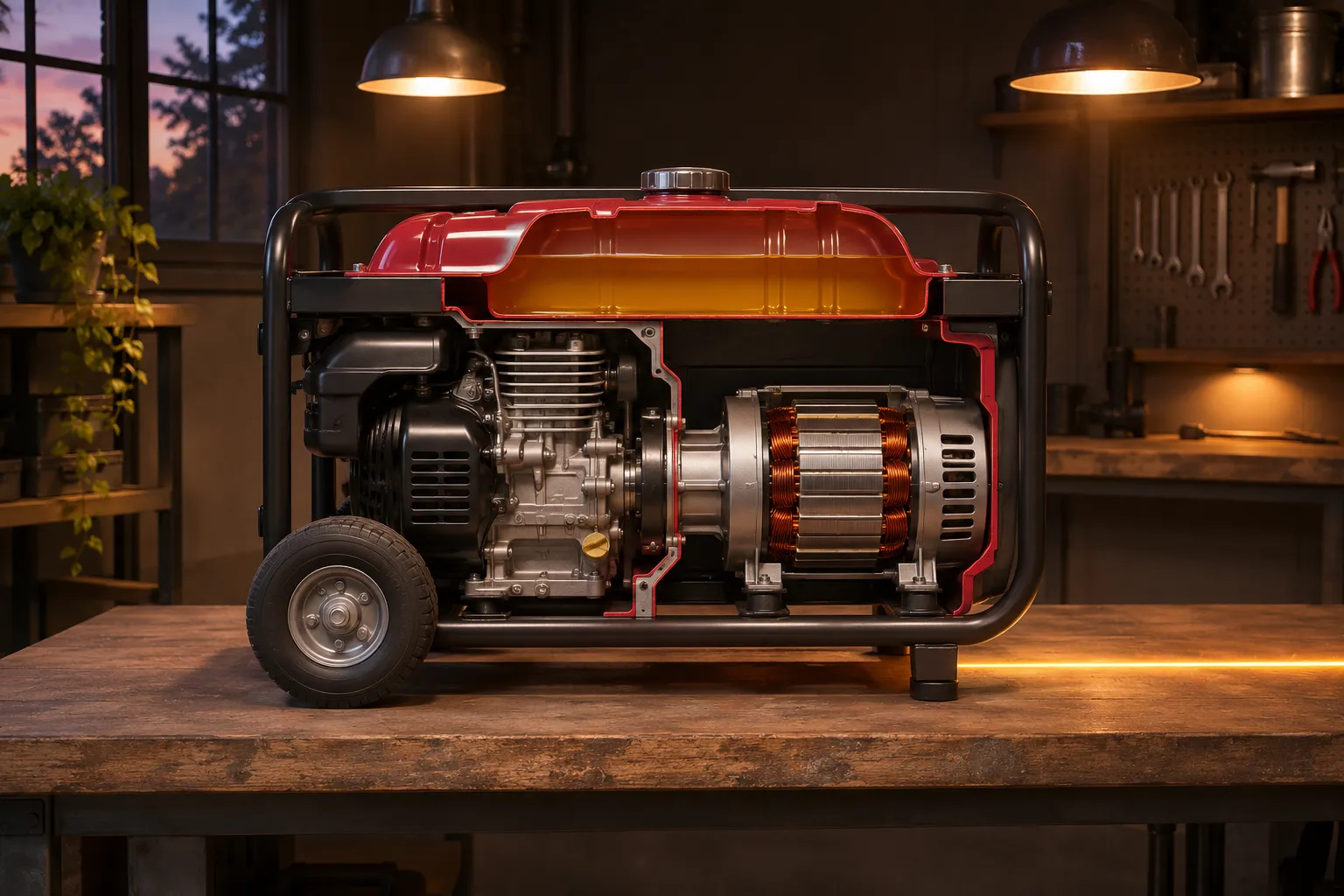
The way a generator works involves several steps: it converts the energy from fuel into electricity. First, the motor rotates a shaft. The alternator then converts this rotation into alternating current, which is supplied to the device's outlets.
Its role and main components
A generator is a self-contained source of electricity. Above all, it combines an internal combustion engine and an alternator to generate electricity off-grid or during a power outage. The term “generator” is more general: in a generator set, the alternator produces the electrical current, and the engine and its auxiliary equipment power it.
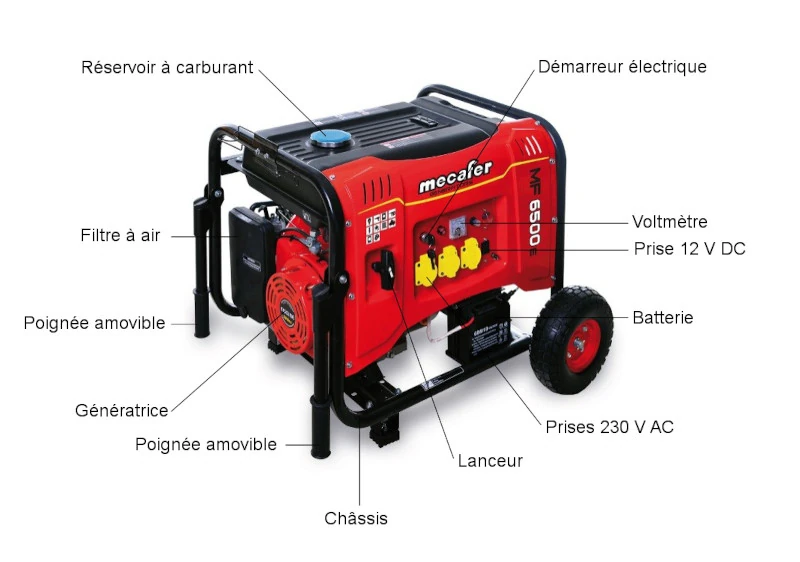
The various components of a generator vary from model to model. In practice, however, these main components are most commonly found:
- The tank and the engine: the former stores fuel, while the latter uses it to generate rotational motion.
- The alternator and the regulator: one generates the current, the other stabilizes it when the load varies.
- Start-up and output protection: These features enable the device to start up and protect the outlets against current surges.
From fuel to engine rotation
The type of fuel depends on the engine: a gasoline-powered generator, a diesel-powered generator, or a natural gas-powered model uses the fuel specified by its manufacturer. A diesel engine runs on diesel fuel, never on gasoline. Be sure to check this information in the owner's manual before your first fill-up.
In a carburetor-equipped gasoline engine, gasoline mixes with air before entering the cylinder. The cycle consists of four strokes: intake, compression, combustion triggered by the spark plug, and then exhaust. Combustion pushes the piston, and the crankshaft converts this back-and-forth motion into rotation, which drives the alternator shaft.
From the alternator's rotation to electricity
The alternator consists of two parts. The rotating rotor generates a magnetic field. The stator, which is stationary, contains coils.
When the rotor spins, its magnetic field passes by the stator coils. This motion generates an alternating current through electromagnetic induction (the generation of a current due to a changing magnetic field). It is this transformation that enables the device to generate electricity.
Depending on the model, other components of a generator set round out this assembly: the cooling system, the exhaust system, the muffler, and the control panel. This panel can house the outlets and an output circuit breaker that cuts off the power in the event of an overload.
What type of power does it supply to the appliances in the home?
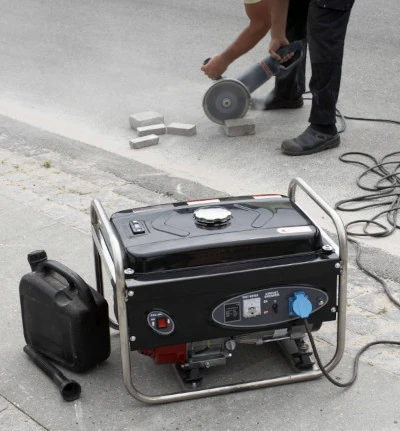
To safely power a device, it is not enough for a generator to produce electricity. This current must have the correct characteristics and remain stable when you plug in or unplug devices.
Output voltage and frequency
Common appliances in a French home operate on single-phase power at 230 V and 50 Hz. The 220 V value is an outdated standard that was replaced by 230 V in 1996. The output voltage of a generator must therefore match these values.
The frequency depends on the speed of the alternator. In a conventional two-pole alternator, a rotational speed of 3,000 revolutions per minute produces 50 Hz. Some more powerful stationary generators use a four-pole alternator that rotates at 1,500 revolutions per minute.
Before making any purchase, read the unit's nameplate: it lists the voltage, frequency, number of phases, and power rating. The difference lies in the stability of this output, on which the compatibility of your devices depends.
Control when the load varies
When the load changes, the motor speed control helps maintain the frequency. Meanwhile, an automatic voltage regulator (AVR) adjusts the voltage output by the alternator. However, the AVR does not adjust the frequency on its own.
In a conventional generator set, the alternator directly supplies the output current, and the engine runs at a fixed speed. At low loads, this constant speed can increase fuel consumption and noise.
The current in an inverter model
An inverter converts the alternating current from the alternator into direct current, and then the electronic system converts it back into alternating current. The frequency no longer depends directly on engine speed, which can slow down when demand is low, thereby consuming less fuel and producing less noise. Its stabilized output is better suited for sensitive electronics. A standard circuit, on the other hand, is suitable for power tools, lighting, and common household appliances.
How do you connect a generator to your home?
Plugging a lamp into the generator and powering the house's permanent electrical circuits are two different projects. The second step begins with a power calculation and involves installing dedicated connection hardware in the electrical panel.
Determining power and range
Choosing a backup generator starts with adding up the power of the appliances that will be used at the same time. Next, check separately for the inrush current when a refrigerator, pump, or compressor starts up. Focus on continuous power—which is available over the long term—rather than peak power, which lasts only a brief moment.
- kW and kVA: kW measures active power and kVA measures apparent power, and the power factor relates the two.
- Resistive loads: 3 kW of devices used simultaneously require at least 3 kW of available power at steady state.
- Current: In a single-phase 230 V system, 3 kVA corresponds to approximately 13 A.
Range depends on the size of the fuel tank and the engine's fuel consumption based on the load. To compare the advertised runtimes, one source recommends considering them at about 70% of the total power.
Disconnect the backup power supply from the mains
The outlets on a portable generator power appliances directly, but not the home's permanent electrical circuits. To provide backup power to these circuits in the event of a power outage, have an electrician inspect the entire system: dedicated input, line protection, mains/off/generator switch, and then the circuits to be backed up. The switch can be manual or automatic.
Conversely, a standard wall outlet or a cable with two male plugs should never be used as an emergency power source. It's dangerous to run electricity through there. The branch circuit breaker alone does not replace the isolator, which prevents current from flowing back into the grid and endangering people working on it.
Check the circuit breakers in the electrical panel
The cables, input, inverter, and circuit breakers must be rated to withstand overloads and short circuits. The fault current of a generator set differs from that of the grid. Depending on the layout of the residence, the electrician also checks the specified wire gauge and whether the system is compatible with single-phase or three-phase power.
Using the panel as a reference point, the electrician checks the neutral, ground, protective conductors, and ground-fault circuit interrupters. 30-mA residual-current devices, grounding, and overcurrent protection each play their own role. The NF C 15-100 series (French standard for low-voltage electrical installations), published in 2024, applies to new installations or those that have been completely renovated since september 1, 2025. It does not require all existing housing units to be rebuilt. TheDecree of august 3, 2016 always cites the amended 2002 edition and accepts an equivalent solution.
How can i use and maintain it safely?
A well-connected unit is still an internal combustion engine. The main risks are exhaust fumes, fuel, and wear and tear. During a power outage, they ask people to take specific actions.
Prevent poisoning and fire
The engine emits carbon monoxide, an invisible and odorless gas, even when running on gas. Always install the unit outdoors, at least 6 meters away from doors, windows, and vents, as recommended by a specialized source.
- Prohibited locations: never in a residence, garage, or basement, even if the door is open.
- Warning signs: Headaches, nausea, dizziness, or feeling unwell may indicate poisoning.
- What to do if in doubt: Evacuate, ventilate the area without putting yourself in danger, and call emergency services.
- Fuel-filled: engine shut down and cooled, no flame, no sparks, and no spilled fuel.
Ensure proper maintenance during use
The oil lubricates the moving parts of the engine. Check the fluid level before each start-up and change the fluid as specified in the manual. Routine maintenance also includes inspecting the engine, checking the alternator, and performing functional tests.
In addition, using a generator requires planning for noise, handling, storage, and refueling. Noise-related disturbances to neighbors can occur both day and night: there is no general right to make noise until 10 p.m.
Understanding the limits of emergency assistance
Starting and then switching over a generator set causes a power outage. For equipment that cannot tolerate any downtime, include a battery or an uninterruptible power supply in a separate contingency plan. In the kitchen, a closed refrigerator will stay cold for about 4 to 6 hours. A full freezer keeps food fresh for 48 hours, and for 24 hours if it is half full. These time frames are guidelines.
In France, certain patients at high risk of death—particularly those on a ventilator for more than 20 hours a day—may request to be registered with the ARS (Regional health agency, the region’s health administration). This registration provides access to alerts and support, but not to a permanent electricity supply.

Frequently asked questions
The domeashop store offers you a list of questions and answers corresponding to the most frequently asked questions related to the theme and products discussed in this article. If you can't find the answer you're looking for, contact us and our specialists will be happy to help.
You have to manage noise, handling, storage, and refueling, with a range limited by the fuel tank. An overload, a malfunction, a switching error, or inadequate protective measures can create a hazard or cause a power outage. A group also does not make an old or undersized panel safe.
It is used to provide emergency power to a home, supply power to a remote location, perform work when no outlet is available, or power a temporary setup. It can serve as a backup power source, a supplement to another power source, or the primary power source in a remote area.
Manual starting starts the engine by pulling a rope. An electric starter uses a battery and a starter motor, which are activated by a key or a button.
The portable unit is designed to be moved and may have handles or wheels. The fixed group remains permanently installed. Some fixed groups start automatically during a power outage, but this feature alone does not ensure a safe connection.
Adding an isolated group does not automatically require a certificate. This is required before power is restored when a complete renovation involves a power outage requested from the utility company. In a residence that is already connected to the power grid, adding an emergency power input and a transfer switch without injecting power or modifying the public utility connection is considered interior work and should be evaluated by an electrician.