
- Home
-
Electrical equipment
-
Sockets and switches
- Bticino
- Legrand
- Hager
- Schneider Electric
- Jung
-
Modelec
-
Collection Confidence
-
Confidence screw collection
- Narrow Confidence facades
- Narrow Confidence facades with screws
- Long, narrow Confidence facades
- Narrow, long Confidence facades with screws
- Narrow, long Confidence cabinet fronts with reading lights
- Narrow, long Confidence cabinet fronts with spotlights
- Simple mechanisms for Confidence facades
- Reinforced mechanisms for Confidence facades
- Reinforced mechanisms for narrow Confidence facades
- Reinforced mechanisms for narrow, long Confidence facades
-
Collection Desir
-
Collection Fascination
-
Collection Hitera
-
Iris Collection
-
Collection Karo
-
Collection M
- Narrow mechanisms
-
Collection Confidence
- Vandal-proof equipment
- Iboco fittings
-
Lighting
-
Interior lighting
-
Wall lights
-
LED strip
-
Downlights
-
Recessed spotlights
-
Surface-mounted spotlights
- Lamps
- Rod-mounted spotlights
- LED panels
-
Suspensions
-
Ceiling lights
-
Track and spotlights track lighting
- Tensioned cable
- Waterproof lighting
- Connected lamps
- Portholes
- Bathroom rulers
- Table lamps
- Panel lighting
- Headboard reading lights
- Light mirror
-
Wall lights
- Outdoor luminaires
- LED bulbs and spotlights
- Special lamps
- Lighting accessories
-
Interior lighting
-
Home security
-
Heating and sanitary
- Heating
-
Individual ventilation
-
Self-adjusting CMV
-
Humidity-sensitive CMV
- Insufflation ventilation
- Double-flow ventilation
- Wall-mounted aerator
- Duct puller
- Ventilation accessories
- Extractors and blowers
- Ventilation grilles
- Flow control
- Roof outlet
- Ventilation box
-
Ventilation duct
- Ventilation sleeve and reducer
- Sound trap
- Ventilation filters
-
Self-adjusting CMV
- Central vacuum
-
Connected home
- Ideas & Advice
-
MenuBack
-
Products
-
-
-
Electrical panel
- Bridging bars, combs
-
Electrical protection
- Differential block
- Earth leakage circuit breakers
-
Earth leakage switches
- 40A ground-fault circuit interrupter
- 63A ground-fault circuit interrupter
- ABB ground fault circuit interrupter
- AC-type ground fault circuit interrupter
- Eaton ground-fault circuit interrupter
- Hager ground-fault circuit interrupter
- Legrand ground fault circuit interrupter
- Schneider residual current circuit breaker
- Siemens ground-fault circuit interrupter
- Type A ground-fault circuit interrupter
- Fuses and fuseholders
- Grounding
- Lightning arresters and surge protectors
- Main circuit breaker
-
Modular circuit breakers
- 10A circuit breakers
- 16A circuit breakers
- 20A circuit breakers
- 32A circuit breakers
- ABB circuit breakers
- Circuit breakers Schneider Electric
- D-curve circuit breakers
- Eaton circuit breakers
- Four-pole circuit breakers
- Hager circuit breakers
- Legrand circuit breakers
- Siemens circuit breakers
- Three-phase circuit breakers
- Molded case circuit breaker
- Energy management
- Modular accessories
- Modular equipment
-
-
-
-
-
Interior lighting
- Bathroom rulers
- Ceiling lights
- Connected lamps
- Downlights
- Headboard reading lights
-
Interior lighting
- Bathroom rulers
- Ceiling lights
- Connected lamps
- Downlights
- Headboard reading lights
- Lamps
- LED panels
- LED strip
- Light mirror
- Panel lighting
- Portholes
-
Recessed spotlights
- Aric
- Arkoslight
- Europole
- Faro Barcelona
- Indigo Lighting - Collingwood
- Ledvance
- Paulmann
- Philips
- SG Lighting
- SLV
- Switch Lite
- Rod-mounted spotlights
- Surface-mounted spotlights
- Suspensions
- Table lamps
- Tensioned cable
- Track and spotlights track lighting
- Wall lights
- Waterproof lighting
-
-
-
Outdoor lighting
- Exterior wall lights
- Bollards and lampposts
- Outdoor recessed
- Mobile luminaires
- Projectors
- Outdoor suspensions
- Outdoor ceiling lights
- Spotlights sign
- Solar luminaires
-
Lights and garlands
- Comet garlands
- Stalactite garlands
- Connectable festoons
- Spotlights and patterns
- Classic garlands
- Curtain lights
- Motifs
- Illuminated fir trees
- Luminous balls and animals
- Guinguette garland
- Garlands Bulbs B22
- Garlands Bulbs E27
- Garlands E14 bulbs
- LED connection cable
- Professional decorations
- Garland accessories
- Outdoor illuminated furniture
- Submersible luminaires
-
-
-
-
-
How to install a smoke detector: Installation guide

To install a smoke detector properly, you need to choose the right location, secure the device firmly, and test it. These guidelines are based on the decree of february 5, 2013, which establishes the rules for installation.
Contents
- Where should the smoke detector be installed in the home?
- Prioritize access to the rooms
- Avoid disruptive elements and influences
- Distribute the devices by room and floor
- How far from the ceiling should the detector be placed?
- Choose a high, open area
- Take into account obstacles at the ceiling
- Adjust the installation to accommodate a slope or a wall
- How do i install the motion detector step by step?
- Prepare the surface and the fasteners
- Mark, drill, and screw in the base plate
- Activate the template and check that it is secured
- How do you test the detector after installation?
- Perform the initial functional test
- Maintain the device to ensure it continues to function properly
- Know who installs and maintains the detector
Where should the smoke detector be installed in the home?
The first consideration is location, even before choosing the anchors or the model. The smoke must reach the device quickly, and its alarm must wake the occupants. In practice, the layout depends on three factors: the location of the rooms, the steam sources, and the number of floors.
Prioritize access to the rooms
As of march 8, 2015, every home in France must have at least one standalone smoke alarm (DAAF, a device that operates independently and emits an audible alarm). Therefore, installing a smoke detector is mandatory in every house or apartment. When it comes to fire safety in your home, this legal minimum is a starting point.
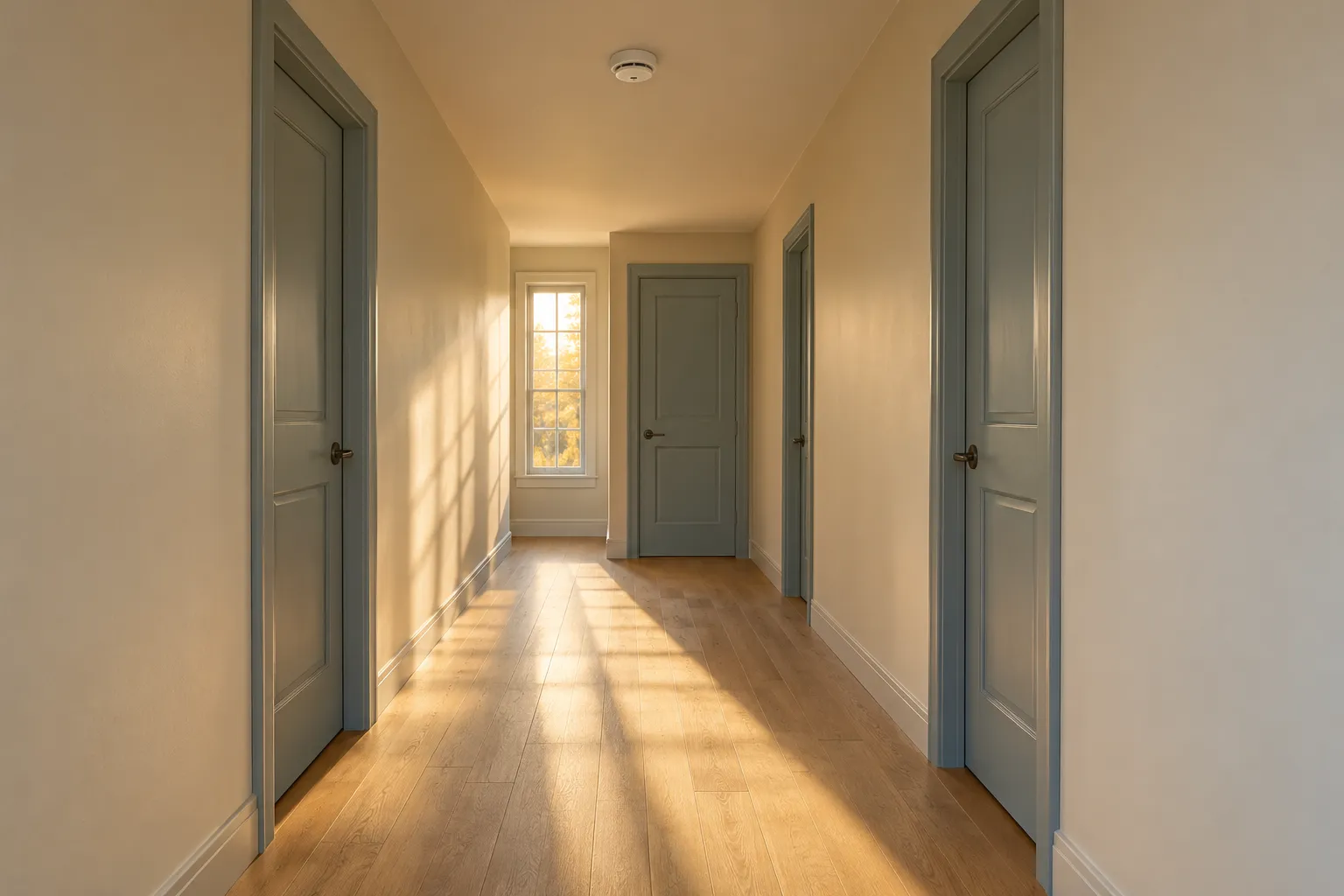
The regulations specify that the smoke detector must be installed in private areas, preferably in the hallway leading to the bedrooms: a corridor or a landing. Installation in the common areas of a building is prohibited. In a studio apartment without a hallway, place the appliance as far away as possible from the kitchen and bathroom. DomeaShop offers these devices in itsrange of fire alarms for the home.
Avoid disruptive elements and influences
A closed-off kitchen and a bathroom should generally be avoided: cooking fumes and steam from these damp rooms can trigger false alarms. Conversely, in an open-concept kitchen, you can install the smoke detector in the living room or in the hallway leading to the bedrooms. One guide recommends 3 meters from the cooking area; another recommends 6 meters from the appliances. These distances are not a legal requirement.
- Drafts: Windows, fans, and vents can divert smoke away from the detector.
- Heat Sources: Avoid placing the appliance on top of a radiator or stove.
- Dirty areas: Dust and greasy deposits interfere with detection.
Distribute the devices by room and floor
In a multi-story home, it is recommended to install one smoke detector per floor, including in converted attics. A large area may also warrant the installation of multiple detectors. If the sleeping areas are separate, equip each hallway leading to the bedrooms. One guide recommends a maximum distance of 7.5 m between two devices, while another advises staying within 3 m of the bedroom doors.
Closed doors at night slow the spread of smoke and muffle the sound of the alarm. A detector in each room further enhances protection. Depending on the equipment, interconnected models may also ring all at the same time.
How far from the ceiling should the detector be placed?
Once you've chosen the part, you still need to find the exact mounting point. The difference comes down to a few dozen centimeters: if the device is placed too close to a wall or a light fixture, the location may interfere with detection.
Choose a high, open area
The detector must be securely mounted high up, near the highest point in the room. The ceiling is the best place to target, because smoke rises and accumulates just below it.
- Horizontal ceiling: The center of the room or hallway is suitable when it is unobstructed.
- Distance from walls: Several guides recommend keeping a distance of at least 30 cm from walls and corners.
- Clearance as specified in the manual: Some models require 50 cm of clearance around the appliance.
- Which rule takes precedence: The model's instructions take precedence over these tips, which are not universal.
These benchmarks are part of the public framework of thefire protection for homes, which requires a secure attachment at the top.
Take into account obstacles at the ceiling
A light fixture or an object attached to the ceiling can block the flow of smoke. A guide therefore recommends keeping a distance of at least 30 cm from these obstacles.
Similarly, a large beam can make the center of the ceiling unsuitable. Depending on the layout of your home, install the unit in the most open area, following the instructions.
Finally, the device must remain accessible. You should be able to press its test button, replace its battery, and clean its openings.
Adjust the installation to accommodate a slope or a wall
If you have a sloped ceiling, place the smoke detector near the top, but not right at the peak: an air pocket there could delay the arrival of smoke. Can a smoke detector be installed on a wall? yes, if the instructions allow it and if the ceiling is not suitable. A local fire and rescue department recommends placing the unit about 30 cm below the ceiling; it should also be kept away from corners and about 1 m from doors.
How do i install the motion detector step by step?
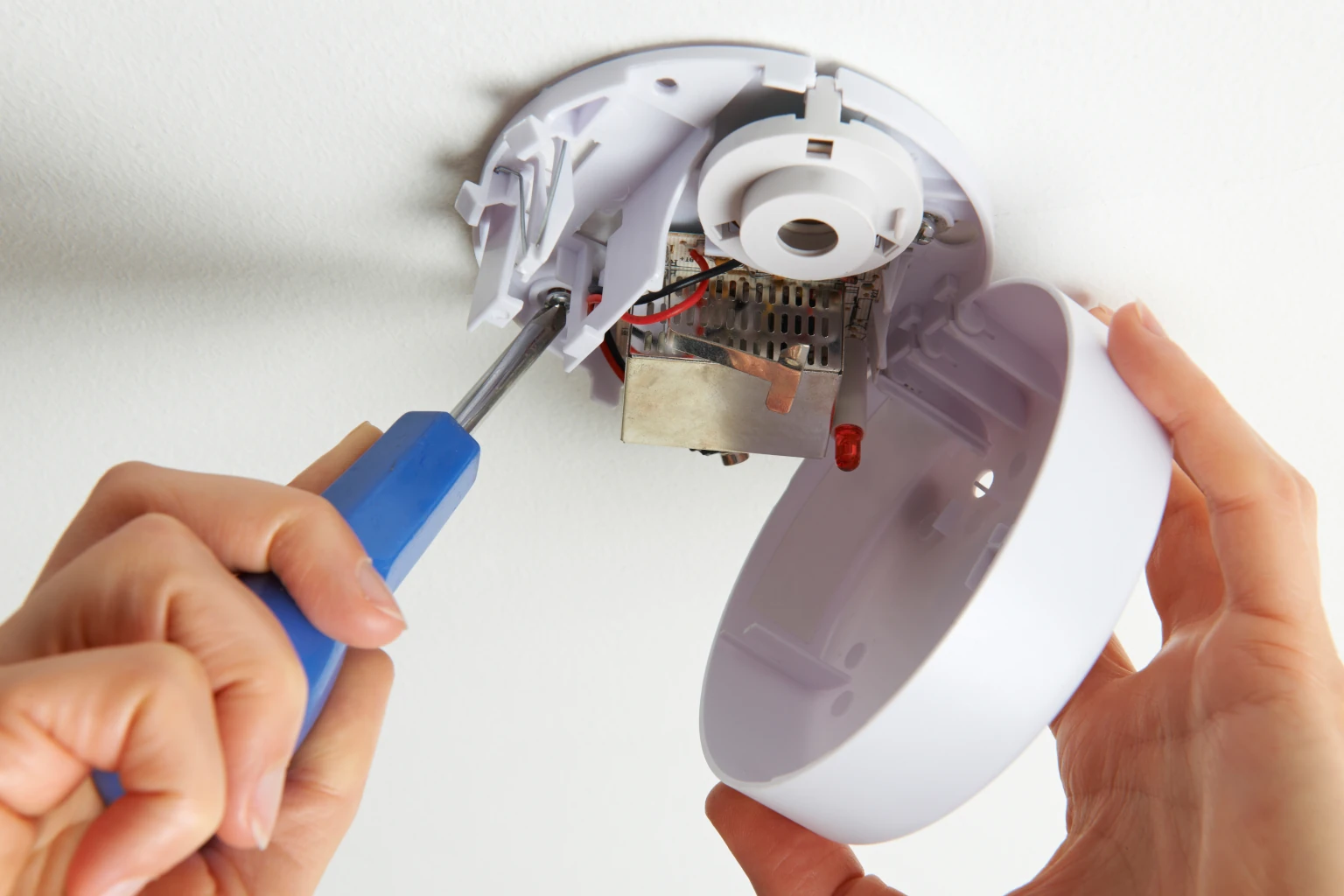
A smoke alarm is mechanically installed using its mounting base (the mounting plate), screws, and anchors. Be sure to have a drill, a suitable drill bit, a pencil, a screwdriver, and a sturdy stepladder on hand.
Prepare the surface and the fasteners
Before drilling, determine what the ceiling is made of: concrete, wood, drywall, or a suspended ceiling. He is the one who determines which fastener to use and the stability of the mounting surface.
- Gypsum board: Technical guidelines specify spring-loaded anchors rated up to 3 kg and metal expansion anchors rated up to 15 kg. Beyond that, the load must be redistributed within the structure. These limits apply to any load on the ceiling, not just smoke detectors.
- Concrete and wood: a concrete anchor in the first case, wood screws in the second.
- Suspended ceiling: If the panel is unstable, secure the fixture to the framing or load-bearing support.
Mark, drill, and screw in the base plate
Before installation, read the instructions and check for the CE marking along with the reference NF EN 14604, the European standard for smoke detectors. The NF mark is a supplementary certification, not a requirement.
A compliant device can then be installed in three simple steps.
- Separate and set up: Detach the sensor from its base, then place the base in the desired location.
- Mark: Use a pencil to mark the drilling points.
- Drill and screw: Drill a hole using the appropriate drill bit for the surface, insert the anchors, then screw the base in tightly.
Once the base is securely tightened, attach the sensor to it.
Activate the template and check that it is secured
Insert the battery if it is replaceable, or turn on the power as described in the manual: the sequence of steps varies by model. Adhesive or magnetic mounting—without drilling—is possible only if it is specified or approved for this detector. Regular adhesive tape isn't enough.
For example, DomeaShop offers thebattery-powered smart smoke detector Schneider Electric Wiser CCT599002, powered by 3 V. It measures 89 × 89 × 33.5 mm and is surface-mounted. It is not self-adhesive, so you must screw it in to secure the sensor.
How do you test the detector after installation?
Just because a detector is installed doesn't mean it's working. An initial test, followed by a routine inspection, confirms that the device will sound the alarm in the event of a fire.
Perform the initial functional test
Once the device is secured and turned on, check its indicator lights, then press the TEST button. According to the instructions, the press must last at least 1 second or at least 5 seconds.
- Correct method: Use only the designated button for the test; never use a flame or burnt paper.
- No sound: Check to make sure the device is properly connected to its dock.
- Power supply: Check it and replace any replaceable battery that is indicated as low.
- New attempt: Repeat the test after each correction.
If the failure persists, the detector should not be considered operational.
Maintain the device to ensure it continues to function properly
Several guides recommend testing the device once a month, along with dusting the openings as directed in the instructions. Dust and insects can interfere with detection or cause false alarms. Replace a replaceable battery as soon as it starts to run low.
Thus, thewireless smoke and heat detector The Ajax FIREPROTECT/W, available from DomeaShop, comes with 2 CR2 batteries and 1 CR2032 battery. Its advertised lifespan is 4 years. A sealed battery rated for 10 years cannot be replaced; instead, the device is replaced at the end of its life.
Know who installs and maintains the detector
Under the general social security system, article R.Section 142-3 of the building and housing Code, in effect since june 13, 2025, assigns responsibility for installation to the landlord rather than the tenant. There is no requirement to hire a professional to install a standalone smoke detector.
The occupant is generally responsible for maintenance and replacement. The owner remains responsible for furnished or seasonal rentals and checks that everything is in working order during the pre-move-in inspection.
Once the installation is complete, the occupant must report the equipment to their insurer. He provides a certificate along with proof of purchase or installation. Some group homes and inclusive housing facilities are exceptions.

Frequently asked questions
The domeashop store offers you a list of questions and answers corresponding to the most frequently asked questions related to the theme and products discussed in this article. If you can't find the answer you're looking for, contact us and our specialists will be happy to help.
Some guides advise against using it with a standard smoke alarm, due to exhaust fumes and false alarms. A heat detector could be considered for this location, since it does not monitor the same hazard as a smoke or carbon monoxide detector.
Do not hide the unit behind a curtain or piece of furniture, and do not paint or cover it. Also, avoid using liquids or sprays to clean it. A guide advises against temperatures below 4 °C or above 40 °C, as well as proximity to fluorescent lights.
Yes. Models designed for people who are deaf or hard of hearing alert the user with a light signal or vibration.
No, the absence of a detector is not sufficient grounds for a denial. The insurer may, however, reduce the compensation if it proves that this absence aggravated the consequences of the loss.