
- Home
-
Electrical equipment
-
Sockets and switches
- Bticino
- Legrand
- Hager
- Schneider Electric
- Jung
-
Modelec
-
Collection Confidence
-
Confidence screw collection
- Narrow Confidence facades
- Narrow Confidence facades with screws
- Long, narrow Confidence facades
- Narrow, long Confidence facades with screws
- Narrow, long Confidence cabinet fronts with reading lights
- Narrow, long Confidence cabinet fronts with spotlights
- Simple mechanisms for Confidence facades
- Reinforced mechanisms for Confidence facades
- Reinforced mechanisms for narrow Confidence facades
- Reinforced mechanisms for narrow, long Confidence facades
-
Collection Desir
-
Collection Fascination
-
Collection Hitera
-
Iris Collection
-
Collection Karo
-
Collection M
- Narrow mechanisms
-
Collection Confidence
- Vandal-proof equipment
- Iboco fittings
-
Lighting
-
Interior lighting
-
Wall lights
-
LED strip
-
Downlights
-
Recessed spotlights
-
Surface-mounted spotlights
- Lamps
- Rod-mounted spotlights
- LED panels
-
Suspensions
-
Ceiling lights
-
Track and spotlights track lighting
- Tensioned cable
- Waterproof lighting
- Connected lamps
- Portholes
- Bathroom rulers
- Table lamps
- Panel lighting
- Headboard reading lights
- Light mirror
-
Wall lights
- Outdoor luminaires
- LED bulbs and spotlights
- Special lamps
- Lighting accessories
-
Interior lighting
-
Home security
-
Heating and sanitary
- Heating
-
Individual ventilation
-
Self-adjusting CMV
-
Humidity-sensitive CMV
- Insufflation ventilation
- Double-flow ventilation
- Wall-mounted aerator
- Duct puller
- Ventilation accessories
- Extractors and blowers
- Ventilation grilles
- Flow control
- Roof outlet
- Ventilation box
-
Ventilation duct
- Ventilation sleeve and reducer
- Sound trap
- Ventilation filters
-
Self-adjusting CMV
- Central vacuum
-
Connected home
- Ideas & Advice
-
MenuBack
-
Products
-
-
-
Electrical panel
- Bridging bars, combs
-
Electrical protection
- Differential block
- Earth leakage circuit breakers
-
Earth leakage switches
- 40A ground-fault circuit interrupter
- 63A ground-fault circuit interrupter
- ABB ground fault circuit interrupter
- AC-type ground fault circuit interrupter
- Eaton ground-fault circuit interrupter
- Hager ground-fault circuit interrupter
- Legrand ground fault circuit interrupter
- Schneider residual current circuit breaker
- Siemens ground-fault circuit interrupter
- Type A ground-fault circuit interrupter
- Fuses and fuseholders
- Grounding
- Lightning arresters and surge protectors
- Main circuit breaker
-
Modular circuit breakers
- 10A circuit breakers
- 16A circuit breakers
- 20A circuit breakers
- 32A circuit breakers
- ABB circuit breakers
- Circuit breakers Schneider Electric
- D-curve circuit breakers
- Eaton circuit breakers
- Four-pole circuit breakers
- Hager circuit breakers
- Legrand circuit breakers
- Siemens circuit breakers
- Three-phase circuit breakers
- Molded case circuit breaker
- Energy management
- Modular accessories
- Modular equipment
-
-
-
-
-
Interior lighting
- Bathroom rulers
- Ceiling lights
- Connected lamps
- Downlights
- Headboard reading lights
-
Interior lighting
- Bathroom rulers
- Ceiling lights
- Connected lamps
- Downlights
- Headboard reading lights
- Lamps
- LED panels
- LED strip
- Light mirror
- Panel lighting
- Portholes
-
Recessed spotlights
- Aric
- Arkoslight
- Europole
- Faro Barcelona
- Indigo Lighting - Collingwood
- Ledvance
- Paulmann
- Philips
- SG Lighting
- SLV
- Switch Lite
- Rod-mounted spotlights
- Surface-mounted spotlights
- Suspensions
- Table lamps
- Tensioned cable
- Track and spotlights track lighting
- Wall lights
- Waterproof lighting
-
-
-
Outdoor lighting
- Exterior wall lights
- Bollards and lampposts
- Outdoor recessed
- Mobile luminaires
- Projectors
- Outdoor suspensions
- Outdoor ceiling lights
- Spotlights sign
- Solar luminaires
-
Lights and garlands
- Comet garlands
- Stalactite garlands
- Connectable festoons
- Spotlights and patterns
- Classic garlands
- Curtain lights
- Motifs
- Illuminated fir trees
- Luminous balls and animals
- Guinguette garland
- Garlands Bulbs B22
- Garlands Bulbs E27
- Garlands E14 bulbs
- LED connection cable
- Professional decorations
- Garland accessories
- Outdoor illuminated furniture
- Submersible luminaires
-
-
-
-
-
How do you choose a security camera for your home?

Choosing a security camera for your home depends on several factors: location, power source, image quality, detection capabilities, storage, and what the law allows you to film. This decision is therefore made on a room-by-room and access-by-access basis.
Contents
- What type of camera should you choose for each location?
- Indoors, outdoors, and areas to monitor
- Body style, engine, and system type
- Durability and installation of an outdoor camera
- How do you power and connect your camera?
- Outlet, battery, or solar panel
- PoE, Wi-Fi, or mobile network
- Smartphone access and digital security
- What image quality should you aim for, both day and night?
- Resolution and usable sharpness
- Angle of view, distance, and backlighting
- Night Vision and moving subjects
- How do you choose storage, alerts, and a budget?
- Memory card or local recorder
- Cloud, detection, and enforcement
- Total cost and complete kits
- What can we film, and how long can we keep the footage?
- Private spaces and the limits of framing
- People in the video, sound, and private mode
- Shelf life depending on the situation
What type of camera should you choose for each location?
The type of camera depends first on the area to be covered, and then on how the camera records images. An interior entrance and a gate at the edge of the property have different requirements. Next, you need to choose the housing design, the lens orientation, and the video surveillance system into which the camera will be integrated.
Indoors, outdoors, and areas to monitor
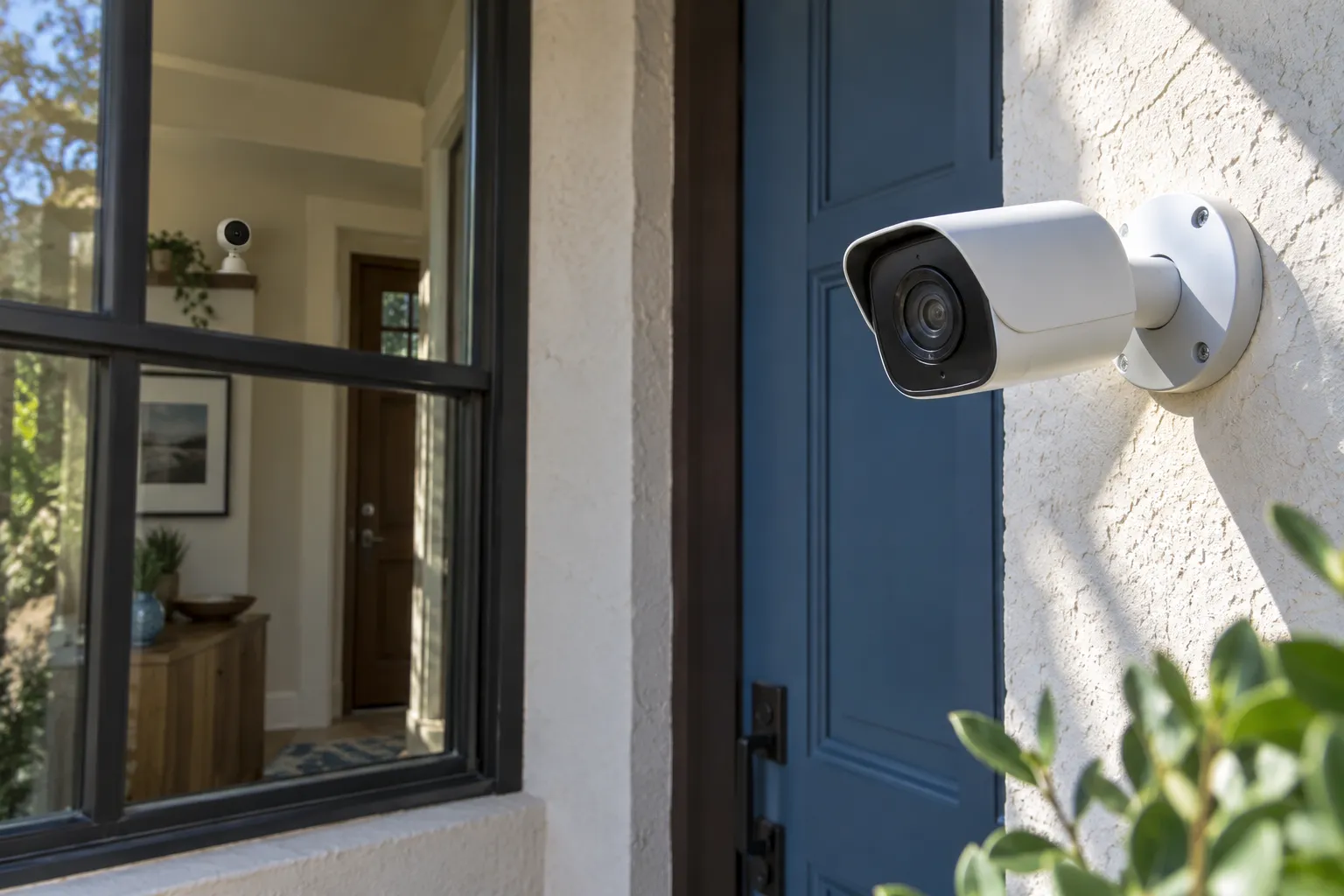
Indoor cameras are used to monitor an entryway, a living room, children, or a pet. An outdoor camera is typically used to monitor an entrance, a driveway, a garage, or a yard. Before deciding on a location, identify the following elements on site:
- The entry point: the door, window, or gate through which a person can enter.
- Distance to the subject: This determines the choice of lens and zoom.
- Obstacles and lighting: A hedge, a pillar, or a streetlight can interfere with the frame.
- Areas to exclude: the parts that should not appear in the image.
Depending on the layout of the home, several fixed cameras may be more suitable than a single adjustable camera. Each one then continuously covers a facade or an area, without depending on the direction in which a single camera is pointing at any given moment.
Body style, engine, and system type
The design emphasizes discretion. A dome camera blends into a ceiling or eave. On the other hand, a bullet camera—which is cylindrical and adjustable—stands out more. A motorized camera can pan to expand the field of view. Depending on the model, it tracks movement or allows you to reposition the lens remotely.
The difference also lies in the transmission. An IP camera transmits its images over the network and can be integrated with an NVR (a network video recorder that centralizes multiple cameras). Analog CCTV cameras are wired cameras connected via coaxial cable to a DVR (digital video recorder), and they generally have lower resolution. DomeaShop offersIP dome, bullet, and motorized cameras from brands such as Hikvision, Bosch, Uniview, and Gigamedia.
Durability and installation of an outdoor camera
An outdoor security camera must be resistant to rain and dust. The IP rating specifies this with two digits: the first indicates protection against solid objects and dust, and the second indicates protection against water. The IP65, IP66, and IP67 ratings are common on models designed for outdoor use.
Once you've chosen a model, place it about 2.5 m above the ground, above the entrance you want to monitor. An outdoor security camera also requires a stable mount, protected connections, and a lens that isn't obstructed by vegetation.
In addition, the IP rating alone is not enough: you must also check the operating temperature, the risk of condensation, and the recommended maintenance schedule. Two standards provide guidelines. NF EN 62676-1-1, published in may 2014, establishes the general requirements for video surveillance systems. NF EN IEC 62676-4, published in november 2025, covers selection, installation, and maintenance.
How do you power and connect your camera?
The power supply and connection determine the maintenance required and the camera's day-to-day reliability. A cable that needs to be pulled, a battery that needs to be recharged, or a weak Wi-Fi signal are all different challenges. The distance to the box and to an electrical outlet is often what determines this choice.
Outlet, battery, or solar panel
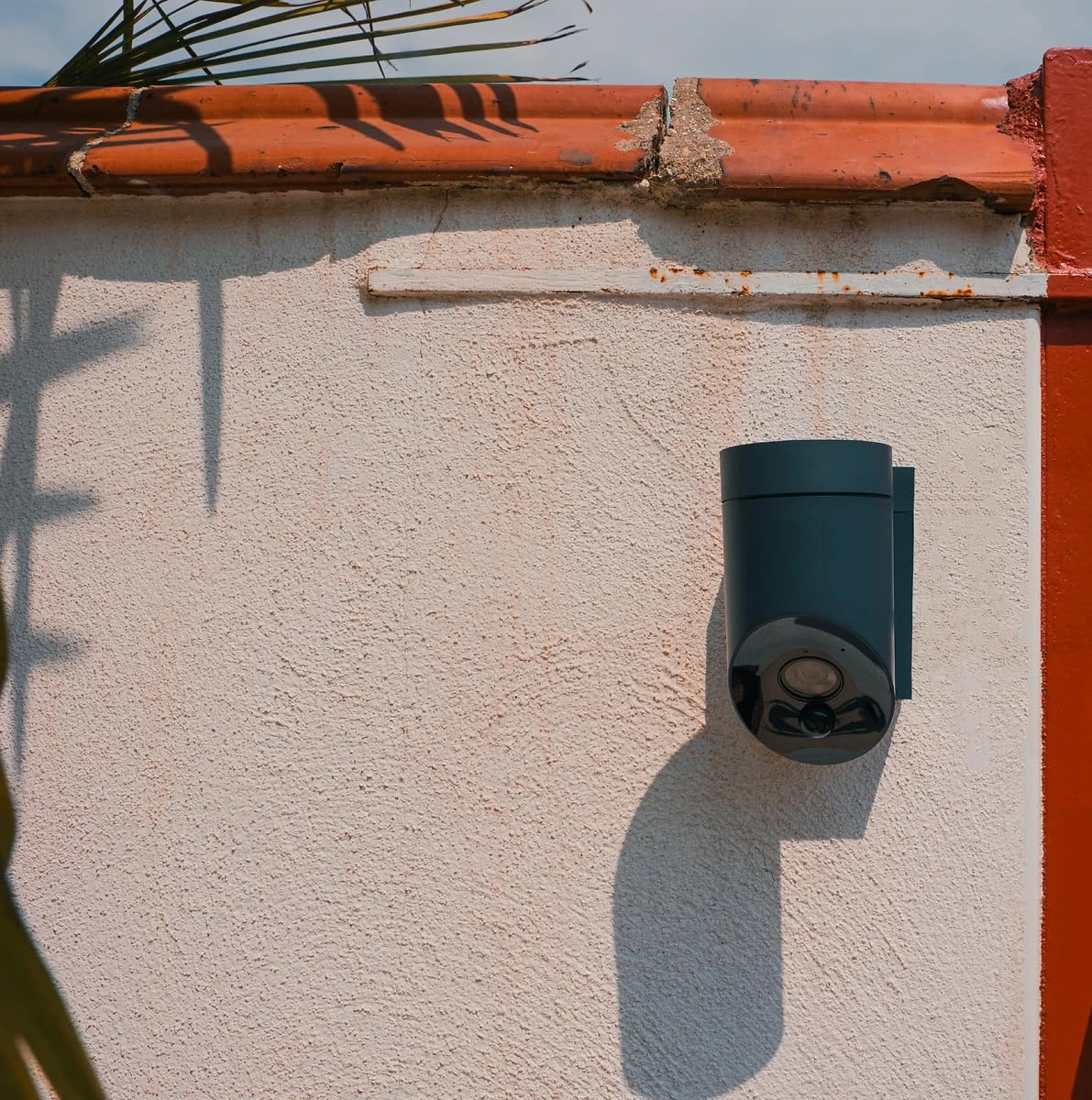
A Wi-Fi security camera doesn't need an ethernet cable, but it may still need a power outlet. A wireless camera is not necessarily battery-powered: check the technical specifications to see how it is powered.
A battery-powered model doesn't require a permanent power cord, but it does need to be recharged. In practice, frequent triggers and high resolution drain the battery faster. This type of camera is therefore not well-suited for continuous recording.
Some battery-powered models can be connected to a solar panel. You should then make sure that the location gets plenty of sunlight and that the camera remains accessible. Therange of smart home cameras includes battery-powered Wi-Fi cameras and kits with solar panels.
PoE, Wi-Fi, or mobile network
PoE (Power over Ethernet) transmits both data and power through a single Ethernet cable. It requires compatible equipment and cable routing, but it eliminates the need for a wireless connection and a battery. On the other hand, Wi-Fi makes installation easier, even though walls, distance, and interference can degrade the video stream.
Arcep (the French telecommunications regulator) states that the 2.4 GHz band is more susceptible to interference than the 5 GHz band. Test the signal reception at the intended location before mounting the camera. For a home without a fixed Internet connection, a 4G or 5G camera may be suitable, provided you have cell service and a SIM card.
Smartphone access and digital security
A connected camera streams live video, alerts, and recordings to an app, allowing you to use a surveillance camera remotely on your smartphone. If there is an Internet outage, some models continue to record locally, while others stop capturing new events. The ANSSI (National cybersecurity Agency) recommends installing updates, using strong passwords, and, if possible, enabling two-factor authentication. Cybercrime.gov.fr also recommends securing your Wi-Fi network and isolating connected devices. TheEuropean regulation on cyber resilience (EU) 2024/2847 requires that certain vulnerabilities be reported as of september 11, 2026. It is scheduled to take effect on december 11, 2027.
What image quality should you aim for, both day and night?
Image quality does not depend solely on the number of pixels. Distance, light, and movement are just as important. You don't choose a camera designed to film a driveway at night the same way you would choose one designed to film a well-lit living room.
Resolution and usable sharpness
The resolution indicates the number of pixels in the image. DomeaShop offers IP cameras with resolutions up to 4K. Here are the most common definitions:
| Definition | Pixels |
| Full HD | 1 920 × 1 080 |
| QHD | 2 560 × 1 440 |
| 4K UHD | 3 840 × 2 160 |
A higher resolution alone does not guarantee a sharp image. There are other factors to consider:
- The lens and the sensor: they determine the actual level of detail.
- Image processing: It affects image noise and sharpness.
- Lighting: A dark scene reduces sharpness.
- Distance and motion: A subject that is far away or moving quickly appears less sharp.
A higher frame rate can better reproduce motion, but it increases the amount of data that needs to be transmitted and stored. So let's compare the resolution, frame rate, and compression together, rather than just focusing on the term "4K."
Angle of view, distance, and backlighting
A wide-angle lens covers more of the scene, but a distant subject appears smaller in the frame. A shorter focal length or a zoom lens is preferable when you need to monitor a long driveway or a distant gate.
Backlighting poses another problem: a face may remain dark even at high resolution. HDR, or high dynamic range, is used to preserve details in both dark and bright areas. Check this setting if the camera is facing a picture window or an entrance that gets direct sunlight.
Night Vision and moving subjects
Infrared cameras generally produce a black-and-white image in the dark. Color night vision generally requires more light or a spotlight. Behind a window, the infrared leds reflect off the glass and can render the nighttime image unusable.
The night vision range, as stated in meters, does not guarantee that a person can be identified at that distance. Depending on the level of protection you're looking for, compare the models using photos taken in low light and with moving subjects.
How do you choose storage, alerts, and a budget?
Storage determines where the videos are located and whether they remain available if the camera is stolen. The detection features determine when the camera records and alerts you. These two choices also have an impact on long-term costs.
Memory card or local recorder
A microSD card stores videos in the camera, up to the capacity supported by the model: some cameras do not support more than 128 gb. Also check what happens when the card is full, since some models overwrite old footage to record new footage. If the camera is stolen or destroyed, the card is lost along with it.
An NVR eliminates this risk by centralizing the video streams from multiple IP cameras. It is also suitable for continuous recording. DomeaShop recommends checking for ONVIF compatibility (an interoperability standard for cameras and recorders), the RTSP protocol, and H. codecs.264/H.265. Some systems also save files to a workstation, a NAS, or an FTP server.
Cloud, detection, and enforcement
The cloud stores the footage off-site and makes it easy to view remotely. However, it depends on the provider, the Internet connection, and sometimes a subscription. Some cameras combine cloud storage with local storage.
Motion detection can trigger a recording and send a notification. To avoid false alarms, adjust the detection zones, sensitivity, and time periods. Some models can also distinguish between people, animals, and vehicles, which means you won't get an alert every time a cat crosses the yard.
Detection, automatic tracking, recording, and notification are separate features: check each one individually on the product page. The app should also make it easy to find videos and change these settings on your phone.
Total cost and complete kits
The budget isn't limited to the cost of the cameras. In addition, there are costs for cabling, power, storage, network equipment, installation, and maintenance. DomeaShop offersCCTV kits with a recorder, such as a 5 MP kit with four dome cameras, an eight-channel PoE NVR, and a 2 tb hard drive. The Access 4 MP kit includes four turret cameras, the same type of NVR, and 1 tb of storage.
The four- and eight-camera Wi-Fi kits come with an eight-channel Wi-Fi NVR, but do not include a hard drive. Before purchasing, make sure that alerts, recordings, and video exports remain available without a paid subscription.
What can we film, and how long can we keep the footage?
Surveillance camera footage may contain personal information: the face of a neighbor, a passerby, or someone who works for you. The framing, audio, and retention period must therefore comply with the limits set by the CNIL (the French data protection authority).
Private spaces and the limits of framing
According to the CNIL, an individual may film certain areas but not others:
- Inside the residence: permitted.
- The garden and the private driveway: permitted.
- Public roads: prohibited, even partially.
- Neighbors' property: prohibited.
The field of view of an outdoor camera must therefore remain within the boundaries of your property. Check the camera's orientation and look for any obstacles before permanently mounting it, while the camera can still be moved easily.
People in the video, sound, and private mode
According to the CNIL, a private individual who employs someone in their home may install cameras to ensure the safety of property and people. However, he must inform the staff and not film them constantly. A microphone and speaker allow you to listen and speak near the camera, but sound quality and transmission latency vary by model.
For video surveillance systems governed by the internal security Code, article R.Section 253-1 provides for recording images without sound. In addition, a private mode can disable detection and recording. Depending on the model, it works using a physical cache, time slots, or the smartphone's geolocation.
Shelf life depending on the situation
The CNIL does not specify a single retention period for a camera used solely in a private setting. The rules for other devices do not automatically apply to this recording.
With regard to video surveillance covered by the relevant regulations, the CNIL considers that a few days are generally sufficient and that the retention period should not exceed one month. In the common areas of residential buildings, this one-month limit should generally not be exceeded.

Frequently asked questions
The domeashop store offers you a list of questions and answers corresponding to the most frequently asked questions related to the theme and products discussed in this article. If you can't find the answer you're looking for, contact us and our specialists will be happy to help.
DomeaShop recommends Full HD (1080p) or 4K for accurate person identification, depending on the distance and field of view. A resolution of 720p may be sufficient for general surveillance.
Storage capacity depends on three factors: how long you want to keep the videos, the video bitrate, and the recording mode. Continuous recording requires much more storage space than recording triggered by motion detection.
Check to see if the manufacturer provides security updates, whether data is encrypted, and what authentication options are available. ANSSI also recommends strong passwords and, if possible, two-factor authentication.
Clean the lens regularly to keep the image sharp. Maintenance also involves checking the fasteners, seals, cables, the proper functioning of the detection system, and the condition of the storage area.