
- Home
-
Electrical equipment
-
Sockets and switches
- Bticino
- Legrand
- Hager
- Schneider Electric
- Jung
-
Modelec
-
Collection Confidence
-
Confidence screw collection
- Narrow Confidence facades
- Narrow Confidence facades with screws
- Long, narrow Confidence facades
- Narrow, long Confidence facades with screws
- Narrow, long Confidence cabinet fronts with reading lights
- Narrow, long Confidence cabinet fronts with spotlights
- Simple mechanisms for Confidence facades
- Reinforced mechanisms for Confidence facades
- Reinforced mechanisms for narrow Confidence facades
- Reinforced mechanisms for narrow, long Confidence facades
-
Collection Desir
-
Collection Fascination
-
Collection Hitera
-
Iris Collection
-
Collection Karo
-
Collection M
- Narrow mechanisms
-
Collection Confidence
- Vandal-proof equipment
- Iboco fittings
-
Lighting
-
Interior lighting
-
Wall lights
-
LED strip
-
Downlights
-
Recessed spotlights
-
Surface-mounted spotlights
- Lamps
- Rod-mounted spotlights
- LED panels
-
Suspensions
-
Ceiling lights
-
Track and spotlights track lighting
- Tensioned cable
- Waterproof lighting
- Connected lamps
- Portholes
- Bathroom rulers
- Table lamps
- Panel lighting
- Headboard reading lights
- Light mirror
-
Wall lights
- Outdoor luminaires
- LED bulbs and spotlights
- Special lamps
- Lighting accessories
-
Interior lighting
-
Home security
-
Heating and sanitary
- Heating
-
Individual ventilation
-
Self-adjusting CMV
-
Humidity-sensitive CMV
- Insufflation ventilation
- Double-flow ventilation
- Wall-mounted aerator
- Duct puller
- Ventilation accessories
- Extractors and blowers
- Ventilation grilles
- Flow control
- Roof outlet
- Ventilation box
-
Ventilation duct
- Ventilation sleeve and reducer
- Sound trap
- Ventilation filters
-
Self-adjusting CMV
- Central vacuum
-
Connected home
- Ideas & Advice
-
MenuBack
-
Products
-
-
-
Electrical panel
- Bridging bars, combs
-
Electrical protection
- Differential block
- Earth leakage circuit breakers
-
Earth leakage switches
- 40A ground-fault circuit interrupter
- 63A ground-fault circuit interrupter
- ABB ground fault circuit interrupter
- AC-type ground fault circuit interrupter
- Eaton ground-fault circuit interrupter
- Hager ground-fault circuit interrupter
- Legrand ground fault circuit interrupter
- Schneider residual current circuit breaker
- Siemens ground-fault circuit interrupter
- Type A ground-fault circuit interrupter
- Fuses and fuseholders
- Grounding
- Lightning arresters and surge protectors
- Main circuit breaker
-
Modular circuit breakers
- 10A circuit breakers
- 16A circuit breakers
- 20A circuit breakers
- 32A circuit breakers
- ABB circuit breakers
- Circuit breakers Schneider Electric
- D-curve circuit breakers
- Eaton circuit breakers
- Four-pole circuit breakers
- Hager circuit breakers
- Legrand circuit breakers
- Siemens circuit breakers
- Three-phase circuit breakers
- Molded case circuit breaker
- Energy management
- Modular accessories
- Modular equipment
-
-
-
-
-
Interior lighting
- Bathroom rulers
- Ceiling lights
- Connected lamps
- Downlights
- Headboard reading lights
-
Interior lighting
- Bathroom rulers
- Ceiling lights
- Connected lamps
- Downlights
- Headboard reading lights
- Lamps
- LED panels
- LED strip
- Light mirror
- Panel lighting
- Portholes
-
Recessed spotlights
- Aric
- Arkoslight
- Europole
- Faro Barcelona
- Indigo Lighting - Collingwood
- Ledvance
- Paulmann
- Philips
- SG Lighting
- SLV
- Switch Lite
- Rod-mounted spotlights
- Surface-mounted spotlights
- Suspensions
- Table lamps
- Tensioned cable
- Track and spotlights track lighting
- Wall lights
- Waterproof lighting
-
-
-
Outdoor lighting
- Exterior wall lights
- Bollards and lampposts
- Outdoor recessed
- Mobile luminaires
- Projectors
- Outdoor suspensions
- Outdoor ceiling lights
- Spotlights sign
- Solar luminaires
-
Lights and garlands
- Comet garlands
- Stalactite garlands
- Connectable festoons
- Spotlights and patterns
- Classic garlands
- Curtain lights
- Motifs
- Illuminated fir trees
- Luminous balls and animals
- Guinguette garland
- Garlands Bulbs B22
- Garlands Bulbs E27
- Garlands E14 bulbs
- LED connection cable
- Professional decorations
- Garland accessories
- Outdoor illuminated furniture
- Submersible luminaires
-
-
-
-
-
How to choose a main circuit breaker That's right for your electrical system

To learn how to choose a main circuit breaker, start by considering your electrical connection: contracted power, single-phase or three-phase, and the circuit breaker's rating. Here, you'll learn how to identify this device among the other protective devices in the panel, how to match the circuit breaker rating to your power consumption, and how to have the circuit breaker rating safely adjusted, in accordance with Enedis's (the public distribution network operator) fees and timelines.
Contents
- Which device serves as the main circuit breaker for the home?
- Identifying the service circuit breaker
- Distinguishing between fault protection mechanisms
- Check that people are protected
- Which caliber should you choose based on the subscribed power?
- Estimate the actual power required
- Consider whether the power supply is single-phase or three-phase
- Compare settings and compatible models
- How can i safely change the gauge?
- Check the installation before submitting the request
- Request the change from the appropriate parties
- Estimate costs and timelines
Which device serves as the main circuit breaker for the home?
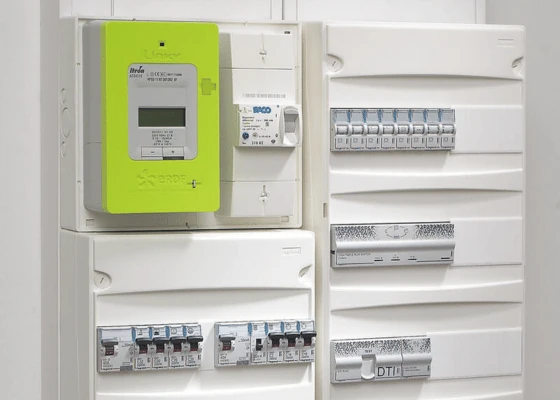
The meter, the service breaker, and the circuit breakers in the panel look alike. However, they do not play the same role. Circuit breakers are classified based on what they protect: the entire home or a single circuit, and whether they protect against overcurrent or ground faults.
Identifying the service circuit breaker
In a residential unit, the term “main circuit breaker” generally refers to the service breaker, also known as the main breaker. It is installed between the utility connection and your indoor electrical system. In practice, if it is positioned to serve this purpose, it is the one that cuts off power to the entire home with a single action.
- Main circuit breaker: Located at the beginning of the electrical system, it protects the entire home.
- Branch circuit breaker: It protects a single circuit in the distribution panel against overloads and short circuits.
- Smart meter: It measures energy consumption and can cut off the power supply if the contracted power limit is exceeded; it should not be confused with a circuit breaker.
- Electrical panel: Located downstream from the service connection, it distributes the circuits and houses their protective devices.
For the same role, the models differ significantly. DomeaShop offers branch circuit breakers that differ in their rating, number of poles, and whether or not they include built-in ground-fault protection. These three criteria form the basis of theSelecting a service circuit breaker.
Distinguishing between fault protection mechanisms
The branch circuit breaker primarily protects against overcurrent. It can also include a 500 mA residual current device (RCD), which detects a current leak by comparing the incoming current to the outgoing current. In the panel, a ground-fault circuit interrupter (GFCI) provides both overcurrent protection and ground-fault protection. Conversely, a residual current device (RCD) only provides the second function: it does not replace the circuit breaker.
The 500 mA differential rating of the connection does not eliminate the need for the 30 mA devices in the distribution panel, known as high-sensitivity devices. According to Promotelec (an association that promotes electrical safety in homes), the NF C 15-100 (French standard for low-voltage electrical installations) requires at least two per dwelling. Divide the circuits among them so that if one trips, it won't cut off power to the entire house.
Check that people are protected
In residential buildings, the TT system (in which the grid neutral and the building's ground potentials are connected to two separate grounding points) combines a grounding connection, a protective conductor, and a residual current device. These elements are not interchangeable. Promotelec uses a ground resistance of less than 100 Ω as a benchmark for a 500 mA residual current: have this value measured before assessing the safety of your electrical system.
Compliance also depends on the edition of the standard. The NF C 15-100 standard, revised in 2024, applies to new construction projects and renovations subject to this standard as of september 1, 2025. It reinforces the requirement to use type F outlets for certain devices with single-phase variable-speed drives: depending on the home’s layout, this requirement may apply to the circuit for a heat pump or an air conditioning unit.
Which caliber should you choose based on the subscribed power?
The rating is measured in amperes and corresponds to the contracted power—that is, the power specified in your contract with your provider. Choosing the right circuit breaker therefore depends first on an assessment of your electricity usage and then on the type of power supply to your home.
Estimate the actual power required
Make a list of appliances that might be running at the same time: heating, hot water, cooking, air conditioning, and charging an electric vehicle. Their simultaneous occurrence matters more than the sum of all installed capacities. An oven and a stovetop used together on a winter evening, with the heat on, take up more space than appliances that are rarely used.
This peak in consumption is then reflected in the size. For single-phase systems, Enedis provides standard correspondences between the contracted power and the circuit breaker's rated current.
| Rated power (Single-Phase) | Standard size according to Enedis |
| 3 kVA | 15A |
| 6 kVA | 30A |
| 9 kVA | 45A |
| 12 kVA | 60A |
The contracted power cannot exceed the connection capacity, which is a technical specification of the grid connection. The Enedis standard dated march 24, 2025, sets a maximum of 12 kVA for single-phase residential connections up to 36 kVA. In a three-phase system, the maximum capacity is 36 kVA, or 12 kVA per phase.
Consider whether the power supply is single-phase or three-phase
The type of power source affects the gauge reading. In a single-phase system, the nominal voltage is 230 V between phase and neutral, and all the power flows through a single phase. In a three-phase system, the voltage between phases reaches 400 V, and the loads are distributed across three conductors.
- Promotelec example: A 12 kVA three-phase service limits the current on each phase to 20 A.
- SéQuélec example: A three-phase power rating of 18 kVA corresponds to 30 A per phase.
- Typical use: Three-phase power meets the needs of equipment designed for this type of power supply.
- Constraint: It requires monitoring the load balance between phases.
These examples show that 12 kVA of three-phase power is not available on each of the three phases. A high-power appliance plugged into a circuit that is already under load can cause a circuit breaker to trip, even if the service capacity appears to be sufficient.
Unless equipment requires three-phase power, single-phase power generally simplifies installation. The difference comes down to the type of appliances you have and the power output required: check their nameplates before deciding on one or the other.
Compare settings and compatible models
The hardware gauge does not always indicate the actual setting. SéQuélec specifies a 9 kVA single-phase connection set to 45 A on a 15–45 A circuit breaker—that is, set to its maximum rating. So be sure to note the setting on your circuit breaker—not just the rating engraved on the front panel.
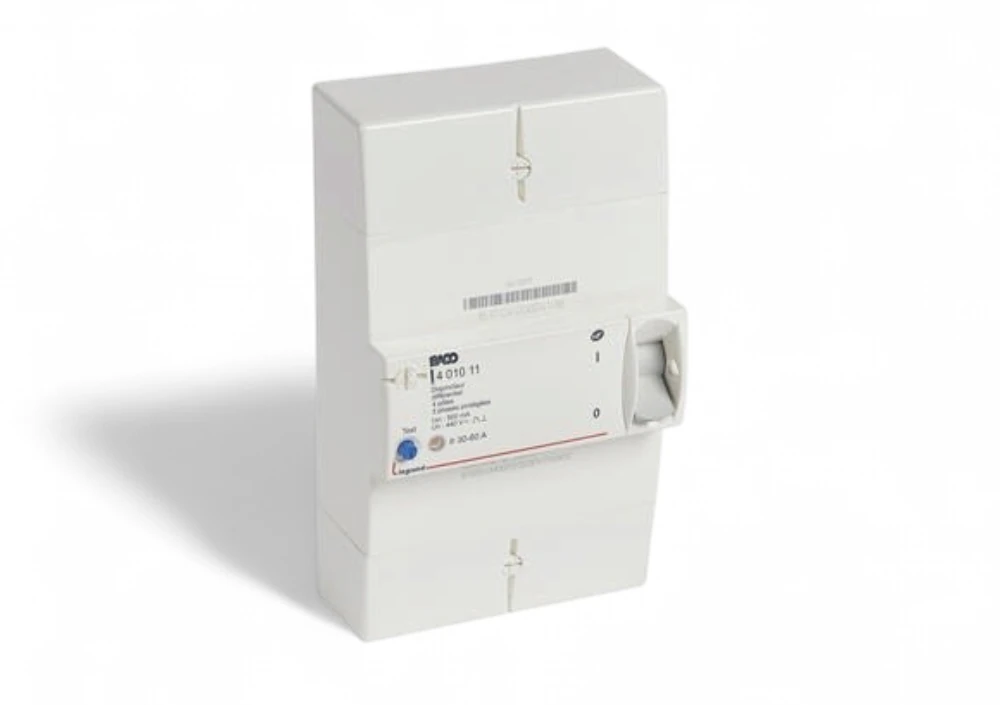
For a single-phase installation, DomeaShop offers the Legrand 401003, aselective residual-current double-pole circuit breaker 45 A and 500 mA, for flush mounting on 4 modules. For three-phase power, the Legrand 401015 is afour-pole non-ground-fault circuit interrupter 60 A, which disconnects the neutral and occupies 6.5 modules.
How can i safely change the gauge?
Changing the gauge isn't just a matter of turning a knob. An increase in power affects the entire downstream system, and any work on the connection is the responsibility of Enedis.
Check the installation before submitting the request
Start by taking a reading: type of connection, contracted power, visible rating and setting of the circuit breaker, and then the distance and characteristics of the connection to the panel. The cross-sectional area of this cable depends on its length and the allowable voltage drop. In Promotelec's single-phase copper panel, the maximum length is 22 m for 10 mm² at 45 A, and 27 m for 16 mm² at 60 A.
- Downstream installation: the cable, electrical panel, residual current devices, and grounding must be able to handle the increased load; otherwise, the conductors will remain inadequately protected.
- Photovoltaic generation: According to Promotelec, a 60-A AGCP (general control and protection device) and 3 kwp of generation—equivalent to approximately 15 A—can expose certain parts to 75 A.
- Outbuilding or workshop: When connecting from the main house, you must check the length, power rating, upstream protection, voltage drop, grounding, and any subpanel.
The Promotelec lengths are based on the assumptions in its table and are not a substitute for a calculation tailored to the specific project. Depending on the level of protection you need, have an electrician perform this calculation, especially if the service breaker is located far from the panel.
Request the change from the appropriate parties
Once you have completed the checks, submit the request to change your power rating to your electricity provider. The customer contacts Enedis if work needs to be done on the service connection. The homeowner does not adjust or replace the service breaker himself.
With a smart meter, exceeding the power limit can cause a power outage and trigger the "POWER limit EXCEEDED" message. In addition, a simple change in power rating does not always require physically replacing the circuit breaker: adjusting the setting may be sufficient.
Estimate costs and timelines
The Enedis service catalog effective as of august 1, 2025, sets €43.57, including tax, for a change of up to 36 kVA through a simple adjustment. The total comes to €64.87 (including tax) when the circuit breaker needs to be replaced. In both cases, the standard processing time is 10 business days.
These amounts cover the cost of work performed on the service connection. They do not include work to modify the interior electrical system performed by an electrician, such as rewiring or modifying the distribution panel.

Frequently asked questions
The domeashop store offers you a list of questions and answers corresponding to the most frequently asked questions related to the theme and products discussed in this article. If you can't find the answer you're looking for, contact us and our specialists will be happy to help.
Yes: It must be compatible with the expected short-circuit current at the installation point, and a higher rating does not correct improper coordination of the protective devices. The Legrand 401003 has a breaking capacity of 2 kA in accordance with EN 61009-1. The Legrand 401015 has a current rating of 2.4 kA according to EN 60898 at 400 V.
Where should the main circuit breaker be located when the service breaker is far from the residence?
In some type 2 connections—which, according to Promotelec, are used at distances exceeding 30 meters—the meter and circuit breaker are located at the property line. According to Promotelec, a general, accessible circuit breaker must be installed in the home at a height between 0.90 m and 1.80 m in single-family homes. The order dated august 3, 2016, requires the installation of an emergency shutdown system for the entire facility.
Not necessarily. According to Enedis, a charging station connected to the existing electrical system may require an increase in power capacity. However, managing the charging process can help prevent this.
The smart meter strictly adheres to the contracted power. An old, improperly adjusted branch circuit breaker could allow this power to be exceeded without tripping immediately.