
- Home
-
Electrical equipment
-
Sockets and switches
- Bticino
- Legrand
- Hager
- Schneider Electric
- Jung
-
Modelec
-
Collection Confidence
-
Confidence screw collection
- Narrow Confidence facades
- Narrow Confidence facades with screws
- Long, narrow Confidence facades
- Narrow, long Confidence facades with screws
- Narrow, long Confidence cabinet fronts with reading lights
- Narrow, long Confidence cabinet fronts with spotlights
- Simple mechanisms for Confidence facades
- Reinforced mechanisms for Confidence facades
- Reinforced mechanisms for narrow Confidence facades
- Reinforced mechanisms for narrow, long Confidence facades
-
Collection Desir
-
Collection Fascination
-
Collection Hitera
-
Iris Collection
-
Collection Karo
-
Collection M
- Narrow mechanisms
-
Collection Confidence
- Vandal-proof equipment
- Iboco fittings
-
Lighting
-
Interior lighting
-
Wall lights
-
LED strip
-
Downlights
-
Recessed spotlights
-
Surface-mounted spotlights
- Lamps
- Rod-mounted spotlights
- LED panels
-
Suspensions
-
Ceiling lights
-
Track and spotlights track lighting
- Tensioned cable
- Waterproof lighting
- Connected lamps
- Portholes
- Bathroom rulers
- Table lamps
- Panel lighting
- Headboard reading lights
- Light mirror
-
Wall lights
- Outdoor luminaires
- LED bulbs and spotlights
- Special lamps
- Lighting accessories
-
Interior lighting
-
Home security
-
Heating and sanitary
- Heating
-
Individual ventilation
-
Self-adjusting CMV
-
Humidity-sensitive CMV
- Insufflation ventilation
- Double-flow ventilation
- Wall-mounted aerator
- Duct puller
- Ventilation accessories
- Extractors and blowers
- Ventilation grilles
- Flow control
- Roof outlet
- Ventilation box
-
Ventilation duct
- Ventilation sleeve and reducer
- Sound trap
- Ventilation filters
-
Self-adjusting CMV
- Central vacuum
-
Connected home
- Ideas & Advice
-
MenuBack
-
Products
-
-
-
Electrical panel
- Bridging bars, combs
-
Electrical protection
- Differential block
- Earth leakage circuit breakers
-
Earth leakage switches
- 40A ground-fault circuit interrupter
- 63A ground-fault circuit interrupter
- ABB ground fault circuit interrupter
- AC-type ground fault circuit interrupter
- Eaton ground-fault circuit interrupter
- Hager ground-fault circuit interrupter
- Legrand ground fault circuit interrupter
- Schneider residual current circuit breaker
- Siemens ground-fault circuit interrupter
- Type A ground-fault circuit interrupter
- Fuses and fuseholders
- Grounding
- Lightning arresters and surge protectors
- Main circuit breaker
-
Modular circuit breakers
- 10A circuit breakers
- 16A circuit breakers
- 20A circuit breakers
- 32A circuit breakers
- ABB circuit breakers
- Circuit breakers Schneider Electric
- D-curve circuit breakers
- Eaton circuit breakers
- Four-pole circuit breakers
- Hager circuit breakers
- Legrand circuit breakers
- Siemens circuit breakers
- Three-phase circuit breakers
- Molded case circuit breaker
- Energy management
- Modular accessories
- Modular equipment
-
-
-
-
-
Interior lighting
- Bathroom rulers
- Ceiling lights
- Connected lamps
- Downlights
- Headboard reading lights
-
Interior lighting
- Bathroom rulers
- Ceiling lights
- Connected lamps
- Downlights
- Headboard reading lights
- Lamps
- LED panels
- LED strip
- Light mirror
- Panel lighting
- Portholes
-
Recessed spotlights
- Aric
- Arkoslight
- Europole
- Faro Barcelona
- Indigo Lighting - Collingwood
- Ledvance
- Paulmann
- Philips
- SG Lighting
- SLV
- Switch Lite
- Rod-mounted spotlights
- Surface-mounted spotlights
- Suspensions
- Table lamps
- Tensioned cable
- Track and spotlights track lighting
- Wall lights
- Waterproof lighting
-
-
-
Outdoor lighting
- Exterior wall lights
- Bollards and lampposts
- Outdoor recessed
- Mobile luminaires
- Projectors
- Outdoor suspensions
- Outdoor ceiling lights
- Spotlights sign
- Solar luminaires
-
Lights and garlands
- Comet garlands
- Stalactite garlands
- Connectable festoons
- Spotlights and patterns
- Classic garlands
- Curtain lights
- Motifs
- Illuminated fir trees
- Luminous balls and animals
- Guinguette garland
- Garlands Bulbs B22
- Garlands Bulbs E27
- Garlands E14 bulbs
- LED connection cable
- Professional decorations
- Garland accessories
- Outdoor illuminated furniture
- Submersible luminaires
-
-
-
-
-
How home automation is revolutionizing your daily life

Home automation makes a real difference in your daily life: the heating adjusts to your schedule, the lighting adapts to each room, and you even receive alerts when you're away. The selection, installation, and security of the equipment will then depend on your home.
Contents
- How does programmable heating change daily life?
- A temperature tailored to the time of day and the room
- Measured savings without excessive promises
- Factors that affect actual returns
- How do automated systems make everyday life easier?
- LED lighting tailored to specific uses
- Shutters controlled based on conditions
- Scenarios rather than repetitive commands
- How does home automation make homes safer?
- Early warning against intrusions
- Detection of other abnormal situations
- The legal limits of video surveillance
- Which solutions should you choose, and how do you install them?
- Features tailored to each home
- Compatibility and functionality to be verified
- A properly installed and maintained system
How does programmable heating change daily life?
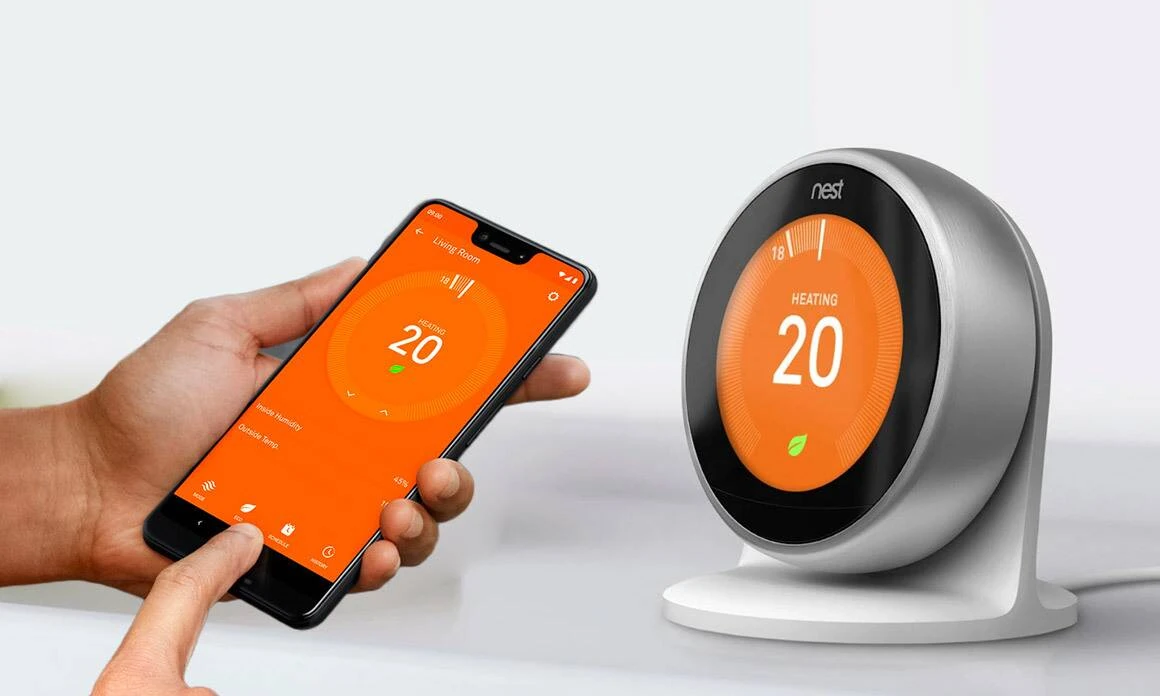
Heating lends itself well to automation. It allows you to adjust the temperature based on actual occupancy in the rooms, rather than maintaining a fixed set point all day long. A programmable unit heats your home at the right time, without any manual adjustments, so your home is just as comfortable when you get home.
A temperature tailored to the time of day and the room
A smart thermostat controls a single setpoint temperature. A heating controller, on the other hand, typically controls multiple zones or multiple units. Depending on the model and installation, Thermor and Atlantic solutions allow you to set time schedules and heating zones: this is the best approach when the rooms in a home are not occupied at the same times.
For the temperature settings, ADEME (the French agency for ecological Transition) recommends 19 °C in occupied living areas and 16 to 17 °C when they are unoccupied. France Rénov' (the public service providing support for energy-efficiency renovations) also recommends keeping the temperature at around 16 to 17 °C at night. If your return is delayed, remote control allows you to postpone heating so that an empty home isn't heated, as ADEME points out.
Measured savings without excessive promises
According to ADEME, lowering the thermostat setting by 1 °C saves an average of 7% in heating energy. This percentage refers only to heating and not to the household's total energy bill.
The same reasoning applies to programming. According to ADEME, a programmable thermostat can result in heating savings of up to 15 percent; however, this percentage does not apply to other household energy uses, such as hot water or household appliances.
A study by the CSTB (Scientific and technical center for Building) and IGNES (professional association of the building electrical and digital engineering industries), published in june 2025, goes even further. It is based on more than 1,500 computer simulations of a 100-square-meter single-family home, rather than on measurements taken in occupied homes. Simulated annual savings range from 16 to 30.5 percent in an older, uninsulated home. They range from 7.5 to 16 percent in a recently built, well-insulated house, compared to a scenario that already has basic temperature control.
Factors that affect actual returns
According to the same study, the comprehensive control system achieves annual energy savings of up to 30 percent, depending on the configuration. The result cannot be applied as-is to an individual invoice. For heating alone, the savings can reach up to 38%. The difference depends on the region's climate, the initial conditions, and the equipment being controlled.
Home automation also cannot make up for poor insulation: a poorly insulated home remains energy-inefficient, even when properly programmed. Connected devices also consume electricity, especially when they have many sensors. So calculate the net result of your energy management by subtracting this energy consumption from the expected energy savings.
Once these limitations have been taken into account, the choice of equipment depends on the number of zones to be controlled. DomeaShop offers arange of smart heating equipment : thermostats, radiators, towel warmers, and heating controllers, which can be controlled via a dedicated control unit or a compatible app.
How do automated systems make everyday life easier?
In addition to heating, automation also covers lighting, shutters, and the sequencing of multiple actions. In a smart home, these devices respond to the time of day, presence, or light. This makes daily life easier by eliminating many repetitive tasks, without taking away the ability to take control at any time.
LED lighting tailored to specific uses
Switching to LED lighting and connecting the lighting are two separate steps. The LED reduces the light source's power consumption, while the connection enables programming and remote control. A compatible smart LED light bulb can also adjust its brightness and color: soft lighting for watching a movie, bright lighting for working.
- Light bulbs and spotlights: They screw into the sockets in place of the old bulbs, particularly in E27 or GU10 sockets.
- LED strips: They create ambient lighting along a piece of furniture or a ceiling.
- Smart switches and modules: They control all the lights from a single location.
- Voice assistant control: It adjusts the brightness or color without a smartphone, provided the light fixture is compatible with the chosen platform.
This customization is complemented by sensors. A motion sensor turns off the lights in an empty room, and a light sensor adjusts the lighting based on the amount of natural light. In practice, the savings depend on your habits: a household that already consistently turns off the lights when leaving will save very little. TheA selection of connected and smart lighting options DomeaShop's selection includes light bulbs, spotlights, light strips, and light switches.
Shutters controlled based on conditions
Compatible motorized shutters and blinds can be controlled based on a schedule, occupancy, light levels, or outdoor temperature. In winter, ADEME recommends closing the shutters as soon as it gets dark: an automated system takes care of this every evening. Conversely, in the summer, automated sunshade control reduced the intensity of summer discomfort by up to 50% in the CSTB/IGNES simulations for june 2025, depending on the scenario and with no guarantee for every home.
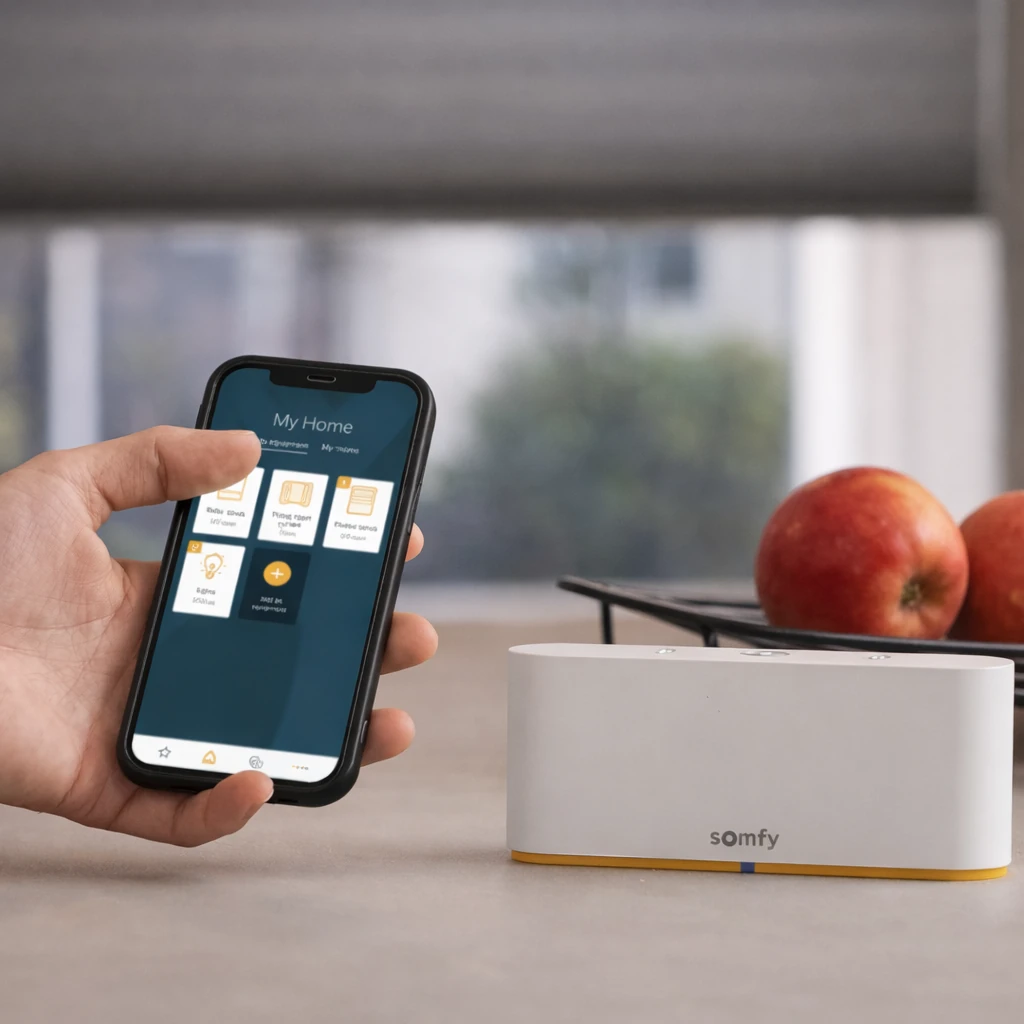
Somfy home automation centralizes control of compatible roller shutters, blinds, gates, and lighting. With the TaHoma switch box and the TaHoma app, you can program scenarios and control these devices remotely.
Scenarios rather than repetitive commands
Every home automation system is based on four components: sensors, a communication network, a controller, and actuators (such as motors, relays, or thermostatic heads that perform actions). The system assesses a situation, applies a rule, and then triggers an action. The smartphone is just one interface among many.
A "departure" scenario can thus close the shutters, turn off certain lights, and adjust the heating—all with a single command. Voice commands can also control certain devices without the need for an app or a switch. A presentation by ESIEE-IT categorizes these applications into four areas: comfort, safety, energy savings, and autonomy. However, there is no official list that defines these “four pillars.”
How does home automation make homes safer?
Security is another major application of home automation. Connected security systems detect an event, alert you on your phone, and trigger a response. They cover burglary, as well as smoke, water leaks, and unauthorized entry into the home.
Early warning against intrusions
An intruder alarm system combines door/window sensors, motion detectors, a siren, and notifications. As soon as a detection occurs, a scenario can also turn on the lights and start video recording. In France, the average burglary rate was 5.6 per 1,000 homes in 2025, with significant variations by region.
There is no general requirement to install an alarm in a private residence. The department of the interior recommends combining it with secure locks and a programmed lighting system. When you're away, he also recommends simulating your presence. So, select the appropriate equipment based on the desired level of protection and the exposure in your neighborhood.
Detection of other abnormal situations
Sensors that detect water leaks, smoke, or when a door or window is opened provide an early warning: for example, a door or window sensor alerts you if a window has been left open. A standalone smoke alarm is required, with at least one per dwelling. The owner installs it, and the occupant is generally responsible for maintaining it. According to Service-Public (the official website of the French government), it must bear the CE marking and reference the NF EN 14604 standard (the European standard for smoke detectors). In addition, a smart lock controls access via a smartphone. A camera helps verify an alert, but it does not in itself provide physical protection.
The legal limits of video surveillance
According to the CNIL (National Commission for information technology and civil liberties, the data protection authority), an individual may film the interior of their property, their yard, or their private driveway. He may not film public roads or a neighbor's property. If an employee is working at your location, inform them that cameras are in use: video surveillance should not be used to constantly monitor their work.
In a condominium, the installation of a camera in common areas is subject to a decision by the general meeting, not an individual choice. According to the CNIL, she must not film the doors, windows, or balconies of the apartments. The images must not be freely accessible to residents and generally should not be retained for more than one month. A few days are often enough.
Which solutions should you choose, and how do you install them?
The right home automation solutions depend on the type of home, your lifestyle, and the existing setup. Before making a purchase, there are three key factors to consider: features that are useful for your home, compatibility between devices, and system setup and maintenance.
Features tailored to each home
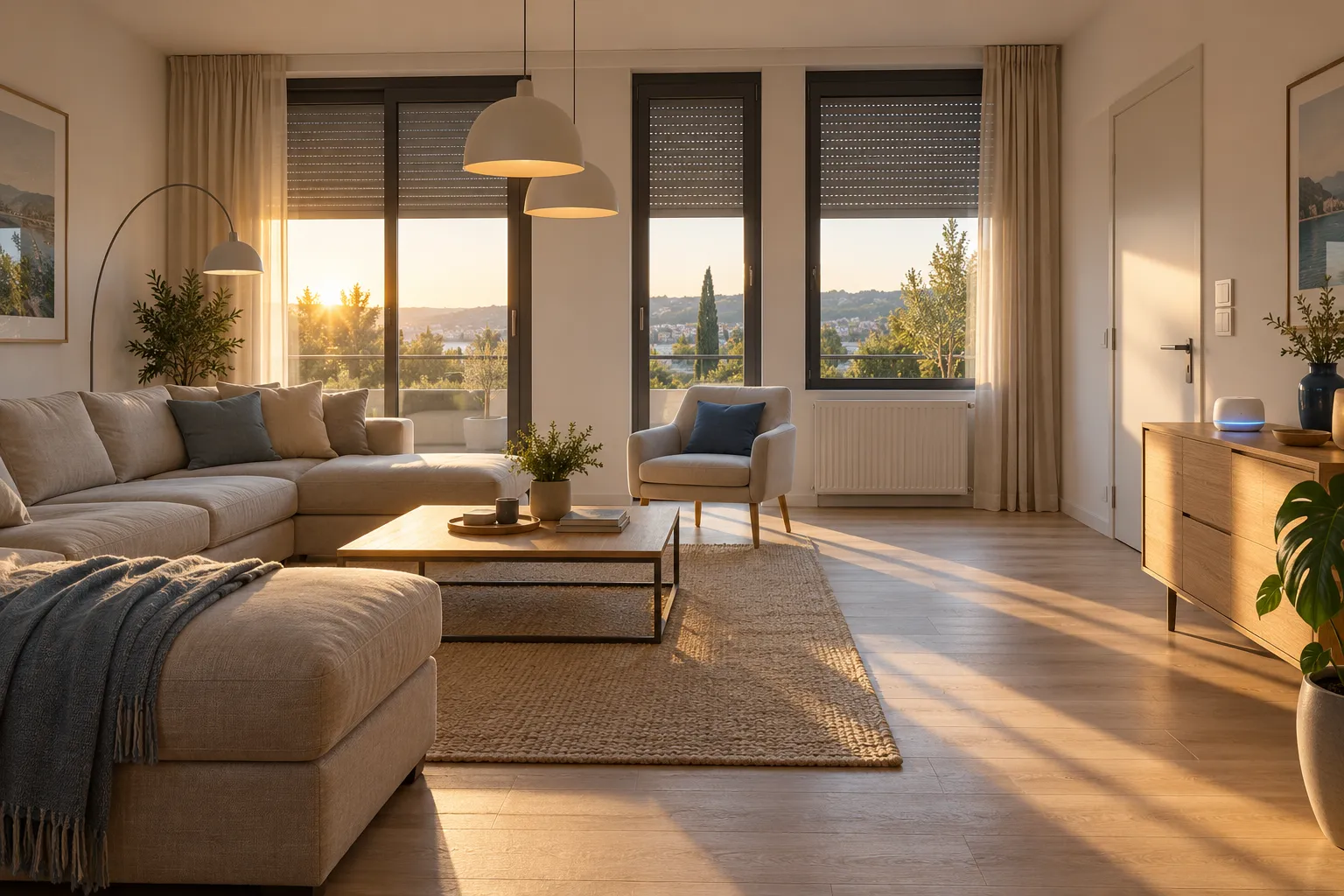
France compétences (the national authority that oversees vocational training) identifies several areas within the smart home sector. It includes controls for heating and air conditioning, lighting, automated door and window systems, access control, and energy consumption monitoring. This list is not exhaustive, and the combination of these elements varies depending on the layout of the home:
- Apartment: heating, lighting, shutters, and sensors for open doors or water leaks. With a central heating system, the occupant does not have full control over the boiler.
- Single-family home: the gate, garage door, and outdoor lighting complement the interior spaces.
- Vacation home: temperature monitoring, alerts, and occupancy simulation cover long absences.
In a condominium, any work on common areas or the building's exterior is governed by the community rules and is not solely at the discretion of the resident. Check this point before installing a motorized gate for shared access or installing equipment that is visible from the outside.
Compatibility and functionality to be verified
Somfy motors use either RTS, the legacy radio technology, or io-homecontrol, a bidirectional technology that reports the status of compatible devices. The technology already in place determines the choice of controls and modules. TheCatalog of boxes and home automation controls DomeaShop's feature lets you find items that are compatible with each protocol. Zigbee is a low-power wireless protocol used for sensors and lighting. Matter facilitates interoperability between ecosystems without guaranteeing that every application will support all advanced features.
A smart home can maintain its local controls even without an Internet connection. However, it loses remote control, notifications, and automated functions that rely on a server—including those for connected home appliances. Check these features before choosing your home automation systems.
A properly installed and maintained system
Before installation, assess the type of heating system, the existing controls, the electrical panel, and network coverage. Whether it's a new construction or a major renovation, the wiring must be planned before the walls are closed up. For minor renovations, wireless solutions minimize the amount of work required. From a regulatory standpoint, decree no. 2025-1343 of december 26, 2025, establishes the requirement for programmable controls effective january 1, 2027, for building permit applications for the relevant new construction projects. For existing buildings, the deadline is january 1, 2030. An internet-connected thermostat is not necessarily required.
Once the installation is complete, digital security takes over. Cybercrime.gov.fr (the public cybercrime assistance program) recommends strong, unique passwords, regular updates, and secure Wi-Fi. Routine maintenance also includes checking the detectors, replacing batteries, and verifying user accounts.

Frequently asked questions
The domeashop store offers you a list of questions and answers corresponding to the most frequently asked questions related to the theme and products discussed in this article. If you can't find the answer you're looking for, contact us and our specialists will be happy to help.
Test each of the following separately: Internet outage, power outage, low battery, loss of Wi-Fi, and notification reception. Also make sure that the heating can still be controlled manually. When programming, start with simple scenarios: home, away, night, vacation, departure, and return.
Connected devices collect and transmit data that can reveal when you are home, when doors are opened, your movements, or your heating habits. A camera, a lock, or a thermostat that isn't properly secured becomes a security vulnerability. The DGCCRF (the consumer protection agency) recommends changing default passwords, installing updates, and limiting the access of these devices to other devices on the network.
Yes. Automating lights and blinds, providing accessible controls, and detecting abnormal situations can make daily life easier for someone who needs to live independently. A "Leaving" scenario closes the shutters, turns off the lights, and adjusts the heating—all with a single command. Voice commands control certain devices without the need for an app or a switch.