
- Home
-
Electrical equipment
-
Sockets and switches
- Bticino
- Legrand
- Hager
- Schneider Electric
- Jung
-
Modelec
-
Collection Confidence
-
Confidence screw collection
- Narrow Confidence facades
- Narrow Confidence facades with screws
- Long, narrow Confidence facades
- Narrow, long Confidence facades with screws
- Narrow, long Confidence cabinet fronts with reading lights
- Narrow, long Confidence cabinet fronts with spotlights
- Simple mechanisms for Confidence facades
- Reinforced mechanisms for Confidence facades
- Reinforced mechanisms for narrow Confidence facades
- Reinforced mechanisms for narrow, long Confidence facades
-
Collection Desir
-
Collection Fascination
-
Collection Hitera
-
Iris Collection
-
Collection Karo
-
Collection M
- Narrow mechanisms
-
Collection Confidence
- Vandal-proof equipment
- Iboco fittings
-
Lighting
-
Interior lighting
-
Wall lights
-
LED strip
-
Downlights
-
Recessed spotlights
-
Surface-mounted spotlights
- Lamps
- Rod-mounted spotlights
- LED panels
-
Suspensions
-
Ceiling lights
-
Track and spotlights track lighting
- Tensioned cable
- Waterproof lighting
- Connected lamps
- Portholes
- Bathroom rulers
- Table lamps
- Panel lighting
- Headboard reading lights
- Light mirror
-
Wall lights
- Outdoor luminaires
- LED bulbs and spotlights
- Special lamps
- Lighting accessories
-
Interior lighting
-
Home security
-
Heating and sanitary
- Heating
-
Individual ventilation
-
Self-adjusting CMV
-
Humidity-sensitive CMV
- Insufflation ventilation
- Double-flow ventilation
- Wall-mounted aerator
- Duct puller
- Ventilation accessories
- Extractors and blowers
- Ventilation grilles
- Flow control
- Roof outlet
- Ventilation box
-
Ventilation duct
- Ventilation sleeve and reducer
- Sound trap
- Ventilation filters
-
Self-adjusting CMV
- Central vacuum
-
Connected home
- Ideas & Advice
-
MenuBack
-
Products
-
-
-
Electrical panel
- Bridging bars, combs
-
Electrical protection
- Differential block
- Earth leakage circuit breakers
-
Earth leakage switches
- 40A ground-fault circuit interrupter
- 63A ground-fault circuit interrupter
- ABB ground fault circuit interrupter
- AC-type ground fault circuit interrupter
- Eaton ground-fault circuit interrupter
- Hager ground-fault circuit interrupter
- Legrand ground fault circuit interrupter
- Schneider residual current circuit breaker
- Siemens ground-fault circuit interrupter
- Type A ground-fault circuit interrupter
- Fuses and fuseholders
- Grounding
- Lightning arresters and surge protectors
- Main circuit breaker
-
Modular circuit breakers
- 10A circuit breakers
- 16A circuit breakers
- 20A circuit breakers
- 32A circuit breakers
- ABB circuit breakers
- Circuit breakers Schneider Electric
- D-curve circuit breakers
- Eaton circuit breakers
- Four-pole circuit breakers
- Hager circuit breakers
- Legrand circuit breakers
- Siemens circuit breakers
- Three-phase circuit breakers
- Molded case circuit breaker
- Energy management
- Modular accessories
- Modular equipment
-
-
-
-
-
Interior lighting
- Bathroom rulers
- Ceiling lights
- Connected lamps
- Downlights
- Headboard reading lights
-
Interior lighting
- Bathroom rulers
- Ceiling lights
- Connected lamps
- Downlights
- Headboard reading lights
- Lamps
- LED panels
- LED strip
- Light mirror
- Panel lighting
- Portholes
-
Recessed spotlights
- Aric
- Arkoslight
- Europole
- Faro Barcelona
- Indigo Lighting - Collingwood
- Ledvance
- Paulmann
- Philips
- SG Lighting
- SLV
- Switch Lite
- Rod-mounted spotlights
- Surface-mounted spotlights
- Suspensions
- Table lamps
- Tensioned cable
- Track and spotlights track lighting
- Wall lights
- Waterproof lighting
-
-
-
Outdoor lighting
- Exterior wall lights
- Bollards and lampposts
- Outdoor recessed
- Mobile luminaires
- Projectors
- Outdoor suspensions
- Outdoor ceiling lights
- Spotlights sign
- Solar luminaires
-
Lights and garlands
- Comet garlands
- Stalactite garlands
- Connectable festoons
- Spotlights and patterns
- Classic garlands
- Curtain lights
- Motifs
- Illuminated fir trees
- Luminous balls and animals
- Guinguette garland
- Garlands Bulbs B22
- Garlands Bulbs E27
- Garlands E14 bulbs
- LED connection cable
- Professional decorations
- Garland accessories
- Outdoor illuminated furniture
- Submersible luminaires
-
-
-
-
-
Lighting: Everything you need to know about Remote-Controlled switches

Everything you need to know about the touch-sensitive switch, including how it works, when it is a useful replacement for a standard two-way switch, how to read its wiring diagram, the requirements of NF C 15-100 (the French standard for electrical installations), and the criteria for selecting or replacing the device. This will give you the guidance you need to install or renovate a lighting system that can be controlled from multiple locations.
Contents
- How does a remote-controlled switch work?
- What is its role in lighting?
- When should you choose this over back-and-forth travel?
- What are its drawbacks?
- How do you connect and test a remote-controlled switch?
- Read the wiring diagram
- Connect the push buttons
- Check the installation and troubleshoot any problems
- What rules should be followed for the lighting circuit?
- Circuit, circuit breaker, and light fixtures
- Circuits and Ground-Fault protection
- Which version of the standard should be applied?
- How do you choose or replace a remote-controlled switch?
- What are the different types?
- Compare electrical specifications
- Replace an existing device
How does a remote-controlled switch work?
A remote-controlled switch is a pulse-controlled relay. Each time a push button is pressed, it sends a brief signal to the device, which then toggles the light. Unlike a conventional switch, the functions of turning the lights on and off are handled by two separate components.
What is its role in lighting?
The remote switch controls the same lighting circuit from multiple locations. Each pulse reverses the state of the contact that powers the lights: when closed, it turns them on; when open, it turns them off. In an electromechanical model, the pulse briefly energizes a coil, and then the mechanism maintains the contact's position without the coil remaining energized.
In addition, multiple lamps can be connected in parallel to this power terminal. They turn on and off together, regardless of which switch is pressed: a series of wall sconces along a staircase thus react as a single unit.
When should you choose this over back-and-forth travel?
For two control points, the reciprocating mechanism is generally the simplest configuration. The remote switch becomes particularly useful in three situations, when there are multiple controls in the same space.
However, three control points do not necessarily require a remote switch: two two-way switches combined with a cross-over switch (an intermediate switch that crosses the two two-way switches) can also control the same lighting. The difference lies in the number of conductors that need to be pulled between the controls.
In a hallway with four entrances, for example, four push buttons control the same wall lights via a remote switch. This way, you avoid the multiple trips that a back-and-forth assembly process with indexers would require.
What are its drawbacks?
An electromechanical model may produce a clicking sound each time it switches, and its moving parts—such as its contacts—wear out over time. In addition, the maximum number of push buttons allowed depends on the model and the controls used: check this information in the manual before adding control points.
How do you connect and test a remote-controlled switch?
The wiring of a remote-controlled switch separates two circuits: the control circuit, which connects the push buttons to the coil, and the power circuit, which supplies power to the lights. Mixing up these two parts may cause a short circuit or damage the device.
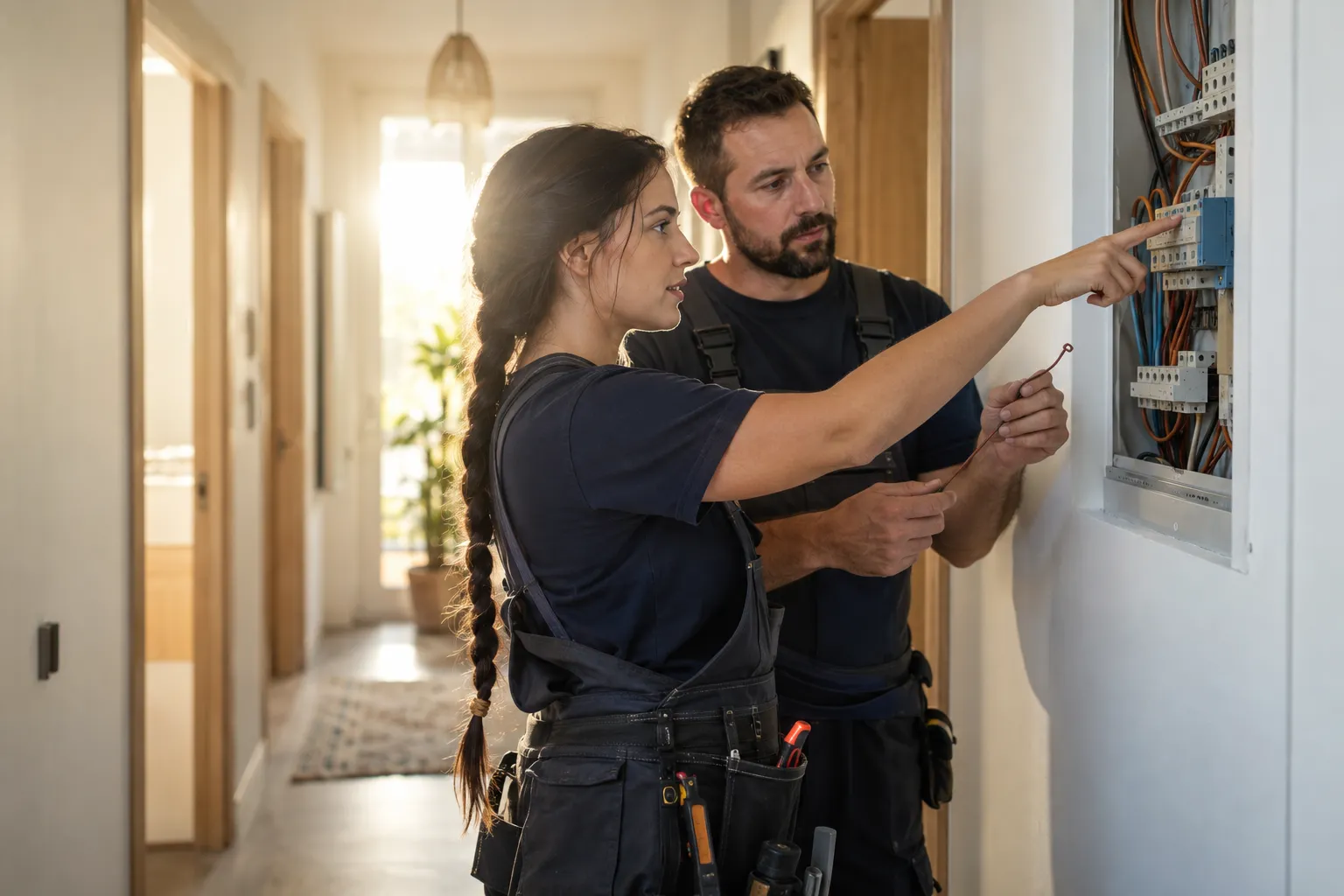
Read the wiring diagram
Let's consider an example of a phase-controlled circuit, protected upstream by the circuit breaker. Each driver is assigned a specific station:
- Power Contact: The protected phase is connected to input terminal 1, and terminal 2 powers three lamps connected in parallel via the lamp return.
- Command: The phase passes through the pushers before reaching A2.
- Neutral: It connects to the lights, along with A1.
However, the pin assignments for A1 and A2 vary from model to model: check the diagram provided with the device. The push-button reset and the lamp reset do not serve the same function. The neutral wire is usually light blue, and the lamp return wire may be orange, but in an older installation, identify each conductor without relying solely on its color.
Connect the push buttons
A pushbutton is a momentary contact that is normally open. When connected in parallel, each pushbutton sends a signal with a single press; when connected in series, they would all have to be pressed at the same time. Conversely, a momentary switch cannot replace a pushbutton on a conventional remote-control switch: it may leave the coil energized and cause overheating or a malfunction.
Push buttons with indicator lights require special attention: the indicator light carries a residual current that can interfere with the control system. Some manufacturers limit the number to 15 indicator-light pushbuttons; this is a value specific to their device and is not universal.
Check the installation and troubleshoot any problems
Before performing any work, turn off the relevant circuit breaker, prevent it from being turned back on, and then verify that there is no voltage using an appropriate device. Measurements in a live panel must be performed by a qualified person.
Once the installation is complete, restore power and test each pushbutton separately: each press should change the lighting status. If a malfunction occurs later, follow these steps in this order:
- The circuit breaker: Make sure it is turned on, because if it trips, it can easily be mistaken for a device malfunction.
- Each pushbutton: If some work and others don't, the problem is likely with a pushbutton or its wiring.
- The power section: If the unit turns on but the lamp remains off, check the light fixture, the lamp return, the neutral wire, and the connections.
In practice, this approach prevents you from replacing a functional remote switch when the problem actually stems from a light fixture or a loose connection in a junction box.
What rules should be followed for the lighting circuit?
The presence of a remote-controlled switch does not affect the requirements of the electrical circuit it controls. The conductor cross-section, protective conductor size, and number of light points comply with NF C 15-100.
Circuit, circuit breaker, and light fixtures
The low current drawn by the coil does not allow for any simplification of the circuit. Three factors determine a home lighting system:
- Conductor cross-sectional area: at least 1.5 mm².
- Circuit breaker: 16 A maximum, regardless of the rating indicated on the remote switch.
- Light sources: a maximum of eight per circuit.
This limit of eight applies to the light fixtures, not to the push buttons connected to the control system. A hallway equipped with four push-button switches and six wall sconces is therefore within the guidelines.
Circuits and Ground-Fault protection
A residence with two or more main rooms must have at least two lighting circuits; only one is permitted for a studio apartment or a one-bedroom apartment. According to Promotelec (an association dedicated to promoting the safety and quality of electrical installations), residential circuits must be protected by a residual current device (RCD) with a maximum rating of 30 mA, with at least two devices of this sensitivity.
The technical guidelines also stipulate that there may be up to eight circuits connected to a single ground-fault circuit interrupter (GFCI) and that there must be at least one type A gfci (suitable for leakage currents from electronic devices) in the dwelling.
Which version of the standard should be applied?
According to CONSUEL (the organization responsible for electrical compliance certificates), the NF C 15-100 series dated august 2024 applies to certificates for which the project reference date is after august 31, 2025—that is, effective september 1, 2025. As of april 1, 2026, the input field defaults to this revised series; the previous version can still be selected if it applies to the project.
CONSUEL reminds you that the 2024 edition is not retroactive: replacing an old remote-controlled switch does not require renovating the entire home. The decree of august 3, 2016, also retains references to the 2002 version, its 2005 update, and amendments A1 through A5; according to AFNOR (the French standards organization), the 2024 edition had not yet been included.
How do you choose or replace a remote-controlled switch?
The right remote-controlled switch depends on its location, the desired noise level, and the electrical characteristics of the circuit. When replacing a device, the existing one provides most of the necessary information.
What are the different types?
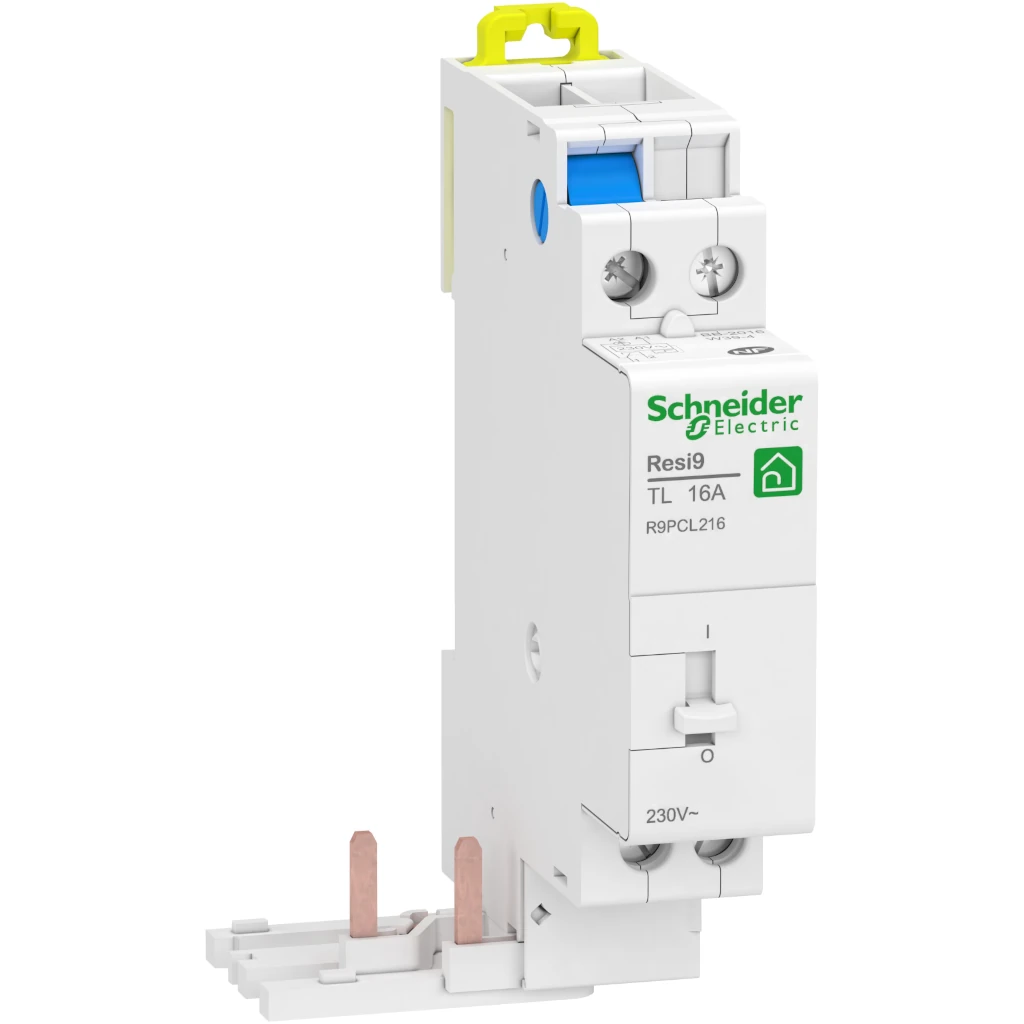
DomeaShop offersmodular relay switches for DIN rail mounting 1 to 3 modules. Families are classified as follows:
- Modular or flush-mounted: the former is mounted on a DIN rail in the electrical panel, while the latter is installed in a flush-mount or junction box.
- Electronic or silent: It dampens the clicking sound of an electromechanical mechanism, but may consume power even when idle, depending on the model.
- Connected: It adds a remote control while retaining the wired push buttons, depending on compatibility.
A quiet model is the best choice when the appliance is located near a bedroom.
Compare electrical specifications
The control voltage must be compatible with the system: depending on the device, it can be 6, 12, 24, or 48 V. Other models operate at 110, 130, or 230/240 V. A single-pole model breaks the phase, while a double-pole model breaks both the phase and the neutral simultaneously; the number and type of contacts must also match the circuit.
For LED lamps, check the maximum load and inrush current specified by the manufacturer rather than relying solely on the contact's rated current. DomeaShop recommends, if necessary, a 20- to 25-amp circuit breaker, without changing the required circuit protection.
For example,the Legrand Cx³ 412408 single-pole screw-terminal remote switch The product offered by DomeaShop features a 16 A normally open contact and 230 V~ control. It is 1 module wide and features a manual control panel on the front.
Replace an existing device
Start by locating the old switch, either on the circuit panel or in a junction box. Next, note its part number, control voltage, and switching capacity, then take a photo of its terminals and wires before disconnecting them. Also, check whether the push-button switches are of the toggle type, and verify the type of light fixtures as well as the compatibility of the push-button switches with indicator lights with the new fixture.
Depending on the layout of the home, a generic diagram may not be suitable: outdated wiring, a partially renovated electrical panel, or a missing neutral wire where it is expected. Some electronic models also have power and contact terminals that are separate from their control terminals.

Frequently asked questions
The domeashop store offers you a list of questions and answers corresponding to the most frequently asked questions related to the theme and products discussed in this article. If you can't find the answer you're looking for, contact us and our specialists will be happy to help.
Not automatically. The addition of a third switch alone does not justify this replacement: two two-way switches connected to a changeover switch can also control the same lighting.
First, check for a push button that is stuck in the closed position or a switch that is held in the wrong position. Fix this problem before replacing a damaged remote switch; otherwise, the new unit will experience the same issue.
One possible setup uses a transformer to power the push buttons and the coil. In this example, the control voltage is typically 12 V.
Depending on the device's compatibility, yes: the push buttons that are already installed can be kept, with the exception of a dimmer switch with the connected model described. This gives you the ability to schedule when lights turn on and off—a feature not found in a standard remote-controlled switch.