- Home
-
Electrical equipment
-
Sockets and switches
- Bticino
- Legrand
- Hager
- Schneider Electric
- Jung
-
Modelec
-
Collection Confidence
-
Confidence screw collection
- Narrow Confidence facades
- Narrow Confidence facades with screws
- Long, narrow Confidence facades
- Narrow, long Confidence facades with screws
- Narrow, long Confidence cabinet fronts with reading lights
- Narrow, long Confidence cabinet fronts with spotlights
- Simple mechanisms for Confidence facades
- Reinforced mechanisms for Confidence facades
- Reinforced mechanisms for narrow Confidence facades
- Reinforced mechanisms for narrow, long Confidence facades
-
Collection Desir
-
Collection Fascination
-
Collection Hitera
-
Iris Collection
-
Collection Karo
-
Collection M
- Narrow mechanisms
-
Collection Confidence
- Vandal-proof equipment
- Iboco fittings
-
Lighting
-
Interior lighting
-
Wall lights
-
LED strip
-
Downlights
-
Recessed spotlights
-
Surface-mounted spotlights
- Lamps
- Rod-mounted spotlights
- LED panels
-
Suspensions
-
Ceiling lights
-
Track and spotlights track lighting
- Tensioned cable
- Waterproof lighting
- Connected lamps
- Portholes
- Bathroom rulers
- Table lamps
- Panel lighting
- Headboard reading lights
- Light mirror
-
Wall lights
- Outdoor luminaires
- LED bulbs and spotlights
- Special lamps
- Lighting accessories
-
Interior lighting
-
Home security
-
Heating and sanitary
- Heating
-
Individual ventilation
-
Self-adjusting CMV
-
Humidity-sensitive CMV
- Insufflation ventilation
- Double-flow ventilation
- Wall-mounted aerator
- Duct puller
- Ventilation accessories
- Extractors and blowers
- Ventilation grilles
- Flow control
- Roof outlet
- Ventilation box
-
Ventilation duct
- Ventilation sleeve and reducer
- Sound trap
- Ventilation filters
-
Self-adjusting CMV
- Central vacuum
-
Connected home
- Ideas & Advice
-
MenuBack
-
Products
-
-
-
Electrical panel
- Bridging bars, combs
-
Electrical protection
- Differential block
- Earth leakage circuit breakers
-
Earth leakage switches
- 40A ground-fault circuit interrupter
- 63A ground-fault circuit interrupter
- ABB ground fault circuit interrupter
- AC-type ground fault circuit interrupter
- Eaton ground-fault circuit interrupter
- Hager ground-fault circuit interrupter
- Legrand ground fault circuit interrupter
- Schneider residual current circuit breaker
- Siemens ground-fault circuit interrupter
- Type A ground-fault circuit interrupter
- Fuses and fuseholders
- Grounding
- Lightning arresters and surge protectors
- Main circuit breaker
-
Modular circuit breakers
- 10A circuit breakers
- 16A circuit breakers
- 20A circuit breakers
- 32A circuit breakers
- ABB circuit breakers
- Circuit breakers Schneider Electric
- D-curve circuit breakers
- Eaton circuit breakers
- Four-pole circuit breakers
- Hager circuit breakers
- Legrand circuit breakers
- Siemens circuit breakers
- Three-phase circuit breakers
- Molded case circuit breaker
- Energy management
- Modular accessories
- Modular equipment
-
-
-
-
-
Interior lighting
- Bathroom rulers
- Ceiling lights
- Connected lamps
- Downlights
- Headboard reading lights
-
Interior lighting
- Bathroom rulers
- Ceiling lights
- Connected lamps
- Downlights
- Headboard reading lights
- Lamps
- LED panels
- LED strip
- Light mirror
- Panel lighting
- Portholes
-
Recessed spotlights
- Aric
- Arkoslight
- Europole
- Faro Barcelona
- Indigo Lighting - Collingwood
- Ledvance
- Paulmann
- Philips
- SG Lighting
- SLV
- Switch Lite
- Rod-mounted spotlights
- Surface-mounted spotlights
- Suspensions
- Table lamps
- Tensioned cable
- Track and spotlights track lighting
- Wall lights
- Waterproof lighting
-
-
-
Outdoor lighting
- Exterior wall lights
- Bollards and lampposts
- Outdoor recessed
- Mobile luminaires
- Projectors
- Outdoor suspensions
- Outdoor ceiling lights
- Spotlights sign
- Solar luminaires
-
Lights and garlands
- Comet garlands
- Stalactite garlands
- Connectable festoons
- Spotlights and patterns
- Classic garlands
- Curtain lights
- Motifs
- Illuminated fir trees
- Luminous balls and animals
- Guinguette garland
- Garlands Bulbs B22
- Garlands Bulbs E27
- Garlands E14 bulbs
- LED connection cable
- Professional decorations
- Garland accessories
- Outdoor illuminated furniture
- Submersible luminaires
-
-
-
-
-
How a surge protector works: Principles and protection

Understanding how a surge protector works will help you decide whether to install one and how to set it up. The following sections describe its operating principle, its connection to the panel, types 1, 2, and 3, the cases in which the standard requires its use, its limitations, and the signs that indicate it needs to be replaced.
Contents
- How does a surge protector detect and divert a power surge?
- What is a surge protector used for?
- What happens when the tension rises?
- How is the voltage limited?
- Why does the connection affect the effectiveness of the surge arrester?
- Where should the protective covering be placed in the home?
- Why shorten the ground connection?
- Why is it necessary to provide for the disconnection of the surge arrester?
- What types of surge protectors protect a home, and how effective are they?
- What do types 1, 2, and 3 protect against?
- When is this protection required and appropriate?
- What are its limitations, and how can you check its condition?
How does a surge protector detect and divert a power surge?
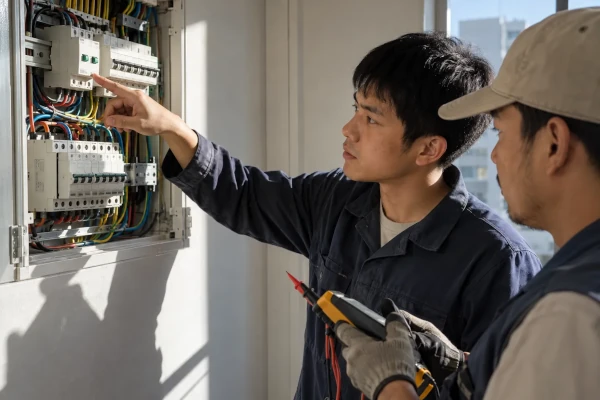
A surge protector does not cut off the power. He reacts in a fraction of a second: he diverts some of the energy from a voltage spike to ground. The difference lies in the speed of this reaction and the voltage that still reaches the devices.
What is a surge protector used for?
The function of a surge arrester is to limit transient overvoltages—that is, very brief voltage spikes. As a result, the voltage reaching the home's electrical circuits and equipment remains lower. These spikes have several causes:
- Distant lightning: A strike anywhere near a residence is enough to create a power surge that spreads through the power grid.
- Switching surges: Switching operations on the power grid also generate them.
- Devices on display: Appliances, computers, and the internet router receive everything that hasn't been clipped.
What happens when the tension rises?
Under normal operating conditions, the surge arrester remains inactive: it allows only a minimal leakage current to pass through. As soon as a voltage surge exceeds its threshold, its protective component becomes conductive. It then creates a path of low resistance that diverts part of the pulse current to ground, according to its wiring diagram.
This transition relies on two internal technologies. Spark gaps operate on the principle of ignition: an arc is established when the voltage exceeds a certain threshold. Conversely, varistors and diodes operate by clipping: they cut off the peak of the voltage waveform.
How is the voltage limited?
By limiting voltage surges between conductors, the device maintains the voltage at a level compatible with the equipment's surge resistance. It does not eliminate all the voltage spikes. Two values describe this behavior: Uc, the maximum allowable continuous voltage, and Up, the voltage protection level. Under identical conditions, a lower Up value indicates better limitation, but it alone does not describe the level of protection achieved once the device is connected.
The current-carrying capacity completes this data: In denotes the rated discharge current, Imax the maximum current for type 2, and Iimp the pulse current for type 1. Some type 2 series have Imax values of 15, 40, or 65 kA. Combined models specify Iimp values of 12.5 or 25 kA, although these values may not be suitable for all cases. DomeaShop combines these levels intoits selection of lightning arresters and surge protectors.
Why does the connection affect the effectiveness of the surge arrester?
Even a well-chosen appliance loses some of its effectiveness if it is connected incorrectly. There are three key factors to consider in an electrical installation: the location of the surge arrester, the length of its conductors to ground, and how it is isolated in the event of a fault.
Where should the protective covering be placed in the home?
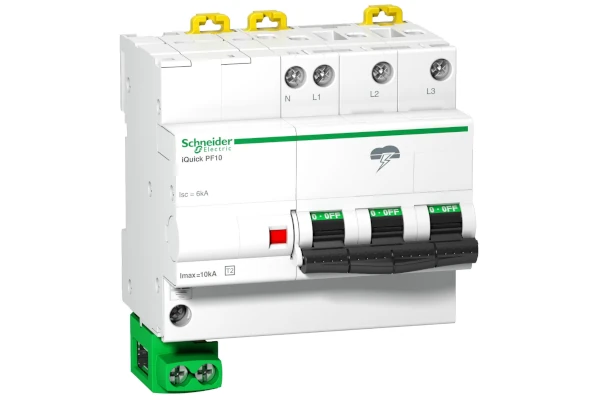
The main surge arrester is installed in the electrical panel at the point of entry of the system, as close as possible to the power supply and the ground. According to NF C 15-100-1 (the French standard that establishes general rules for electrical installations), a surge protector that protects the entire residence must be installed immediately downstream from the main circuit-breaking device.
The distance to the devices is then taken into account. In its 2024 edition, NF C 15-100-10 (the section of the standard devoted to residential buildings) recommends additional protection when equipment is located more than 10 m from the main surge arrester. This distance does not apply to the length of the connecting wires. DomeaShop offers modular surge protectors for electrical panels as well as surge protectors designed to be placed near sensitive equipment.
Why shorten the ground connection?
The surge arrester must be properly connected to the ground terminal and to the equipotential bonding system, which brings the metal structures in the dwelling to the same potential. A good ground connection does not compensate for conductors that are too long or improperly routed: these increase the residual voltage reaching the devices. In practice, the installation guideline specifies a maximum length of 50 cm for the connection run, to be adjusted according to the diagram and the equipment specifications.
The conductor's cross-sectional area matters, too. A guide in NF C 15-100-10 specifies a minimum of 6 mm² of copper or equivalent for a type 2. This minimum increases to 16 mm² for type 1. Connect the ground terminal to the panel's terminal block using the shortest possible route, after connecting the phase and neutral wires. The single-phase and three-phase models ofthe Hager line of modular surge protectors must also be connected to a properly grounded system.
Why is it necessary to provide for the disconnection of the surge arrester?
After being subjected to heavy loads, a surge arrester can deteriorate to the point of failing, particularly by short-circuiting. The disconnect device then isolates the faulty unit. It does not limit the voltage surge where it occurs.
For a non-self-protected model, select a circuit breaker or other external device rated for the expected short-circuit current and coordinated according to the manufacturer's specifications. It must not trip unintentionally during normal operation. A self-protected model includes this feature and does not require a dedicated circuit breaker if the manufacturer's specifications are followed. Still, his condition needs to be monitored.
What types of surge protectors protect a home, and how effective are they?
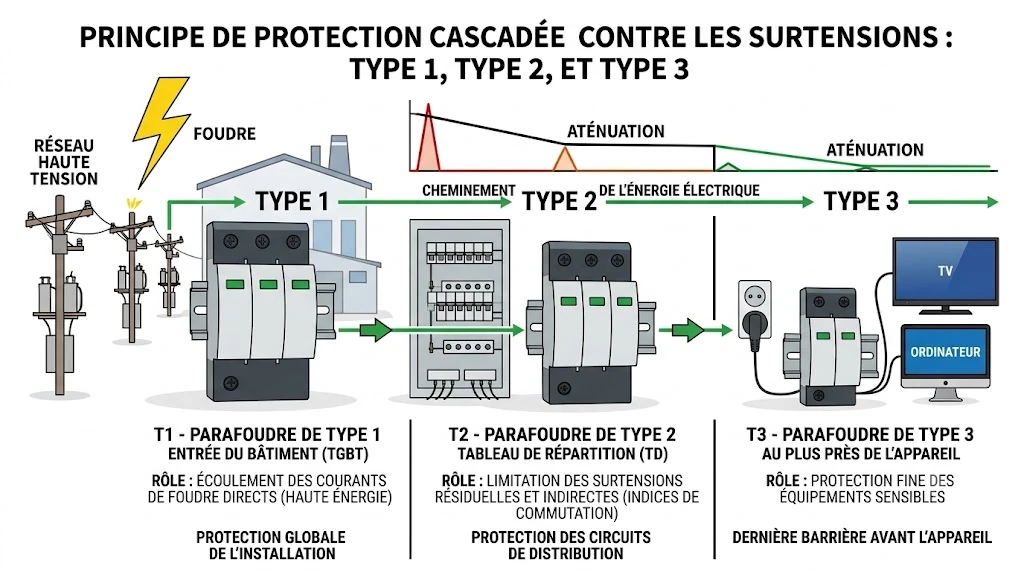
Surge arresters are classified into three types based on the amount of energy they can dissipate and their location in the system. The appropriate level of electrical protection depends on the building's exposure, its power supply, and the equipment to be protected.
What do types 1, 2, and 3 protect against?
Each type is tested with a different current waveform, which reflects the amount of energy it can withstand:
- Type 1: It diverts high-energy lightning currents, particularly when the building is equipped with external lightning protection. It is tested using a 10/350 µs pulse, and there are combined type 1 and type 2 models available.
- Type 2: This is the standard protection for a low-voltage circuit when Type 1 protection is not required. It is tested using an 8/20 µs pulse.
- Type 3: This thin shield is placed near a device and remains synchronized with the head shield.
Type 3 corresponds to what is often called a surge arrester: its lower current-carrying capacity means it cannot replace a type 1 or type 2 device. This may be necessary when sensitive equipment is located far from the distribution panel.
DomeaShop offers Hager models for single-phase and three-phase networks, as well asLegrand type 3 surge protectors.
When is this protection required and appropriate?
NF C 15-100-10 does not require lightning arresters in all residential buildings. It distinguishes zone AQ1, defined by a keraunic level Nk = 25 (number of thunderstorm days per year) or a lightning density Ng = 2.5 (impacts per km² per year), from zone AQ2, defined by Nk > 25 or Ng > 2.5. A building equipped with external lightning protection requires a type 1 system in both zones, with the exception of certain buildings equipped with a transformer substation. A fully underground power supply does not always require a surge arrester. When personal safety is at stake, a risk analysis is required in AQ1, and a surge protector becomes mandatory in AQ2.
The selection then takes into account the power system—for example, whether the surge arrester is single-phase or three-phase—the grounding configuration, Uc, Up, the discharge currents, and coordination with the disconnection. According to AFNOR (the French standards organization), standards NF C 15-100-1 and NF C 15-100-10 are dated august 2024. The revised series will serve as the reference standard starting in september 2025 for new installations and related work. NF EN 61643-11, dated may 2014, is a separate product standard that the models of theLegrand surge protector catalog.
What are its limitations, and how can you check its condition?
Not all types of power surges can be protected against by a conventional surge protector. It handles transient spikes, but not power outages, voltage drops, or temporary overvoltages in the grid, such as those caused by high voltage or a low-voltage neutral break.
Its presence, therefore, does not guarantee absolute protection. After a severe thunderstorm, check its status indicator and make sure it hasn't disconnected. On some models, a red indicator light signals that a cartridge or the entire unit needs to be replaced.
What happens next depends on the device's design: some surge arresters have a replaceable cartridge, while others are one-piece units. Once installation is complete, verify the electrical compatibility of the new equipment, its connections, and its coordination with the power disconnection.