
- There are no more items in your cart
- Shipping
- Total €0.00
How does a water heater safety group work?

The safety group is an essential part of your water heater installation. Yet many homeowners are still unfamiliar with how it works. This discreet device plays an important role in protecting your hot water tank and ensuring the safety of your home. Understanding how it works will not only ensure the longevity of your appliance, but also prevent potentially serious accidents. In this comprehensive article, we'll explore in detail how the safety group works, its components, its essential role, as well as all the practical aspects involved in its installation and maintenance.
Contents
- What is a water heater safety group?
- The essential components of a safety group
- The non-return valve
- The safety valve
- The disconnector
- The draining device
- Detailed operating principle
- In the heating phase
- Filling phase
- In the event of abnormal overpressure
- The different types of safety groups
- The standard safety group
- The NF safety group
- Safety group with integrated siphon
- Stainless steel safety group
- Installing a safety group
- Optimum positioning
- Drain connection
- Installation precautions
- Safety unit maintenance and servicing
- The monthly manoeuvre
- Descaling the safety group
- Replacing the safety group
- Common problems and solutions
- Permanent flow through the drain
- No flow during heating
- Leak in fittings
- Corrosion of the group body
- The importance of the safety group for the life of the water heater
- Current standards and regulations
- The cost and choice of a safety group
- Conclusion
What is a water heater safety group?
The safety group is a mandatory safety device installed on the cold water inlet of your electric water heater. This is a compact unit combining several safety and control devices in a single metal block, usually made of chrome-plated or nickel-plated brass.
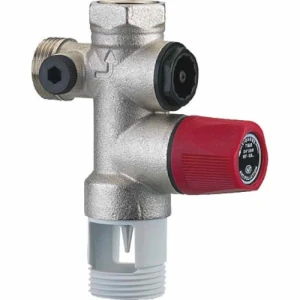
This equipment has been made mandatory by standard NF EN 1487 for all domestic hot water storage systems. Its absence or malfunction can not only invalidate your home insurance in the event of a claim, but also expose your home to significant risks.
The safety group takes the form of a metal block just a few centimetres long, equipped with several connections: a cold water inlet, an outlet to the water heater, and a drain opening pointing downwards. On the side, you'll usually find a lever for testing the unit's operation.
The essential components of a safety group
To understand how a safety group works, it's important to know its various components and their specific roles.
The non-return valve
The non-return valve is the unit's first safety element. Its role is to prevent hot water from flowing back into the cold water system. Without this device, when the pressure in the cylinder rises as it heats up, the hot water could flow back into the cold water pipes, creating not only a waste of energy but also a risk of contamination of the drinking water network.
The valve operates on a simple but effective principle: a moving part closes automatically as soon as the downstream pressure (on the water heater side) becomes higher than the upstream pressure (on the water inlet side). This one-way valve ensures that water only flows in one direction, from the mains to the storage tank.
The safety valve
The safety valve is the heart of the protection system. It is calibrated to open automatically when the pressure inside the water heater exceeds a preset threshold, generally 7 bar for domestic installations. This value corresponds to the maximum pressure a standard hot water cylinder can withstand without the risk of exploding.
When water heats up in the water heater, it expands. This thermal expansion leads to an increase in pressure inside the vessel. Without a decompression system, this pressure could continue to rise until the balloon ruptures, with catastrophic consequences. The valve opens to evacuate excess pressure, allowing a small amount of water to escape.
The disconnector
The shut-off device is a valve integrated into the safety group, which isolates the water heater from the cold water network. This function is particularly useful when servicing, descaling or replacing the cylinder. By closing this valve, you can work on the water heater without having to cut off the water supply to the whole house.
Some safety group models also incorporate a separate drain valve, offering additional flexibility for system maintenance.
The draining device
The draining device allows the water contained in the water heater to be completely evacuated. This function is essential for maintenance, descaling, or when the home is unoccupied in winter and you need to protect the system from freezing. Draining is generally performed by operating a lever or button on the side of the safety group.
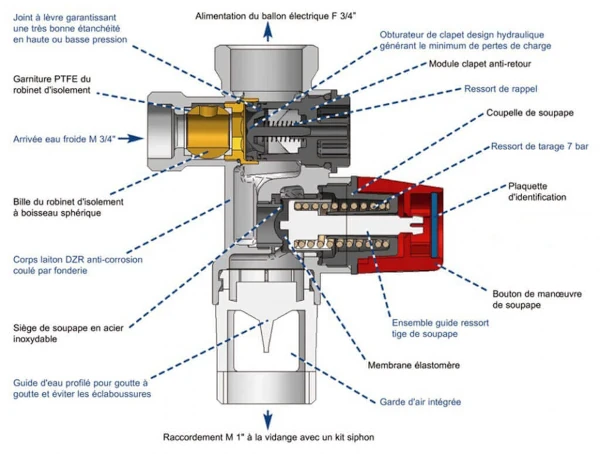
The device features a threaded outlet to which a transparent drain hose or floor drain is connected to discharge water into the sewer system.
Detailed operating principle
To understand the overall operation of the safety group, you need to observe what happens during the various phases of water heater use.
In the heating phase
When the water heater thermostat triggers the electric resistance to heat the water, the temperature of the water in the tank gradually rises. This rise in temperature causes the water to expand. This is because water increases in volume when it heats up: a volume of cold water at 15°C will occupy around 3 to 4% more volume when heated to 65°C.
In a closed system such as a water heater, this expansion causes an increase in pressure. As the non-return valve prevents water from flowing back into the network, the pressure rises until it reaches the set point of the safety valve. At this point, the valve opens automatically and allows a few drops of water to flow out, compensating for expansion and keeping pressure within acceptable limits.
This is why it is perfectly normal to observe a slight flow of water through the safety group during the heating phase. This flow, generally ranging from a few centilitres to half a liter a day, is not a malfunction but proof that the system is working properly.
Filling phase
When you open a hot water tap in your home, you create a vacuum in the cylinder. The hot water runs out and is immediately replaced by cold water, which arrives via the safety group. The non-return valve opens to allow cold water to flow from the mains to the water heater.
During this phase, the pressure in the storage tank drops and the safety valve remains closed. Filling is carried out at network pressure, generally between 3 and 4 bar. Once the valve is closed, the system returns to equilibrium.
In the event of abnormal overpressure
In the event of a malfunction, such as a thermostat failure that would allow the water to heat up indefinitely, the temperature and therefore the pressure would continue to rise. In this dangerous scenario, the safety valve plays its ultimate protective role, opening fully to evacuate excess pressure and prevent the cylinder from exploding.
It's in these emergency situations that the safety group really comes into its own. Without it, a faulty water heater could explode with considerable force, causing major property damage and endangering the occupants of the dwelling.
The different types of safety groups
Not all safety groups are created equal, and there are different models to suit specific situations.
The standard safety group
The standard model is the most commonly installed in homes. Calibrated to 7 bar, it is suitable for most domestic electric water heaters with capacities ranging from 50 to 300 liters. These units are available in different connection diameters, generally 15 mm (1/2 inch) or 20 mm (3/4 inch), to be chosen according to the diameter of your piping.
The NF safety group
Safety groups bearing NF certification have passed rigorous tests to guarantee compliance with French and European standards. This certification ensures superior manufacturing quality, increased durability and reliable operation over time. For a standard-compliant installation, we strongly recommend choosing an NF-certified safety group.
Safety group with integrated siphon
Some top-of-the-range models feature a hydraulic siphon to prevent odors from the sewage system from rising up through the safety group drain. This function is particularly useful when the water heater is installed in a living room or a poorly ventilated enclosed space.
Stainless steel safety group
For installations exposed to harsh conditions (highly calcareous water, corrosive environment, intensive use), there are safety units made entirely from stainless steel. More expensive than brass models, they offer exceptional corrosion resistance and extended service life.
Installing a safety group
The installation of a safety group must comply with precise rules to guarantee its correct operation and the safety of the installation.
Optimum positioning
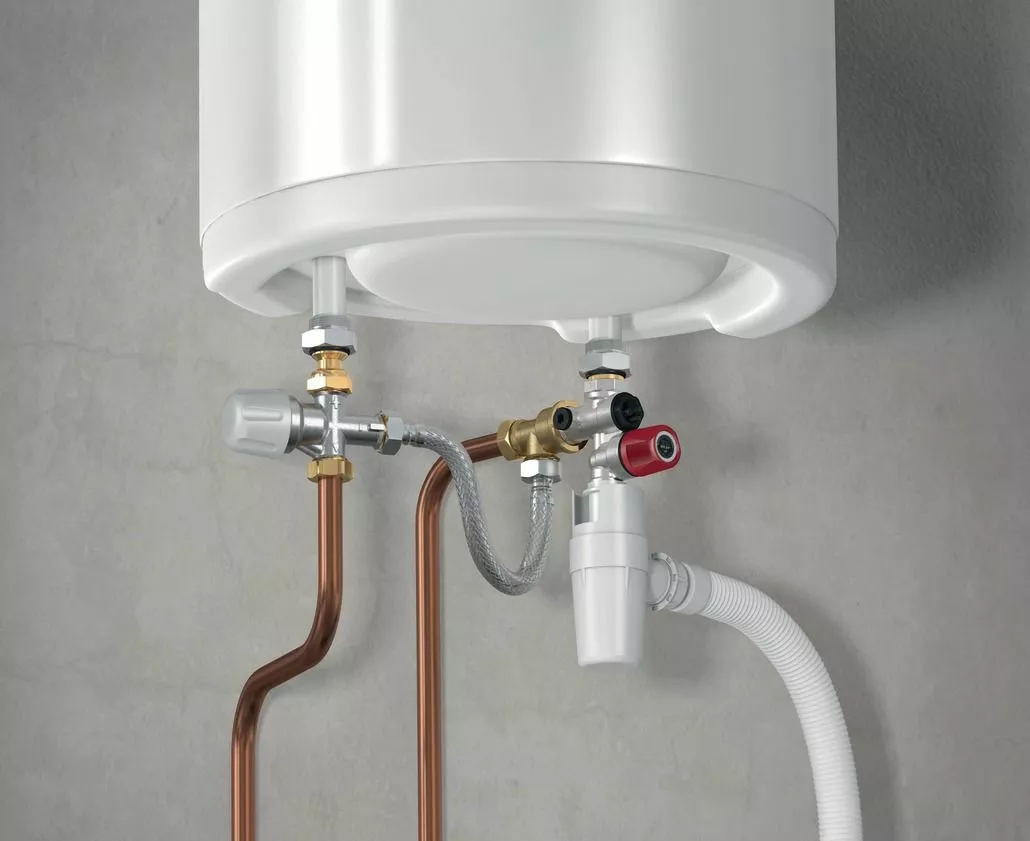
The safety group must be installed on the water heater's cold water inlet, between the general shut-off valve and the storage tank inlet. It should be positioned vertically, with the drain hole facing downwards. This orientation is crucial to ensure correct water drainage and prevent the mechanism from jamming.
It is important to leave sufficient space below the safety group to allow the drain hose to be connected and to facilitate maintenance operations. A clearance of at least 30 centimetres is recommended.
Drain connection
Water drainage through the safety group must be properly organized. It is strictly forbidden to let water run freely over the floor, as this will create humidity problems and could damage the flooring. What's more, continuous run-off on the floor can go unnoticed, resulting in significant water wastage.
The drain hose must be connected to the hole provided on the safety group. This pipe, generally made of copper or transparent PVC with a diameter of 14 or 16 mm, must have a regular downward slope with no intermediate low points that could create a parasitic siphoning effect. The end of the pipe must open above a floor drain, toilet bowl or drip tray, with a load break to avoid any risk of backflow.
The distance between the end of the pipe and the collection point must be at least 2 centimetres to allow visual observation of the flow and ensure that no wastewater can back up into the system.
Installation precautions
Before installing a safety group, it is essential to check that the pressure in the water network does not exceed the group's set pressure. If the network pressure exceeds 7 bars, which may occur in certain geographical areas or on the lower floors of buildings, a pressure reducer must be installed upstream of the safety group.
Connections must be tightened with care, using suitable gaskets (fiber gaskets for conical connections, filasse and jointing compound for cylindrical connections). Over-tightening can damage the body of the safety group and cause leaks, while under-tightening will not guarantee a watertight seal.
It is also advisable to install a shut-off valve upstream of the safety group, to facilitate replacement at a later date without having to cut off the water supply to the whole house.
Safety unit maintenance and servicing
A safety group requires regular maintenance to ensure long-term operation.
The monthly manoeuvre
The first maintenance operation, which is often overlooked, is to manually operate the lever on the safety group once a month. This procedure checks that the safety valve has not jammed and can be opened freely if required.
To carry out this check, simply lift the lever: you should hear and see water flowing through the drain hose. If no flow occurs, or if the lever is difficult to manipulate, this indicates a problem requiring further action.
This regular operation prevents the build-up of limescale and deposits that could block the mechanism. It's a simple operation that only takes a few seconds, but can prevent serious malfunctions.
Descaling the safety group
In regions with particularly hard water, the safety group can gradually scale up, compromising its operation. Symptoms of severe scaling include permanent flow through the drain, blockage of the operating lever, or no flow at all during heating.
Descaling the safety group is a delicate operation that generally requires disassembly. It's often simpler and safer to replace a scaled safety group than to try to descale it, especially as the cost of this part is moderate in relation to the risks involved in the event of malfunction.
Replacing the safety group
Professionals recommend replacing the safety group every 5 to 10 years, depending on water quality and intensity of use. This frequency may seem short, but it is justified by the major stresses to which this equipment is subjected: pressure and temperature variations, constant contact with water, scale deposits.
Preventive replacement of the safety group during water heater maintenance is a wise precaution to avoid unpleasant surprises. A faulty safety unit can lead to serious water damage or, in the worst case scenario, a serious accident.
Common problems and solutions
Even with regular maintenance, certain problems can occur with the safety group.
Permanent flow through the drain
If you notice that the safety group is constantly leaking water, even outside the heating phases, there are several possible causes. The valve may be blocked in the open position by scale or deposits, the seal may be worn, or the network pressure may be excessive.
In the event of a large permanent flow, first check the system pressure using a pressure gauge. If it exceeds 5 bar, a pressure reducer must be installed. If the pressure is normal, the problem probably lies with the safety group itself, which needs replacing.
No flow during heating
Conversely, a total absence of flow during the heating phase may indicate that the valve is blocked in the closed position. This situation is potentially dangerous, as it prevents thermal expansion from decompressing. Pressure may continue to build up in the balloon, creating a risk of explosion.
If you never notice any water flow during heating, and manual operation of the lever does not cause any flow, the safety assembly must be replaced immediately.
Leak in fittings
Leakage from safety group connections can occur over time, due in particular to temperature and pressure variations that stress the seals. A moderate tightening of the fittings is sometimes enough to solve the problem. If the leak persists, disassemble the fitting, check the condition of the seal and replace it if necessary.
Corrosion of the group body
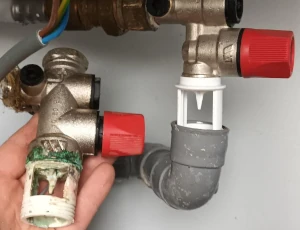
In some cases, particularly when exposed to aggressive water or a damp environment, the metal body of the safety group may corrode. Traces of verdigris on a brass band or rust on metal parts are signs of advanced degradation. If a safety group shows signs of severe corrosion, it must be replaced without delay.
The importance of the safety group for the life of the water heater
Beyond its obvious safety role, the safety group contributes significantly to the longevity of your water heater.
By regulating the pressure inside the tank, it prevents excessive stress on the enamelled vessel and its welds. Repeated pressure variations are a major cause of material fatigue, and can lead to microcracks that progressively develop into leaks.
By preventing hot water from flowing back into the mains, the non-return valve enables the water heater to maintain its temperature without loss, thus reducing heating cycles and the load on the electric resistance.
A properly functioning safety group helps optimize the energy efficiency of your system, and can extend the life of your water heater by several years.
Current standards and regulations
The installation of a safety group is governed by a number of regulations that are important to know.
Standard NF EN 1487 defines the technical characteristics to be met by a safety group for domestic hot water production systems. Among other things, it specifies setting pressure, dimensions, authorized materials and resistance tests.
DTU 60.1 (Document Technique Unifié relative à la plomberie) requires all storage water heaters to be fitted with a safety group, and specifies installation conditions, including the obligation to connect the drain to the sewer.
Current thermal regulations also encourage the use of devices to recover heat from water discharged by the safety group, although this practice is still not widespread in domestic installations.
The cost and choice of a safety group
The price of a safety group varies considerably according to quality, functionality and brand.
A standard entry-level safety group can cost between 15 and 25 euros, while a medium-quality NF-certified model is between 30 and 50 euros. Top-of-the-range models with integrated siphon or stainless steel can cost from 80 to 120 euros.
To choose the right safety group, several criteria need to be taken into account. The connection diameter must match that of your piping (usually 15 mm or 20 mm). The set pressure must be adapted to your installation (7 bar for most domestic installations). NF certification is a guarantee of quality and compliance with standards.
It's also a good idea to choose well-known plumbing brands, which generally offer greater durability and reliable after-sales service.
Conclusion
The safety group is much more than a simple accessory for your water heater: it's an essential protective device that guarantees the safety of your installation and the occupants of your home. Its operation, based on simple but effective physical principles, manages water expansion during heating and prevents dangerous overpressure.
Understanding the role of each component, the different phases of operation and the importance of regular maintenance will help you get the most out of your system and avoid costly problems. A well-maintained safety group, replaced on time, is the guarantee of a reliable, long-lasting water heater.
Don't forget that monthly lever operation is a simple gesture that can save you a lot of trouble, and that preventive replacement every 5 to 10 years represents a minimal investment compared to the risks involved. If you notice a malfunction, don't hesitate to call in a qualified professional for a quick diagnosis and intervention.
Your safety and that of your system depend on it.

Frequently asked questions
The domeashop store offers you a list of questions and answers corresponding to the most frequently asked questions related to the theme and products discussed in this article. If you can't find the answer you're looking for, contact us and our specialists will be happy to help.
Yes, it's perfectly normal for the safety group to leak a few drops of water during and after the heating phase of your water heater. This flow, generally between 2 and 5% of the tank volume, corresponds to the evacuation of water expanded by heat. For a 200-litre tank, this represents approximately 4 to 10 liters per day. On the other hand, a permanent and significant flow outside the heating phases indicates a malfunction requiring intervention.
If you have a basic knowledge of plumbing and the appropriate tools, you can install a safety group yourself, in strict compliance with current standards. The operation involves turning off the water, draining the water heater, dismantling the old unit, installing the new one with the appropriate seals and connecting the drain. However, if in doubt, or if you feel uncomfortable with this type of intervention, it's best to call in a qualified plumber who will guarantee a safe and compliant installation.
The cost of professional replacement of a safety group varies according to your region and the plumber you choose. You should expect to pay between 80 and 150 euros for a standard job, including the supply of the safety unit (20 to 50 euros) and labor (60 to 100 euros). This rate may increase if access to the water heater is difficult, or if additional work is required (installation of a pressure reducer, modification of the piping, etc.).). Asking for several quotes allows you to compare prices and choose the most advantageous offer.
The service life of a safety group depends mainly on the quality of the water (hardness, pH) and the intensity of use of the water heater. Under normal conditions, a good-quality safety unit can operate correctly for 5 to 10 years. However, in regions with very hard water, this period can be reduced to 3-5 years. Manufacturers and professionals recommend systematic replacement every 5 years to guarantee optimum performance and prevent malfunctions. A safety group is an inexpensive piece of equipment whose preventive replacement is preferable to unexpected failure.
A stuck lever usually indicates scaling of the valve mechanism. You can try to unblock it by manoeuvring it several times with a little force, which can sometimes be enough to break up the limescale deposits. If the lever remains stuck despite your efforts, or if it can be operated but does not produce any water flow, the safety group is probably out of order and needs to be replaced quickly. Do not apply excessive force to the lever, as this may break the mechanism or create a permanent leak. In this case, complete replacement of the safety group is the safest and most durable solution.
No, the same safety group is suitable for both vertical and horizontal water heaters. What's important is that the safety group is installed vertically on the cold water inlet, with the drain opening pointing downwards, whatever the position of the tank. Connection diameter (15 mm or 20 mm) and set pressure (generally 7 bar) remain the main selection criteria. On the other hand, for large-capacity water heaters (over 300 liters) or professional installations, it may be necessary to use a reinforced safety group or a specific safety device.
Technically, it's possible to recover the water draining from the safety group and use it for non-drinking purposes (watering, toilet flushing, etc.).). However, this practice requires a specific installation with a drip tray and filtration system, and is rarely implemented in domestic homes due to its complexity and cost. The volume of water evacuated daily (a few liters) generally does not justify such an investment. There are, however, heat recovery systems that preheat the cold water entering the water heater using the heat from the discharged water - a more energy-efficient solution.
A slight hissing sound during the heating phase may be normal and corresponds to the passage of water through the safety valve during decompression. However, loud, persistent whistling usually indicates a problem. Possible causes include excessively high network pressure, partial scaling of the safety group creating a restriction, or a valve manufacturing fault. If the noise is annoying or accompanied by other symptoms (excessive flow, leaks), we recommend that you have the system checked by a professional, who can install a pressure reducer if necessary, or replace the faulty safety group.
If you're going on vacation for a short time (less than two weeks), you don't need to turn off the safety group valve. Simply switch the heater to the "off" or "absence" position if your appliance has this function. However, if you're going to be away for a long time, especially in winter, we recommend draining the water heater completely to avoid any risk of freezing or leaks. In this case, you'll need to turn off the water supply upstream of the safety group, cut off the water heater's power supply, open the hot water taps in the house and activate the safety group's draining device until all the water has been drained.
The safety group and the pressure reducer are two complementary pieces of equipment that perform different functions. The safety group protects the water heater against internal overpressure caused by water expansion during heating, by evacuating excess water when pressure exceeds 7 bar. The pressure reducer is installed upstream of the safety group, and its function is to reduce the pressure of the water network when it is too high (above 5 bar). If the pressure in your water system exceeds 5 bar, you need to install a pressure reducer to protect not only the water heater, but also your entire sanitary installation, and prevent excessive flow through the safety group.