
- Home
-
Electrical equipment
-
Sockets and switches
- Bticino
- Legrand
- Hager
- Schneider Electric
- Jung
-
Modelec
-
Collection Confidence
-
Confidence screw collection
- Narrow Confidence facades
- Narrow Confidence facades screw
- Long, narrow Confidence facades
- Long, narrow Confidence facades screw
- Long, narrow Confidence facades with reading light
- Long, narrow Confidence facades with spot light
- Simple mechanisms for faceplate Confidence
- Reinforced mechanisms for faceplate Confidence
- Reinforced mechanisms for narrow Confidence facades
- Reinforced mechanisms for long, narrow Confidence facades
-
Collection Desir
-
Collection Fascination
-
Collection Hitera
-
Iris Collection
-
Collection Karo
-
Collection M
- Narrow mechanisms
-
Collection Confidence
- Vandal-proof equipment
- Iboco fittings
-
Lighting
-
Interior lighting
-
Wall lights
-
LED strip
-
Downlights
-
Recessed spotlights
-
Surface-mounted spotlights
- Lamps
- Rod-mounted spotlights
- LED panels
-
Suspensions
-
Ceiling lights
-
Track and spotlights track lighting
- Tensioned cable
- Waterproof lighting
- Connected lamps
- Portholes
- Bathroom rulers
- Table lamps
- Panel lighting
- Headboard reading lights
- Light mirror
-
Wall lights
- Outdoor luminaires
- LED bulbs and spotlights
- Special lamps
- Lighting accessories
-
Interior lighting
-
Home security
-
Heating and sanitary
- Heating
-
Individual ventilation
-
Self-adjusting CMV
-
Humidity-sensitive CMV
- Insufflation ventilation
- Double-flow ventilation
- Wall-mounted aerator
- Duct puller
- Ventilation accessories
- Extractors and blowers
- Ventilation grilles
- Flow control
- Roof outlet
- Ventilation box
-
Ventilation duct
- Ventilation sleeve and reducer
- Sound trap
- Ventilation filters
-
Self-adjusting CMV
- Central vacuum
-
Connected home
- Ideas & Advice
-
MenuBack
-
Products
-
-
-
Electrical panel
- Bridging bars, combs
- Electrical protection
- Energy management
- Modular equipment
- Other modular devices
-
-
-
-
-
Interior lighting
- Bathroom rulers
- Ceiling lights
- Connected lamps
- Downlights
- Headboard reading lights
-
Interior lighting
- Bathroom rulers
- Ceiling lights
- Connected lamps
- Downlights
- Headboard reading lights
- Lamps
- LED panels
- LED strip
- Light mirror
- Panel lighting
- Portholes
-
Recessed spotlights
- Aric
- Arkoslight
- Europole
- Faro Barcelona
- Indigo Lighting - Collingwood
- Ledvance
- Paulmann
- Philips
- SG Lighting
- SLV
- Switch Lite
- Rod-mounted spotlights
- Surface-mounted spotlights
- Suspensions
- Table lamps
- Tensioned cable
- Track and spotlights track lighting
- Wall lights
- Waterproof lighting
- Lamps
- LED panels
- LED strip
- Light mirror
- Panel lighting
- Portholes
-
Recessed spotlights
- Aric
- Arkoslight
- Europole
- Faro Barcelona
- Indigo Lighting - Collingwood
- Ledvance
- Paulmann
- Philips
- SG Lighting
- SLV
- Switch Lite
- Rod-mounted spotlights
- Surface-mounted spotlights
- Suspensions
- Table lamps
- Tensioned cable
- Track and spotlights track lighting
- Wall lights
- Waterproof lighting
-
-
-
Outdoor lighting
- Exterior wall lights
- Bollards and lampposts
- Outdoor recessed
- Mobile luminaires
- Projectors
- Outdoor suspensions
- Outdoor ceiling lights
- Spotlights sign
- Solar luminaires
-
Lights and garlands
- Comet garlands
- Stalactite garlands
- Connectable festoons
- Spotlights and patterns
- Classic garlands
- Curtain lights
- Motifs
- Illuminated fir trees
- Luminous balls and animals
- Guinguette garland
- Garlands Bulbs B22
- Garlands Bulbs E27
- Garlands E14 bulbs
- LED connection cable
- Professional decorations
- Garland accessories
- Outdoor illuminated furniture
- Submersible luminaires
-
-
-
-
-
Dimmable LED bulbs: How do they work?

Understanding how a dimmable LED bulb works, how it interacts with a dimmer, and the compatibility requirements helps prevent installation errors. This allows you to choose a model that is compatible with the existing circuit, without the risk of flickering or premature failure.
Contents
- What is a dimmable light bulb?
- The Principle of Variable Lighting
- Dimmable or non-dimmable
- How Does an LED Dimmer Work?
- A light bulb works without a dimmer switch
- Dimming signals
- Applications for Low-Voltage LEDs
- Choose a compatible dimmable light bulb
- Check compatibility with the drive
- Avoiding Gradation Errors
- Choosing the Right Base and Luminous Flux
What is a dimmable light bulb?
A dimmable LED bulb, also known as a dimmable light bulb, contains an electronic driver capable of interpreting a dimming signal to adjust the luminous flux. Unlike a standard LED, which operates at full power, it adjusts its brightness based on the command it receives. Our Guide to LED Bulbs and Spotlights lists these models along with their technical specifications.

The Principle of Variable Lighting
The dimmable feature relies on the internal driver's ability to modulate the current supplied to the LEDs. To understand how this technology actually works, keep this simple point in mind: the drive controls a change in current within this flux range, without ever altering the supply voltage. The driver processes the signal sent by the inverter differently, then reduces or increases the current supplied to the diodes.
- PWM Modulation : The driver turns the LEDs on and off at a high frequency. The eye then perceives a variation in intensity without any noticeable flicker.
- Analog dimming : The current or voltage supplying the LEDs gradually decreases, producing a smooth transition in brightness.
- Dimming range : Most dimmable bulbs can be dimmed down to 10% of their maximum light output, whereas a non-dimmable model turns off abruptly.
The benefits are tangible: electricity consumption decreases as the brightness is lowered, the ambiance adapts to the activity, and the bulb's lifespan can be extended when it operates at reduced brightness. Some models have a rated operating life of up to 15,000 hours; moderate use can further extend their lifespan.
Dimmable or non-dimmable
Check the certification before purchasing. The information on the packaging eliminates the need to open the base to identify the driver type. In Europe, the words "dimmable" or "non-dimmable" have been required to appear on packaging since 2018.
A non-dimmable light bulb cannot be modified to become dimmable: its circuitry is not designed for that purpose. In a circuit that is already equipped with a variable-speed drive, replacing it with a dimmable model prevents this damage to the control circuit. The difference lies in whether the driver is compatible with dimming signals.
| Feature | Dimmable LED bulb | Non-dimmable LED bulb |
| Intensity variation | 10% to 100% of the nominal flow | Always at full power |
| Drive Compatibility | Yes, if the drive is compatible | No, risk of failure |
| Electronic driver | Designed to interpret dimming signals | Fixed circuit, without signal processing |
| Required disclosure (EU) | "Dimmable" on the packaging | "Non-dimmable" on the packaging |
Check the instructions on the packaging or the manufacturer's technical data sheet before installation. For an existing light fixture controlled by a dimmer, you must replace a non-dimmable bulb with a compatible model and use a suitable dimmer: this way, you preserve the circuit and enjoy stable dimming.
How Does an LED Dimmer Work?
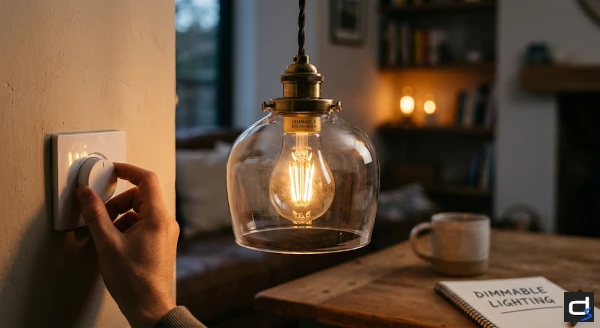
The dimmer is the key component that controls the current sent to the light bulb. It replaces a conventional switch in the lighting circuit and regulates the power supplied to the bulb's driver. Without a dedicated device, it’s impossible to adjust the brightness of a dimmable LED: it simply turns on at full power, just like a regular light bulb.
A light bulb works without a dimmer switch
A dimmable LED bulb works on a standard circuit without a dimmer: it turns on and off normally, at full power. To take advantage of its dimming capability, install a compatible dimmable LED dimmer in place of the existing switch. This wall-mounted device regulates the signal sent to the driver to control the brightness of the light bulb.
- Rotary knob : It allows for continuous and intuitive adjustment of the light intensity, from minimum to maximum, with a single gesture.
- Multi-level push button : Three or four preset brightness levels are activated by successive presses. This solution is appropriate when adjustment accuracy is not a priority.
- Touch control : Press and hold or swipe the surface to adjust the intensity. This control is often integrated into modern home automation systems.
Once the dimmer is installed, the light bulb receives a modulated signal rather than a constant power supply. The driver interprets this signal and adjusts the current sent to the diodes in real time. In practice, you can switch from bright task lighting to soft lighting for an evening without replacing the light bulb or modifying the circuit.
Dimming signals
TRIAC technology is widely used in French 230-volt residential installations. The component cuts off each half-wave of the alternating current; the timing of the cut-off then determines the amount of energy delivered to the light bulb. A falling-edge dimmer is generally better suited to the low power levels of modern LEDs than an older rising-edge model designed for halogen bulbs: it reduces the risk of flickering and overheating. Conversely, an older halogen dimmer can cause the light to flicker or go out abruptly before the brightness reaches zero.
A dimmable light bulb can operate without a dimmer, but its dimming capability remains unused in that case: it behaves like a standard LED. The PWM, 0–10 V, 1–10 V, DALI, and DMX protocols are reserved for integrated lighting systems, LED strips, and more complex home automation systems. For everyday residential use, TRIAC dimming is sufficient in the vast majority of situations.
Applications for Low-Voltage LEDs
Low-voltage LED bulbs and spotlights operating at 12 V or 24 V—such as those with GU5.3, GU4, or G4 bases—require a different installation process than that of a standard 230 V bulb. The dimmer alone is not enough: a dimmer-compatible transformer must be installed between the dimmer and the light bulbs. The manufacturer must specify that this transformer is dimmable or TRIAC-compatible so that the dimming signal is converted correctly.
- TRIAC dimmer : Installed upstream of the power supply on the 230 V mains, it modulates the signal before it is converted to variable low voltage.
- Variable power supply : Labeled “dimmable” or “TRIAC” by the manufacturer, it converts the input TRIAC signal into an output PWM signal suitable for LEDs.
- Electronic ballast : It must support dimming. A standard model that is not compatible may cause flickering or prevent any changes.
- Dimmable GU10 LEDs : These spotlights operate directly at 230 V and do not require a transformer. However, their variable-speed drive must remain compatible with the total connected load.
Depending on the setup of the housing, it may be necessary to replace both the power supply and the dimmer to achieve stable dimming. Before ordering any equipment, verify that the transformer is compatible with the selected drive. The difference lies in the overall compatibility: the bulb, voltage, wattage, dimmer, and power supply must all work together.
Choose a compatible dimmable light bulb
The word “dimmable” on the packaging is a good first indicator. However, it is not enough to ensure that the system operates properly. Compatibility between the light bulb, the dimmer, and the existing electrical circuit is determined based on several technical criteria: an ill-considered choice can cause dimming issues, even with new equipment.
Check compatibility with the drive
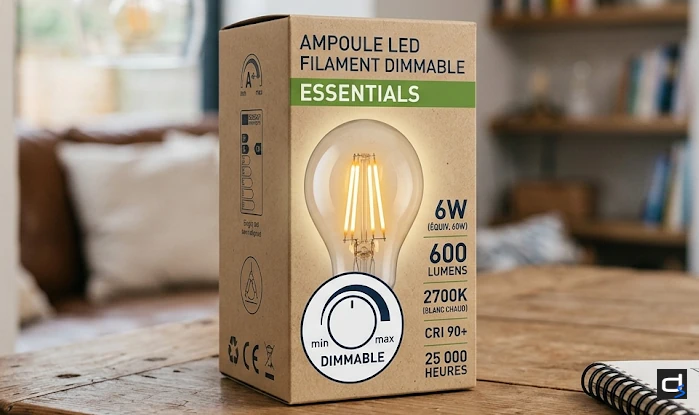
A dimmer must explicitly state that it is compatible with LEDs and that its power range matches that of the connected bulbs. An 8.8-watt dimmable E27 LED bulb, such as the LED Classic PFM CLA60 Frosted Dimmable E27 8.8 W 806 lm, therefore requires a dimmer whose minimum and maximum load ranges fall within this wattage. The difference lies in the combination of these two elements, which are often the source of gradation problems.
- Minimum load for the dimmer : A model that requires a minimum of 20 W will not function properly with a single 4 W LED bulb. The lights may flicker or turn off unexpectedly.
- Maximum load of the dimmer : The total wattage of the light bulbs connected to the same circuit must not exceed the specified capacity. A margin of 10 to 15 percent is still recommended.
- Declared load type : The drive must specify its compatibility with LEDs. A fixture designed exclusively for halogen bulbs will cause an LED to sizzle as soon as it is turned on.
- Circuit consistency : Using the same bulb model in a circuit minimizes performance variations between drivers of different generations or technologies.
The light bulb's technical specifications may also list dimmers that have been tested and approved by the manufacturer. Check this list before making a purchase: doing so reduces the risk of having to replace equipment after installation.
Avoiding Gradation Errors
Certain symptoms indicate that the light bulb and the dimmer are incompatible. Flickering often occurs when the minimum load is not met or when the type of load is not compatible with the technology being used. A buzzing sound may indicate that the dimmer is causing components in the LED driver to vibrate, while the light turning off before reaching the minimum brightness level generally indicates that the dimming signal is no longer being maintained properly.
A residual glow—visible when the light bulb remains dimly lit at the lowest setting—is often caused by a leakage current or by an electrical system that lacks a neutral wire. If these symptoms persist, consider using a next-generation electronic dimmer capable of handling low power levels. It will be better suited for modern LED drivers. Simply replacing the light bulb won't be enough if the dimmer switch isn't compatible.
Choosing the Right Base and Luminous Flux
The base determines mechanical compatibility with the light fixture. Check the light fixture's manual to identify the exact base type before placing an order. Check which type of light bulb is compatible before looking at the luminous flux: this quick step will help you avoid ordering the wrong one.
Measured in lumens, luminous flux determines the perceived brightness in a room. At the same wattage, a dimmable LED can provide a light output comparable to that of a more powerful incandescent bulb, while consuming less electricity. In a living room or bedroom, a light output of 806 lm at 8.8 W—such as that of the LED Classic PFM CLA60—provides comfortable lighting at full power and allows you to adjust the brightness to suit the desired atmosphere.
Color temperature rounds out the selection: 2,700 K produces a warm, soothing light for living spaces, while 4,000 K offers a neutral light suitable for an office or workshop. Wattage, luminous flux, and color temperature also help control energy consumption over time. Depending on the layout of the room, these criteria guide the selection of a dimmable E27 LED bulb and determine the quality of the lighting produced.

Product categories
The domeashop store offers product categories related to this item to provide you with more information about the product(s) you are looking for. Don't hesitate to contact us for advice from our specialists.
Frequently asked questions
The domeashop store offers you a list of questions and answers corresponding to the most frequently asked questions related to the theme and products discussed in this article. If you can't find the answer you're looking for, contact us and our specialists will be happy to help.
Yes. A dimmable LED bulb operates on a standard circuit controlled by a conventional switch. It turns on and off at full power, just like a regular LED bulb. However, to adjust the light intensity, a compatible dimmer must be installed on the circuit; without it, the dimming function simply will not work.
The wall-mounted dimmer replaces the standard light switch and regulates the electrical signal sent to the light bulb. In a 230-volt residential installation, operation often relies on TRIAC technology: this component switches off each half-wave of the alternating current, while the timing of the switch-off determines the amount of energy available to the diodes. The bulb's driver then interprets this signal and adjusts the luminous flux in real time. The dimming remains quiet and stable when the system is compatible.
This residual glow is usually caused by a ground fault in the drive or by an installation that lacks a neutral wire. In that case, the dimmer is not suitable for controlling a low-power LED. Replace it with a newer electronic model that is LED-compatible and designed to handle low loads: this is generally a better solution than replacing the bulb.
The difference lies in the integrated circuit. A dimmable LED has a driver capable of interpreting the dimming signals sent by a dimmer, whereas a non-dimmable LED operates at a fixed power level. Installing a non-dimmable light bulb on a circuit equipped with a dimmer switch can cause flickering, noise, and premature failure. This feature cannot be added through modification, because the bulb's internal circuitry does not allow it.
Check three things: the light bulb must be labeled “dimmable,” the dimmer must be explicitly compatible with LEDs, and the total wattage of the light bulbs must remain within its load range. Allow for a margin of 10 to 15 percent below the maximum value. Best practice when setting up a new installation: Use the same bulb model throughout the circuit and consult the list of dimmers approved by the manufacturer. Depending on the housing configuration, this check helps minimize flickering and compatibility issues.