
- Home
-
Electrical equipment
-
Sockets and switches
- Bticino
- Legrand
- Hager
- Schneider Electric
- Jung
-
Modelec
-
Collection Confidence
-
Confidence screw collection
- Narrow Confidence facades
- Narrow Confidence facades with screws
- Long, narrow Confidence facades
- Narrow, long Confidence facades with screws
- Narrow, long Confidence cabinet fronts with reading lights
- Narrow, long Confidence cabinet fronts with spotlights
- Simple mechanisms for Confidence facades
- Reinforced mechanisms for Confidence facades
- Reinforced mechanisms for narrow Confidence facades
- Reinforced mechanisms for narrow, long Confidence facades
-
Collection Desir
-
Collection Fascination
-
Collection Hitera
-
Iris Collection
-
Collection Karo
-
Collection M
- Narrow mechanisms
-
Collection Confidence
- Vandal-proof equipment
- Iboco fittings
-
Lighting
-
Interior lighting
-
Wall lights
-
LED strip
-
Downlights
-
Recessed spotlights
-
Surface-mounted spotlights
- Lamps
- Rod-mounted spotlights
- LED panels
-
Suspensions
-
Ceiling lights
-
Track and spotlights track lighting
- Tensioned cable
- Waterproof lighting
- Connected lamps
- Portholes
- Bathroom rulers
- Table lamps
- Panel lighting
- Headboard reading lights
- Light mirror
-
Wall lights
- Outdoor luminaires
- LED bulbs and spotlights
- Special lamps
- Lighting accessories
-
Interior lighting
-
Home security
-
Heating and sanitary
- Heating
-
Individual ventilation
-
Self-adjusting CMV
-
Humidity-sensitive CMV
- Insufflation ventilation
- Double-flow ventilation
- Wall-mounted aerator
- Duct puller
- Ventilation accessories
- Extractors and blowers
- Ventilation grilles
- Flow control
- Roof outlet
- Ventilation box
-
Ventilation duct
- Ventilation sleeve and reducer
- Sound trap
- Ventilation filters
-
Self-adjusting CMV
- Central vacuum
-
Connected home
- Ideas & Advice
-
MenuBack
-
Products
-
-
-
Electrical panel
- Bridging bars, combs
-
Electrical protection
- Differential block
- Earth leakage circuit breakers
-
Earth leakage switches
- 40A ground-fault circuit interrupter
- 63A ground-fault circuit interrupter
- ABB ground fault circuit interrupter
- AC-type ground fault circuit interrupter
- Eaton ground-fault circuit interrupter
- Hager ground-fault circuit interrupter
- Legrand ground fault circuit interrupter
- Schneider residual current circuit breaker
- Siemens ground-fault circuit interrupter
- Type A ground-fault circuit interrupter
- Fuses and fuseholders
- Grounding
- Lightning arresters and surge protectors
- Main circuit breaker
-
Modular circuit breakers
- 10A circuit breakers
- 16A circuit breakers
- 20A circuit breakers
- 32A circuit breakers
- ABB circuit breakers
- Circuit breakers Schneider Electric
- D-curve circuit breakers
- Eaton circuit breakers
- Four-pole circuit breakers
- Hager circuit breakers
- Legrand circuit breakers
- Siemens circuit breakers
- Three-phase circuit breakers
- Molded case circuit breaker
- Energy management
- Modular accessories
- Modular equipment
-
-
-
-
-
Interior lighting
- Bathroom rulers
- Ceiling lights
- Connected lamps
- Downlights
- Headboard reading lights
-
Interior lighting
- Bathroom rulers
- Ceiling lights
- Connected lamps
- Downlights
- Headboard reading lights
- Lamps
- LED panels
- LED strip
- Light mirror
- Panel lighting
- Portholes
-
Recessed spotlights
- Aric
- Arkoslight
- Europole
- Faro Barcelona
- Indigo Lighting - Collingwood
- Ledvance
- Paulmann
- Philips
- SG Lighting
- SLV
- Switch Lite
- Rod-mounted spotlights
- Surface-mounted spotlights
- Suspensions
- Table lamps
- Tensioned cable
- Track and spotlights track lighting
- Wall lights
- Waterproof lighting
-
-
-
Outdoor lighting
- Exterior wall lights
- Bollards and lampposts
- Outdoor recessed
- Mobile luminaires
- Projectors
- Outdoor suspensions
- Outdoor ceiling lights
- Spotlights sign
- Solar luminaires
-
Lights and garlands
- Comet garlands
- Stalactite garlands
- Connectable festoons
- Spotlights and patterns
- Classic garlands
- Curtain lights
- Motifs
- Illuminated fir trees
- Luminous balls and animals
- Guinguette garland
- Garlands Bulbs B22
- Garlands Bulbs E27
- Garlands E14 bulbs
- LED connection cable
- Professional decorations
- Garland accessories
- Outdoor illuminated furniture
- Submersible luminaires
-
-
-
-
-
Single-flow or dual-flow mechanical ventilation: how do you choose?

When choosing between a single-flow and a dual-flow mechanical ventilation system, several factors come into play: the purchase and installation budget, the temperature of the supply air, maintenance requirements, and the layout of the home. Here you'll find specific price ranges, financial assistance options that are still available, and practical guidelines to help you choose the right system for your house or apartment.
Contents
- How much should you budget for each mechanical ventilation system?
- Purchase and installation price
- Electricity and heating savings
- Subsidies and vat rates
- Which system offers the most comfort?
- Inlet air temperature
- Air Circulation and filtration
- Outdoor noise and network noise
- What kind of maintenance does each system require?
- Steps for a smooth process
- Filters and controls for a dual-flow system
- Maintenance costs and lifespan
- Which mechanical ventilation system should you choose based on your home?
- Older housing or limited renovation
- New home or major renovation
- Apartment and special considerations
How much should you budget for each mechanical ventilation system?
The cost of a ventilation system is broken down into the purchase price, installation, electricity consumption, and any available financial assistance. This comparative analysis first outlines the installation cost ranges, then compares the fans' energy consumption with the savings on heating costs. Finally, he reviews the public services that are still available.

Purchase and installation price
The cost of a complete installation varies significantly from one technology to another. The dual-flow system does, in fact, require a second duct network and a larger control unit. These amounts are commercial estimates, not regulated rates:
- Self-regulating single-flow system: between 250 and 700 € for a complete installation.
- Single-stream humidity-controlled system: between €350 and €1,050, depending on the number of rooms and access to the ducts.
- Dual-flow: between €2,000 and €7,700, depending on the number of rooms served and the available space.
When it comes to renovations, the price gap is widening: expect to pay between €1,500 and €3,500 for a single-flow system. The cost ranges from €3,500 to €7,000 for a dual-flow system, depending on the home's layout.
| System | Complete installation | Installation during renovation |
| Simple, self-regulating flow | €250 to €700 | €1,500 to €3,500 |
| Single-flow, humidity-controlled system | €350 to €1,050 | €1,500 to €3,500 |
| Dual-flow | €2,000 to €7,700 | €3,500 to €7,000 |
Request a detailed quote for a dual-flow system: unit, two circuits and their insulation, penetrations, ductwork, electrical supply, condensate drainage, balancing, and finishing work. On an older construction site, difficulties in running the conduits caused the estimate to rise from 4,800 to 6,400 euros (excluding tax). This additional cost of €1,600 is an exception, not the average.
Electricity and heating savings
In terms of electricity consumption, a low-power single-flow fan uses about 5 to 30 W, or typically 40 to 250 kWh per year. At 15 W continuously for 8,760 hours, it consumes approximately 131 kWh per year. In contrast, the two fans in a dual-flow unit often consume a combined total of 20 to 80 W. They consume between 150 and 700 kWh per year, depending on the actual flow rate, the resistance of the ducts, and the settings.
In practice, this excess is comparable to the recovered heat. With a flow rate of 150 m³/h and 2,500 degree-days, the calculation “0.34 × 150 × 2,500 × 24 / 1,000” yields approximately 3,060 kWh of theoretical heat loss per year. For every 2,450 kWh recovered, gross energy savings amount to approximately €490 per year at €0.20 per kWh and €245 per year at €0.10 per kWh. With a heat pump that has a COP of 3, those costs drop to 163 €/year. Be sure to include the additional installation and maintenance costs in your calculation.
Subsidies and vat rates
As of september 1, 2026, in mainland france, ventilation is excluded from MaPrimeRénov’ by project (the public assistance program administered by anah for energy-efficiency renovation work). According to Service-Public, it can serve as a supplementary task in a major renovation. Energy-saving certificates (rebates paid by energy suppliers) require the use of form BAR-TH-127 for single-flow, humidity-controlled systems and form BAR-TH-125 for certain high-performance dual-flow systems. The BAR-TH-125 specification requires compliance with technical criteria and installation by a professional.
According to Service-Public, these two systems may also be eligible for a reduced vat rate under certain conditions. As of january 1, 2025, an individual dual-flow system must have an energy efficiency rating of A or higher to qualify. Its temperature ratio must be at least 85%, as measured in accordance with standard NF EN 13141-7 (test method for residential dual-flow units). Its weighted electrical power must not exceed 47.6 WThC in the reference configuration. These energy efficiency thresholds can be found in the technical specifications for the appliances listed in theEquipment catalog for dual-flow mechanical ventilation systems before signing a quote.
Which system offers the most comfort?
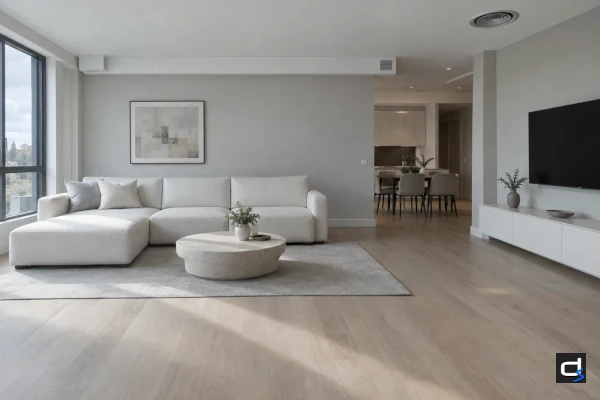
The difference between single-flow and dual-flow mechanical ventilation is most noticeable in the winter, near windows, and at night. Three factors are important: the temperature of the fresh air, its filtration, and the perceived noise level. Each system has its advantages in these three areas.
Inlet air temperature
In winter, the single-flow system expels heated indoor air and draws in cold outdoor air. Its air intakes can then cause a draft near the windows. According to Qualitel (a housing quality certification organization), a dual-flow system recovers 70 to 90 percent of the heat from the exhaust air. This percentage does not reflect the decrease in the heating bill.
Let's consider a theoretical example: 20 °C indoors, 0 °C outdoors, and a heat exchanger with 85% efficiency. The supplied air would then be approximately 17 °C. The actual savings then depend on the flow rate, the climate, the home's airtightness, the heating system, and the settings.
Air Circulation and filtration
To refresh the air, the single-flow system extracts stale air from damp rooms: the kitchen, bathroom, and toilet. Fresh air enters through the main rooms, flows under the doors, and then reaches the exhaust vents, without heat recovery. This basic ventilation system operates at a constant flow rate on theline of self-regulating single-flow mechanical ventilation systems.
Dual-flow ventilation, on the other hand, uses two duct systems and two fans. Outdoor air is filtered and then heated in the heat exchanger without mixing with the exhaust air. Its filters trap dust and pollen based on their filtration rating and protect the heat exchanger. This option is recommended when the home is highly exposed to pollen and indoor air quality is a priority.
Outdoor noise and network noise
The air intakes in a single-flow system can let in street noise. ADEME (the french agency for ecological transition) states that acoustic air inlets can help reduce this nuisance. Choose this model if your bedrooms face a busy street.
A dual-flow system eliminates traditional window screens in living areas, which can improve acoustic comfort. On the other hand, its network can become noisy if it is poorly designed or unbalanced.
The noise is caused by loosely secured ducts, unbalanced airflow, or clogged filters. Anti-vibration mounts under the unit and sound traps in the piping systems limit the transmission of vibrations throughout the home.
What kind of maintenance does each system require?
Maintaining a single-flow mechanical ventilation system is relatively simple, while a dual-flow mechanical ventilation system requires more frequent inspections. The difference lies in the filters, the heat exchanger, and the cost of professional service.
Steps for a smooth process
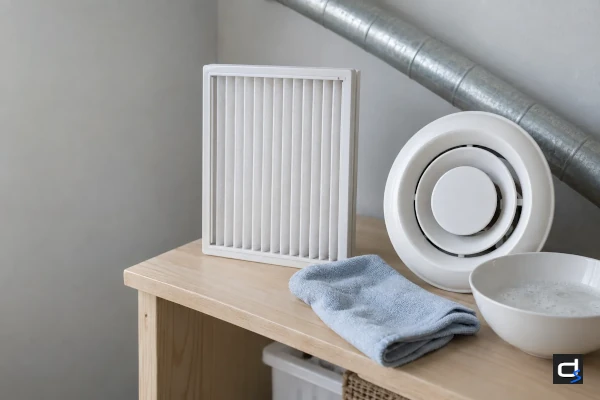
Qualitel recommends dusting off the air intakes every month. The exhaust vents should be cleaned about every 6 months. The motor and fan are inspected once a year, and a specialist inspects the system approximately every 3 years.
In addition, domeashop recommends checking to make sure the ducts are neither clogged nor damaged. An unusual noise or a decrease in flow rate warrants further examination by a professional.
Filters and controls for a dual-flow system
Qualitel recommends cleaning the dust from the filters of a dual-flow system every 6 months. ADEME generally recommends replacing them 1 to 2 times a year, at least after the pollen season, depending on the model and the environment. A clogged filter reduces airflow, increases electricity consumption, and degrades indoor air quality.
Maintenance also covers the heat exchanger, condensate drainage, air vents, fans, and ductwork. ADEME recommends that the occupant perform a complete maintenance check each year and have a professional inspection every 3 years.
Maintenance costs and lifespan
Professional service generally costs between 100 and 150 euros for a simple installation. For a dual-flow meter, expect to pay between €150 and €300, excluding the regulated rate. ADEME estimates the cost at around €130 when access is easy and the attic is safe.
An engine block lasts about 10 to 20 years. With proper maintenance, a dual-flow heat exchanger often lasts 15 years or more. This lifespan depends on the manufacturing process, humidity, dirt buildup, and the quality of the installation.
Which mechanical ventilation system should you choose based on your home?
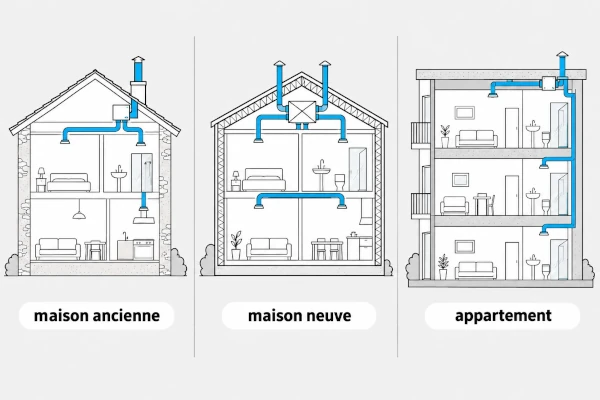
The decision to install a single- or dual-flow mechanical ventilation system depends on the airtightness of the home, the space available for the ducts, and the overall cost of heating and ventilation. Three typical scenarios can help guide your decision.
Older housing or limited renovation
In an older home that is not well sealed or poorly insulated, air that seeps in bypasses the ventilation system. These leaks reduce the expected gain from a dual-flow system. A single stream is therefore easier to consider. There are several variations:
- Self-regulating mechanical ventilation system: essentially constant airflow, without adjustment based on occupancy.
- Hygro A: humidity-controlled exhaust vents, self-regulating air inlets.
- Hygro B: humidity-controlled air vents and inlets, for more precise regulation.
- Existing network: sometimes retained or modified following an assessment.
A self-regulating single-flow mechanical ventilation system does not adjust to humidity levels. domeashop offers, among other things, self-adjusting models from the brands S&P Unelvent, Aldes, and Atlantic.
A single-flow, humidity-controlled mechanical ventilation system increases airflow when the kitchen or bathroom produces more steam. The product lineEasyHOME Hygro, Hygrocosy, and Hydra is part of domeashop's line of humidity-controlled mechanical ventilation systems.
New home or major renovation
In a new, highly airtight home or a major renovation project that includes insulation, a dual-flow system allows for the evaluation of heat recovery and air filtration. Its value is determined by local heating needs, not just by the heat exchanger's rated efficiency. It requires two networks, an accessible control center, flow balancing, and condensate drainage. ADEME recommends placing the unit within the heated space or insulating the components located outside of it. domeashop offers accessories for the InspirAIR Home, InspirAIR Side, InspirAIR TOP, and DEE FLY MODULO product lines. With regard to regulations, the decree of march 24, 1982, requires general and continuous ventilation, without specifying any particular technology. The NF DTU 68.3 series (best practices for mechanical ventilation) provides guidelines for design and installation. The RE2020 (environmental regulations for new construction), which has been in effect since january 1, 2022, does not systematically require a dual-flow system.
Apartment and special considerations
In an apartment with no space for two networks and an accessible control unit, space constraints may make a single-flow system the better choice. A decentralized dual-flow mechanical ventilation system is still an option: its units are installed room by room in the exterior walls. In a condominium, first check whether the ventilation system is individual or shared, what the building regulations say, and who owns the ducts. Making changes to common areas or the exterior appearance may require a permit, and a denial would halt the project in its original form.
If there is a fireplace or a fireplace insert, the mechanical ventilation system must not reverse the draft in a naturally ventilated flue, in accordance with the decree of march 24, 1982. In particular, ADEME recommends a separate air intake for the appliance.

Frequently asked questions
The domeashop store offers you a list of questions and answers corresponding to the most frequently asked questions related to the theme and products discussed in this article. If you can't find the answer you're looking for, contact us and our specialists will be happy to help.
The exhaust system alone is not enough: you need to create a supply air system, install the unit and the filters, balance the systems, and provide for condensate drainage. The old air inlets in the windows must then be sealed off to prevent untreated outside air from entering.
Check the ceiling height, access to the attic or drop ceilings, and the possible route to the rooms. Flat ducts sometimes run under ceilings or behind walls. Rigid or semi-rigid ducts limit pressure drops and noise, and reducing the number of elbows lowers fan power consumption.
Replacing an indoor mechanical ventilation system generally does not require a permit. However, installing a new opening in the facade or roof may require checking local zoning regulations. If a prior declaration is required, the processing time is generally one month, except in special cases.
This valve allows air to bypass the heat exchanger. This way, it avoids heating up the cool night air in the summer. Only certain dual-flow models are equipped with this feature.