
- There are no more items in your cart
- Shipping
- Total €0.00
LED strip lights for the bedroom: A guide to choosing your led lighting

Designing bedroom lighting with LED strips raises several questions: What length should you choose, what color should you go with, and where should you install the strip? this guide will help you choose the right materials and accessories to create a personalized atmosphere with lighting tailored to your space.
Contents
- Choosing an LED strip for the bedroom
- Measuring the LED strip for the bedroom
- Adjust the length of the LED strip to fit the decor
- What LED color is best for sleeping?
- Warm white for a bedroom
- RGB or RGBW, depending on the mood
- Compare LED strips and their performance
- LED density and brightness
- 5050 LEDs or cobs for the bedroom
- Where to place an LED strip in the bedroom
- LED lighting around the bed
- A strip on the ceiling or wall
- Lighted storage units and baseboards
- Install an LED strip with a remote control
- Power supply and lighting safety
- Remote control and RGB control
- Profile for a discreet white strip
Choosing an LED strip for the bedroom
Before placing your order, decide how you want to use it: subtle ambient lighting, a light outline along the ceiling, or a decorative halo behind the bed. Two criteria guide this choice: the total length of the ribbon and its tension.
Measuring the LED strip for the bedroom
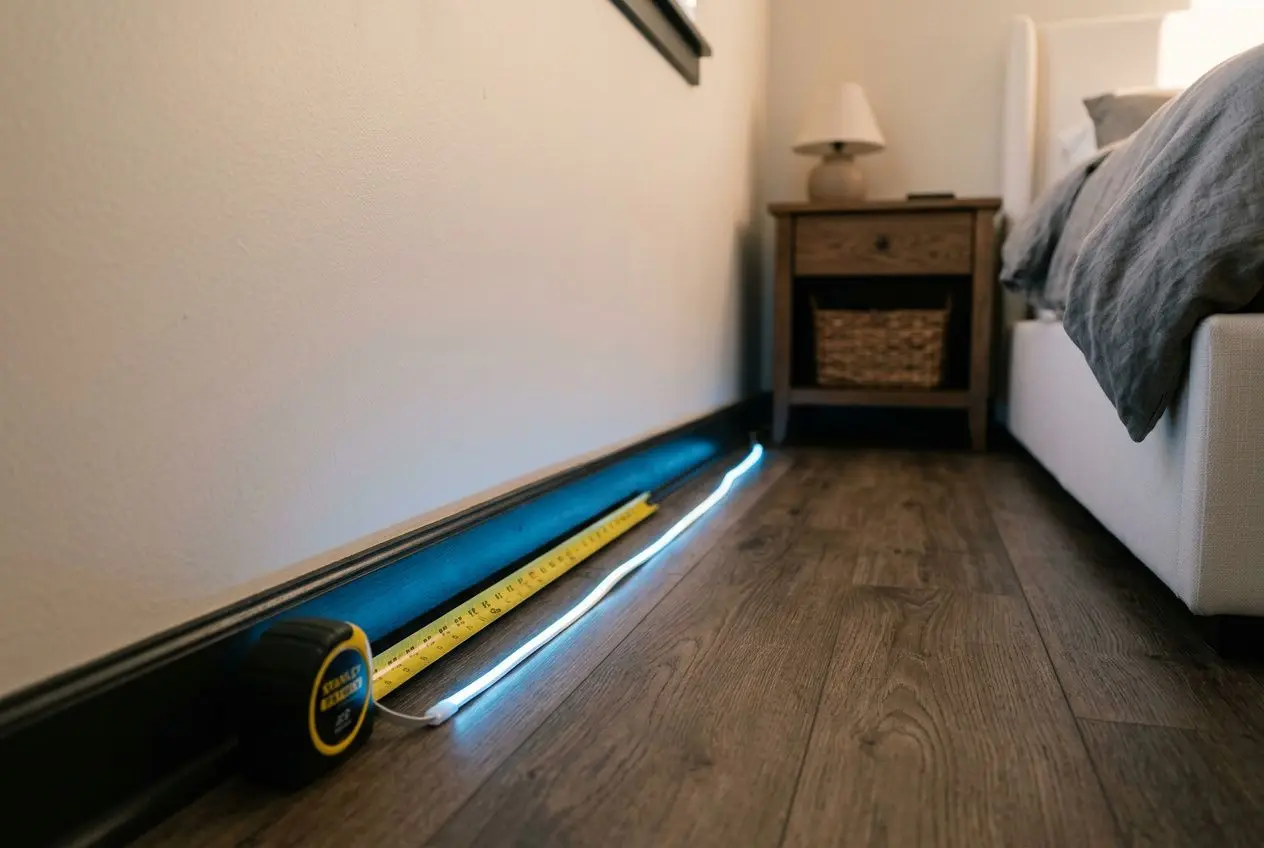
To install the right leds in a bedroom, measure the entire area you want to light, including the corners and the back walls. A difference of just a few centimeters may require a visible splice or a shortening that weakens the circuit. Transfer the measurements to a sketch before placing your order, then add a margin of at least 10 cm per corner.
- 5 meters : a length ideal for highlighting a wall, a low cornice, or framing a headboard with subtle lighting.
- 10 meters : a recommended length for creating a complete light border along the ceiling or highlighting the doors and windows in a large bedroom.
- 24 V : This voltage ensures stable operation up to approximately 10 meters, with no loss of brightness at the end of the strip, making it particularly suitable for large rooms.
- 48 V voltage : It maintains uniform lighting over very long distances, particularly for a ceiling light strip, without any visible loss of brightness.
The power of LED strips generally ranges from 4.8 W/m to 21 W/m, depending on the model. This data is used to size the transformer: multiply the power per meter by the total length, then select a power supply with a capacity that exceeds this result by at least 20%.
Adjust the length of the LED strip to fit the decor
LED strips follow the contours of a curved piece of furniture, a molded plaster cornice, or a slanted wall. This option is best suited for setups with multiple angles; its flexibility reduces the need for additional connectors and maintains electrical continuity.
For decorative lighting along the edge of a cathedral ceiling or to highlight several pieces of furniture, a 15-meter LED strip may be suitable. However, be sure to check the voltage, total power, and power supply options associated with this length. DomeaShop offers 5- and 10-meter rolls, as well as 24-volt models up to 20 meters long for large-scale projects.
Choose a warm color temperature between 2,700 K and 3,500 K to create a relaxing atmosphere, and save the adjustable brightness for when you're reading in bed. For LED lighting placed near the bed or behind the headboard, use indirect lighting to avoid glare.
What LED color is best for sleeping?
The color temperature of an LED strip directly affects the quality of sleep and visual comfort in a bedroom. A white that is too cool stimulates alertness and can make it difficult to fall asleep, while a warm white promotes relaxation more naturally. Choosing the right color, then, means adjusting the lighting to suit each time of day.
Warm white for a bedroom
To create a relaxing atmosphere, choose a warm white color temperature between 2,300 K and 3,500 K: this range produces soft light that is ideal for relaxation. An LED strip installed in the ceiling, within a recessed crown molding, provides indirect, ambient lighting without any glare from above. The amber hue is reminiscent of an incandescent light bulb and creates a warm atmosphere around the bed.
CCT strips allow you to adjust the color temperature between extra-warm white, warm white, neutral white, and cool white depending on the time of day. In the evening, a temperature of 2,200 K helps you fall asleep; in the morning, a temperature of 4,000 K promotes a more energetic wake-up. Some COB strips feature the “Dim to Warm” function: as the light is dimmed, it transitions from a warm white at 2700 K to an even softer hue.
| Color temperature | Range (K) | Recommended for use in the bedroom |
| Extra-hot white | 2,200–2,700 K | A cozy atmosphere, a nightlight, and relaxation at night |
| Warm white | 2,700–3,500 K | Soft main lighting, reading light, relaxation |
| Natural white | 4,000–5,500 K | Daily activities, makeup, and extensive reading |
| Cool white | 6,000 K and higher | Functional accent lighting, walk-in closet, built-in closet |
RGB or RGBW, depending on the mood
RGB LED strips change the color of the room to suit the desired mood. In practice, an LED light strip installed along the wall can shift from an energizing blue in the morning to a soothing red or a warm amber in the evening. This versatility makes it particularly well-suited for rooms that serve both as a place to rest and a space for remote work, provided that the brightness is adjusted to ensure visual comfort.
- RGB : three channels—red, green, and blue—for a wide range of colors; this option is ideal for dynamic decor and festive or romantic atmospheres.
- RGBW : This strip combines RGB colors with a dedicated white channel. This is appropriate when decorative lighting also needs to provide white light that can be used on a daily basis.
- CCT monochrome : The white tone can be adjusted between warm and cool without adding color; this solution is ideal for a minimalist room where only the brightness varies.
- Tinted Monochrome : A fixed color—blue, red, or amber—creates a decorative halo around the headboard without an RGB controller.
The RGBW model offers a versatile solution for a bedroom: colors set the mood, while white provides the perfect backdrop for reading or practical activities. Conversely, a single-color amber or red strip is sufficient for purely decorative use around the bed, offering simpler installation and lower cost. Depending on the layout of your home, make sure the controller is easily accessible so you can adjust the color and brightness without moving any furniture.
Compare LED strips and their performance
Not all LED strips are created equal. The chip used, the density per meter, and the voltage determine the final result. These criteria help you choose the right product from your very first order and avoid visible bright spots, a drop in brightness at the end of the strip, or an under-sized installation.
LED density and brightness
The density of leds per meter directly affects the uniformity and brightness of an LED light strip. To create a soft ambiance, some LED strips for bedrooms sold at big-box stores—particularly at Action—feature 60 leds per meter: this density is suitable for decorative use without overly bright lighting. For a lighted ceiling or functional lighting, use 204 leds per meter or more to create a continuous line.
- 60 LEDs/m : an entry-level density for discreet lighting. It is suitable for moldings and decorative trim when brightness is not a priority.
- 120 LEDs/m : an appealing balance between uniformity and power consumption. This setting is suitable for the headboard or shelves, providing more even lighting without being too bright.
- 204 LEDs/m and above : intense, even lighting—ideal for a luminous ceiling, targeted reading lighting, or a walk-in closet where visibility must remain optimal.
- Up to 840 leds/m : the maximum density offered by certain COB models. It forms an almost continuous line of light, with no visible dots, for demanding applications.
Brightness also depends on the power per linear meter: expect between 4.8 W/m for decorative models and 21 W/m for high-intensity strips. Check the transformer's capacity before finalizing the lengths, as an undersized power supply can shorten the lifespan of the leds. In practice, check the total power calculated for the installation, not just the length of the tape.
5050 LEDs or cobs for the bedroom
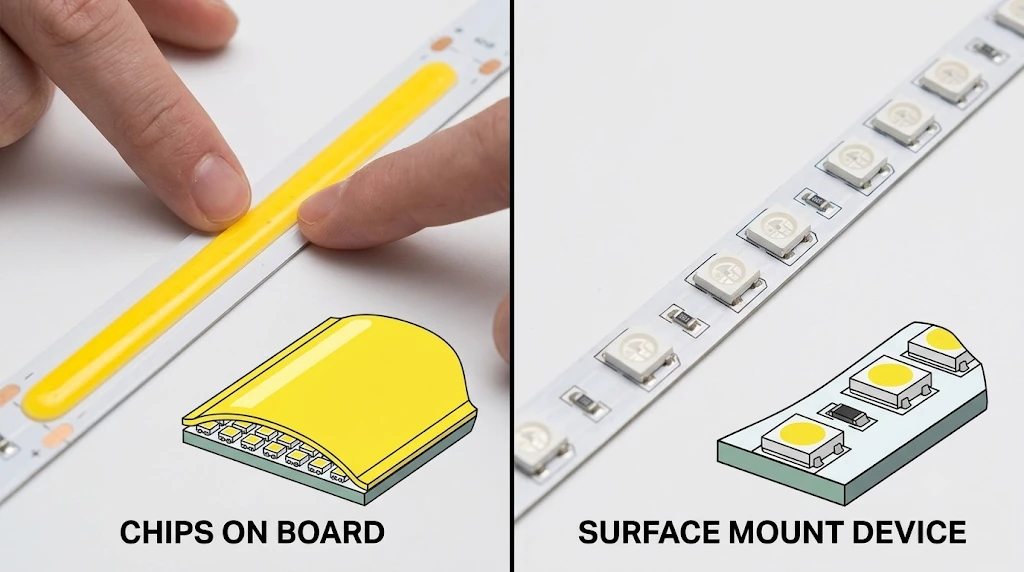
5050 LEDs measure 5 × 5 mm. They offer high power and remain the industry standard for RGB and RGBW strips. Their housing contains three leds, which allow them to produce a wide range of colors with high light intensity. Before comparing products on Amazon, make sure that an RGB LED strip for the bedroom actually uses 5050 leds: color quality depends directly on this choice.
2835 SMD chips, measuring 2.8 × 3.5 mm, are more compact and consume less power for an equivalent luminous flux. They are suitable for monochrome or CCT strips when energy efficiency takes precedence over color saturation. COB strips bring a large number of chips together on a continuous substrate: the individual light points disappear almost entirely, and the light strip becomes very uniform.
When mounted on a wall or ceiling, a COB strip emits a softer, more indirect light, sometimes without an additional diffuser. It is therefore suitable for cornices and recessed niches where soft lighting is desired. Conversely, low-voltage LED strips equipped with 5050 SMD leds are ideal for creative projects: the color changes as needed and can be controlled using a remote control or an app. For a bedroom, be sure to choose a wattage that's appropriate for the intended use to ensure good lighting near the bed.
Where to place an LED strip in the bedroom
The placement of an LED strip can dramatically change the look of a room. Whether placed along the ceiling, behind the bed, or under a piece of furniture, the same lighting fixture does not create the same light or the same atmosphere. First, measure the perimeter of the area to be fitted and note the exact location of the bed or crown molding.
LED lighting around the bed
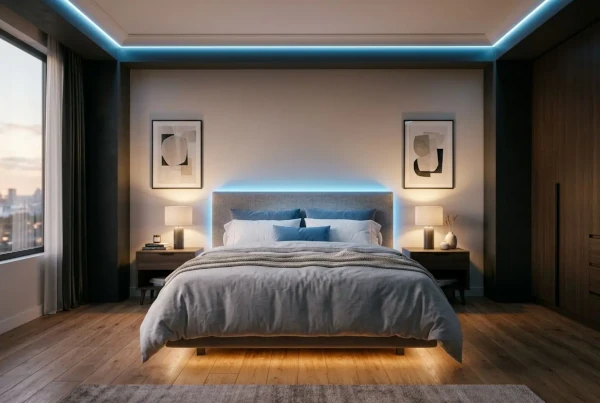
Mounted behind the headboard, an LED strip creates a warm and functional decorative glow. Choose a warm white at 2700 K for a soft nightlight, or a neutral white for reading. In a shared room, this targeted lighting minimizes disruption to the other occupant.
- Halo behind the headboard : decorative backlighting effect with a warm white or RGB strip, allowing you to change the color and create different moods.
- Above the headboard : targeted, glare-free reading light with a natural white 4000 K strip light directed downward.
- Under the bed frame : an LED light strip that casts a soft glow toward the floor, creating the impression of a floating bed. It can also be used as a night light.
- Behind the tv : an LED strip mounted on the wall behind the screen to reduce visual contrast and improve eye comfort while watching.
For installation around the headboard, be sure to use a power supply rated for the total wattage of the strip, connectors compatible with your model, and a cord equipped with a switch. If the strip is RGB, add an RGB controller to control the color and brightness. DomeaShop brings these accessories together in a bedroom set complete.
A strip on the ceiling or wall
Ideal for minimizing glare, a ceiling cove provides indirect, even lighting. The strip remains invisible from the bed, while its light is reflected upward or along the ceiling, depending on its orientation.
- Recessed cove lighting : LED strip installed in a ceiling recess to provide indirect lighting, available in warm white or with an adjustable color temperature (CCT).
- Ceiling edge : LED strip mounted around the perimeter to form a light border. 10 meters is enough for a standard room, compared to 15 to 20 meters for a larger layout.
- Accent wall : LED strips for bedrooms installed along a textured wall or a piece of art to highlight the texture and enhance the depth of the decor.
- Wall shelves : LED strips mounted under each shelf to highlight the items while creating an intimate, ambient glow.
Once the fixture has been installed on the crown molding, look at the reflection on the ceiling from the center of the room to check that the lighting is even. A drop in intensity at the end of the strip usually indicates an undersized power supply or a 12-volt strip that is too long. In this case, a 24-volt or 48-volt model will help maintain more uniform lighting.
Lighted storage units and baseboards
In a walk-in closet, a white LED strip light placed above the clothes rod improves visibility of the clothes without requiring a separate light fixture. Cool white creates a crisp, contemporary look; warm white creates a more welcoming atmosphere. The difference lies in the furniture's design and the room's overall atmosphere. Look for the cutting marks every 5 or 10 cm, depending on the model, to adjust the strip to the exact length of each closet.
Under the baseboards, an LED strip casts a soft, low-angle light onto the floor, which can make the space appear larger. Place it along the perimeter to guide the way to the door or the bathroom. LED strips for bedrooms can be mounted on wood, concrete, glass, or aluminum, provided that the surface is thoroughly cleaned and dried before installation.
Install an LED strip with a remote control
Once you've chosen a model, the success of the installation depends on three factors: a properly sized power supply, a control system compatible with the type of LED, and a neat finish using a profile. These choices affect home safety and the longevity of the lighting.
Power supply and lighting safety
12-volt, 24-volt, and 48-volt LED strips cannot be plugged directly into a 230-volt household electrical outlet. A suitable transformer converts the voltage and protects the system. An undersized power supply causes gradual overheating and reduces the lifespan of the leds, which can reach 50,000 hours when the equipment is properly sized.
- Suitable transformer : Choose a transformer with a capacity at least 20% greater than the total power of the strip, calculated as follows: length in meters × power in W/m.
- Connectors and cord : For installation around the headboard, choose connectors that are compatible with the strip and a power cord equipped with a switch.
- RGB or CCT controller : It allows you to control the color or color temperature. Place it between the transformer and the ribbon before turning on the power.
- Motion sensor : This option is suitable for a walk-in closet or as a nightlight. The tape activates automatically without any manual intervention and prevents the light from being left on.
For installation in a walk-in closet, the motion sensor paired with the LED strip is particularly cost-effective: the light turns on when the door opens and then turns off automatically after a customizable delay. In practice, an IP20 strip light is suitable for indoor use outside of bathrooms. This rating provides sufficient protection against dust without adding unnecessary waterproofing to a room.
DomeaShop lists the power supplies, connectors, and controllers that are compatible with its LED strips, making it easy to put together a complete kit. Always check the voltage: A 12-volt transformer used with a 24-volt strip will permanently damage the leds the first time it is powered on.
Remote control and RGB control
The remote control is the easiest way to control the power, color, lighting effects, and brightness of an RGB or RGBW strip. It requires no network configuration and works as soon as installation is complete, making it ideal for homes without a home automation hub. The models offered by DomeaShop typically include a color wheel, transition modes, and a dimmer.
Wi-Fi-connected LED strips can be controlled using a mobile app. They allow you to create specific scenarios: a natural white lighting atmosphere for reading in the evening, a gradual wake-up with warm white light in the morning, or a simulation of occupancy while you're away. Compatibility with voice assistants also makes remote control easier, which is especially useful when the home already has a home automation system or connected devices.
An infrared remote control is all you need for easy operation. Conversely, when multiple areas of the room use independent LED strips, a Wi-Fi controller with an app synchronizes the various lights from a single location. In particular, this setup allows all the LED strips in the bedroom to be set to extra-warm white before the lights are turned off.
Profile for a discreet white strip
The aluminum profile protects the strip from dust and impacts, while ensuring even distribution of LED light along a ledge or shelf. Depending on the layout of the space, choose a recessed profile for a flush finish or a surface-mounted model for quick installation on an existing surface.
A frosted diffuser softens the light and improves its uniformity. The difference lies in the visibility of the light points: when positioned correctly, the diffuser prevents them from being visible from the head of the bed, even when the light is shining directly into the room.

Frequently asked questions
The domeashop store offers you a list of questions and answers corresponding to the most frequently asked questions related to the theme and products discussed in this article. If you can't find the answer you're looking for, contact us and our specialists will be happy to help.
The most common locations are the ceiling cove for indirect lighting, the back or top of the headboard, the underside of the bed frame, and the baseboards. In a walk-in closet, an LED strip mounted above the clothes rod improves visibility of the clothes.
An extra-warm white light, around 2,200 K, helps you fall asleep, while a warm white light ranging from 2,300 K to 3,500 K creates a relaxing atmosphere. Avoid cool white light in the evening: it stimulates alertness. At night, a motion-sensing light strip can also serve as a nightlight.
A combination that works well: indirect lighting along the crown molding to set the overall mood, complemented by task lighting above the headboard for reading, using natural white light at 4000 K. A CCT or Dim-to-Warm strip allows you to adjust the color temperature based on the time of day.