
- Home
-
Electrical equipment
-
Sockets and switches
- Bticino
- Legrand
- Hager
- Schneider Electric
- Jung
-
Modelec
-
Collection Confidence
-
Confidence screw collection
- Narrow Confidence facades
- Narrow Confidence facades with screws
- Long, narrow Confidence facades
- Narrow, long Confidence facades with screws
- Narrow, long Confidence cabinet fronts with reading lights
- Narrow, long Confidence cabinet fronts with spotlights
- Simple mechanisms for Confidence facades
- Reinforced mechanisms for Confidence facades
- Reinforced mechanisms for narrow Confidence facades
- Reinforced mechanisms for narrow, long Confidence facades
-
Collection Desir
-
Collection Fascination
-
Collection Hitera
-
Iris Collection
-
Collection Karo
-
Collection M
- Narrow mechanisms
-
Collection Confidence
- Vandal-proof equipment
- Iboco fittings
-
Lighting
-
Interior lighting
-
Wall lights
-
LED strip
-
Downlights
-
Recessed spotlights
-
Surface-mounted spotlights
- Lamps
- Rod-mounted spotlights
- LED panels
-
Suspensions
-
Ceiling lights
-
Track and spotlights track lighting
- Tensioned cable
- Waterproof lighting
- Connected lamps
- Portholes
- Bathroom rulers
- Table lamps
- Panel lighting
- Headboard reading lights
- Light mirror
-
Wall lights
- Outdoor luminaires
- LED bulbs and spotlights
- Special lamps
- Lighting accessories
-
Interior lighting
-
Home security
-
Heating and sanitary
- Heating
-
Individual ventilation
-
Self-adjusting CMV
-
Humidity-sensitive CMV
- Insufflation ventilation
- Double-flow ventilation
- Wall-mounted aerator
- Duct puller
- Ventilation accessories
- Extractors and blowers
- Ventilation grilles
- Flow control
- Roof outlet
- Ventilation box
-
Ventilation duct
- Ventilation sleeve and reducer
- Sound trap
- Ventilation filters
-
Self-adjusting CMV
- Central vacuum
-
Connected home
- Ideas & Advice
-
MenuBack
-
Products
-
-
-
Electrical panel
- Bridging bars, combs
-
Electrical protection
- Differential block
- Earth leakage circuit breakers
-
Earth leakage switches
- 40A ground-fault circuit interrupter
- 63A ground-fault circuit interrupter
- ABB ground fault circuit interrupter
- AC-type ground fault circuit interrupter
- Eaton ground-fault circuit interrupter
- Hager ground-fault circuit interrupter
- Legrand ground fault circuit interrupter
- Schneider residual current circuit breaker
- Siemens ground-fault circuit interrupter
- Type A ground-fault circuit interrupter
- Fuses and fuseholders
- Grounding
- Lightning arresters and surge protectors
- Main circuit breaker
-
Modular circuit breakers
- 10A circuit breakers
- 16A circuit breakers
- 20A circuit breakers
- 32A circuit breakers
- ABB circuit breakers
- Circuit breakers Schneider Electric
- D-curve circuit breakers
- Eaton circuit breakers
- Four-pole circuit breakers
- Hager circuit breakers
- Legrand circuit breakers
- Siemens circuit breakers
- Three-phase circuit breakers
- Molded case circuit breaker
- Energy management
- Modular accessories
- Modular equipment
-
-
-
-
-
Interior lighting
- Bathroom rulers
- Ceiling lights
- Connected lamps
- Downlights
- Headboard reading lights
-
Interior lighting
- Bathroom rulers
- Ceiling lights
- Connected lamps
- Downlights
- Headboard reading lights
- Lamps
- LED panels
- LED strip
- Light mirror
- Panel lighting
- Portholes
-
Recessed spotlights
- Aric
- Arkoslight
- Europole
- Faro Barcelona
- Indigo Lighting - Collingwood
- Ledvance
- Paulmann
- Philips
- SG Lighting
- SLV
- Switch Lite
- Rod-mounted spotlights
- Surface-mounted spotlights
- Suspensions
- Table lamps
- Tensioned cable
- Track and spotlights track lighting
- Wall lights
- Waterproof lighting
- Lamps
- LED panels
- LED strip
- Light mirror
- Panel lighting
- Portholes
-
Recessed spotlights
- Aric
- Arkoslight
- Europole
- Faro Barcelona
- Indigo Lighting - Collingwood
- Ledvance
- Paulmann
- Philips
- SG Lighting
- SLV
- Switch Lite
- Rod-mounted spotlights
- Surface-mounted spotlights
- Suspensions
- Table lamps
- Tensioned cable
- Track and spotlights track lighting
- Wall lights
- Waterproof lighting
-
-
-
Outdoor lighting
- Exterior wall lights
- Bollards and lampposts
- Outdoor recessed
- Mobile luminaires
- Projectors
- Outdoor suspensions
- Outdoor ceiling lights
- Spotlights sign
- Solar luminaires
-
Lights and garlands
- Comet garlands
- Stalactite garlands
- Connectable festoons
- Spotlights and patterns
- Classic garlands
- Curtain lights
- Motifs
- Illuminated fir trees
- Luminous balls and animals
- Guinguette garland
- Garlands Bulbs B22
- Garlands Bulbs E27
- Garlands E14 bulbs
- LED connection cable
- Professional decorations
- Garland accessories
- Outdoor illuminated furniture
- Submersible luminaires
-
-
-
-
-
How to choose the perfect LED bulb for your home

Choosing the right LED bulb for your home requires an understanding of a few technical criteria: base type, luminous flux in lumens, color temperature in kelvins, compatibility with a dimmer, and protection rating.
Contents
- Choosing the base and compatibility
- Identify the light fixture's base
- Check the drive and the dimensions
- Power and lumens by room
- Adjust the lighting to suit each use
- Compare light equivalents
- Which light color should you choose?
- Create a warm atmosphere
- Achieve accurate color reproduction
- Choose a light bulb that's right for the fixture and its intended use
- Choosing the right lighting angle
- Decorative string lights or smart lighting
- Assessing lifespan and effectiveness
Choosing the base and compatibility
The physical compatibility between the light bulb and the light fixture determines the entire choice. Identify the exact base type of the existing light fixture, then check the dimensions of the bulb you plan to use to avoid any unpleasant surprises during installation.
Identify the light fixture's base
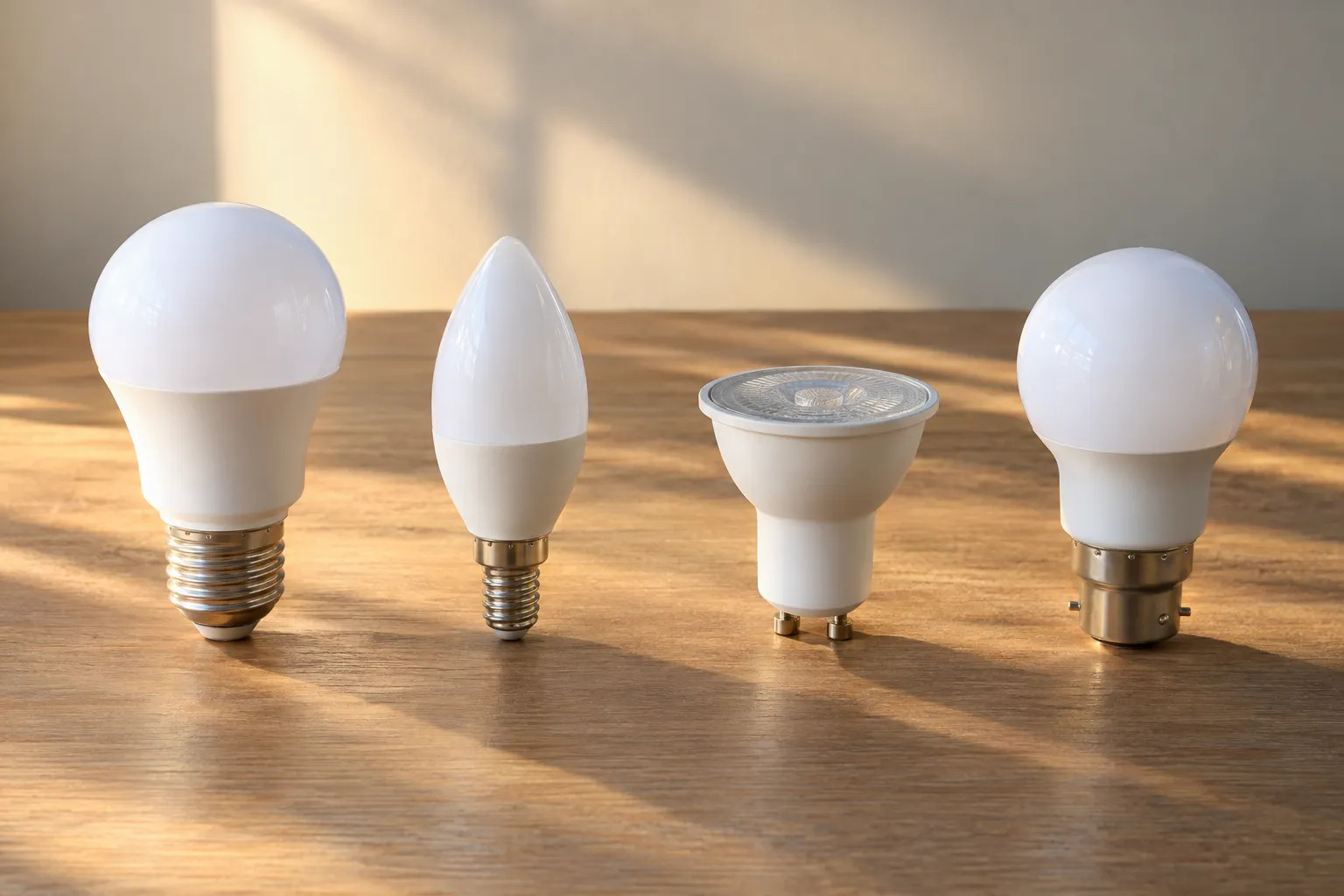
The base is the essential starting point when choosing an LED bulb for your home: it must fit the light fixture’s socket exactly; otherwise, installation is not possible. E27 and E14 screw-in bases are the most common in typical homes; the E27 has a diameter of 27 mm, and the E14 has a narrow 14 mm screw. The B22 bayonet mount, on the other hand, snaps into place with a quarter-turn and measures 22 mm. ForChoosing the right LED lighting, ADEME reminds consumers that checking the base is the first step to take before making any purchase.
- E27 and E14 (screw) operate directly on 230 V, without a transformer; the E27 is suitable for standard pendant lights and ceiling fixtures, while the E14 is suitable for wall sconces and small light fixtures.
- GU10 (230 V spotlights) screws into recessed spotlights; it also operates at 230 V without a transformer, unlike the GU5.3, which requires a 12 V power supply.
- B22 (bayonet) is still commonly found in older homes; its quarter-turn locking mechanism is sturdy but requires precise handling during installation.
- The G9 and GX53 are used in compact fixtures and flat ceiling lights; both operate at 230 V and are compatible with many replacement LED bulbs.
Before confirming your order, be sure to check that the bulb fits in the light fixture in question. Some replacement leds are longer or wider than the original model and may prevent the cover or globe from closing. TheLED filament bulbs The products listed by DomeaShop include their full dimensions, allowing you to check the height and diameter before replacing a model.
Check the drive and the dimensions
Compatibility with a variable-speed drive is a criterion that is often overlooked. If you are using a dimmer switch, the light bulb must have the label dimmable on its packaging; otherwise, it may flicker, buzz, or fail prematurely. The dimmer itself must be designed for LED technology, as older models intended for halogen bulbs are not always compatible.
To make it easier to convert between the old wattage and luminous flux in lumens, a rule of thumb is to divide the wattage of the bulb being replaced by 8 to 10 to estimate the equivalent LED wattage. Watts now indicate only power consumption, never brightness: the difference lies in lumens.
The packaging for an LED bulb must include the following information: the base type, energy efficiency class, luminous flux in lumens, estimated lifespan, power consumption, color temperature, and compatibility level. TheGuide to smart light bulbs describes the connection protocols and home automation compatibility needed to integrate these models into an existing system. Once all this information has been verified, the selection can be narrowed down based on the desired brightness and color. The layout of the room and the house then plays a role in the final decision.
Power and lumens by room
The brightness of an LED bulb is measured in lumens, not watts. Tailoring this lighting to the actual needs of each space prevents both overly dim lighting and excessive energy consumption. Each type of room requires different levels of illuminance, measured in lux, which directly guide the selection of the right model.
Adjust the lighting to suit each use
The difference lies in the distribution of light sources rather than solely in the brightness of the central light fixture. To determine which LED bulb to choose for a living room, aim for an illuminance of 100 to 200 lux: a 20 m² room will therefore require between 2,000 and 4,000 lumens, distributed among the main light fixture, wall sconces, and accent spotlights. A single central light fixture with an output of 1,000 to 1,500 lm is sufficient for general lighting, with each additional spot light consuming between 5 and 7 W.
- Living room: 100 to 200 lux recommended; central light fixture with 1,000 to 1,500 lm, accent spotlights of 5 to 7 W each; warm white (2,700 K) is preferred for ambiance.
- Kitchen: 300 to 500 lux required; central lighting of 1,500 to 2,000 lm; 6- to 9-W GU10 LED spotlights for work areas; neutral white (4,000 K) recommended.
- Bedroom: 100 to 150 lux is sufficient; main light fixture with 1,000 to 1,200 lm, warm white (2,700 K), and a dimmable feature is recommended to adjust the brightness according to the time of day.
- Bathroom: 200 to 300 lux required; minimum protection rating of IP44 in the relevant areas; 12 V low-voltage safety power supply required in zones 0 and 1, in accordance with standard NF C 15-100.
The kitchen is the room that requires the highest light output to ensure optimal visibility on the countertop. Conversely, a bedroom benefits from softer lighting, which calls for models with low light output and a warm color temperature.
| room | Recommended Lux | Total luminous Flux (lm) | Power per source | Recommended temperature |
| Salon | 100 – 200 lux | 2 000 – 4 000 lm | 5–7 W (spotlights) | 2 700 K |
| Kitchen | 300 – 500 lux | 1 500 – 2 000 lm | 6 – 9 W (GU10) | 4 000 K |
| Room | 100 – 150 lux | 1 000 – 1 200 lm | 10 – 12 W | 2 700 K |
| Bathroom | 200 – 300 lux | 1 000 – 1 500 lm | Varies by IP | 4 000 K |
Compare light equivalents
To determine what wattage of LED bulb to choose for a bedroom or other room, it's helpful to start with the old bulb that's currently in place and convert its wattage to lumens. The established equivalencies are as follows: 249 lm replaces a 25 W bulb, 470 lm replaces a 40 W bulb, 806 lm equals 60 W, 1,055 lm equals 75 W, and 1,521 lm equals 100 W.
In addition, LED technology offers significantly greater energy efficiency than traditional light sources: at the same brightness level, an LED consumes about one-tenth as much energy as an incandescent bulb and one-seventh as much as a halogen bulb. In a complete installation comprising multiple light fixtures, the difference in energy consumption becomes significant over the course of a year, without compromising visual comfort or lighting quality.
Which light color should you choose?
Color temperature directly affects the perception of space and the sense of well-being in each room. Two light bulbs with the same light output can create radically different atmospheres depending on their temperature in kelvins.
Create a warm atmosphere
LEDs are superior in terms of lifespan, efficiency, and availability, as energy-efficient compact fluorescent bulbs are gradually being phased out of the market. LED technology now covers the entire range of color temperatures, from very warm white to neutral white.
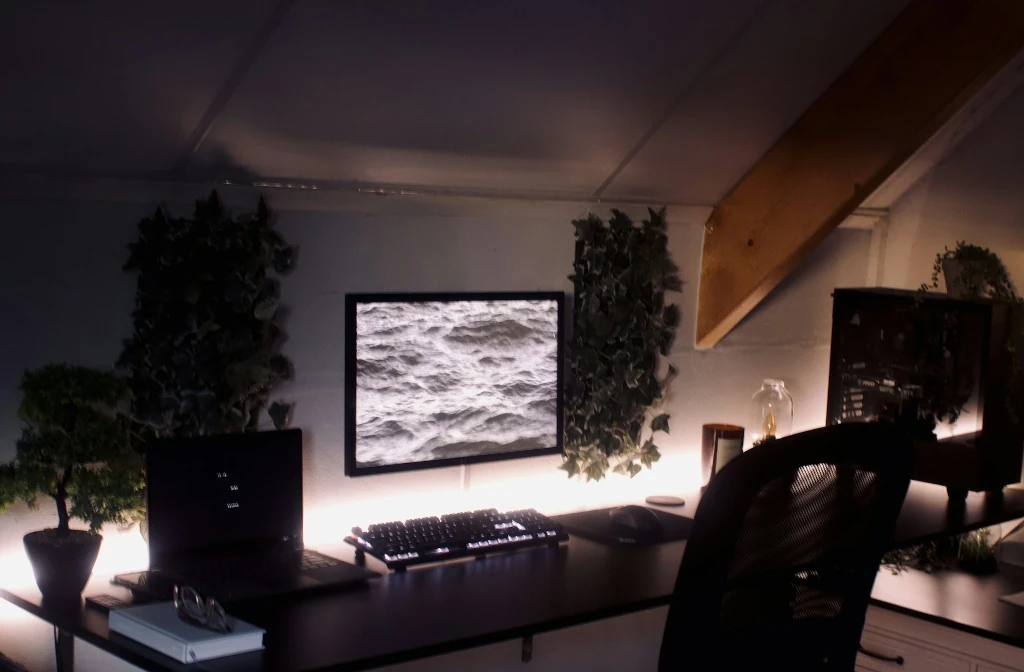
Warm white—below 3,000 K—is the best choice when the goal is to create a relaxing and inviting atmosphere in a living room or bedroom. The 2,700 K color temperature, the most common in homes, replicates the warm, golden glow of old incandescent bulbs. Even lower temperatures, ranging from 1,800 to 2,400 K, are ideal for decorative lighting and relaxation areas with a particularly intimate atmosphere.
Neutral white, ranging from 3,500 to 4,500 K, is suitable for activity areas: kitchen countertops, bathroom mirrors, desks, or reading areas. Cool white light—above 6,000 K—is reserved for technical and professional uses; it is not recommended for residential living spaces.
Achieve accurate color reproduction
The color rendering index, often referred to by the abbreviation cri, measures on a scale of 1 to 100 how accurately a light source renders the colors of illuminated objects. LED bulbs generally have a cri between 70 and 80; a cri above 80 is recommended for everyday household use, particularly in the kitchen, the closet, or in front of a mirror, where color accuracy is crucial.
An IRC of 90 or higher is important for showcasing decorative objects, paintings, or textiles whose colors must be reproduced accurately. Depending on the layout of the home, certain spaces—such as a hallway or a utility room—may require a lower IRC, while living areas and workspaces deserve special attention when choosing the right light bulb.
Choose a light bulb that's right for the fixture and its intended use
Lighting: Beyond the socket and color temperature, the beam angle and the type of bulb determine the final result in every room of the house. The same 800-lumen bulb installed in a recessed spot light or in an open pendant light will not create the same atmosphere at all.
Choosing the right lighting angle
The beam angle determines how the light flux is distributed in space: a narrow beam concentrates the energy on a specific area, while a wide beam spreads the light over a large area.
- Recessed spotlights: An angle of 36° to 60° is suitable; at angles greater than 90°, the installation already limits the beam spread, and a wider angle offers no additional benefit.
- Highlighting objects or paintings: A narrow beam accentuates details and creates a focused highlighting effect, without serving as general lighting for the room.
- Open-style pendant lights and ceiling lights: A wide beam angle is essential for distributing light to every corner of the room and avoiding shadows.
In practice, it's also worth checking the physical dimensions of the bulb when using recessed spotlights with compact housings. Some LED models are slightly thicker than the halogen bulbs they replace and may protrude slightly beyond the edge of the fixture. Check the dimensions in the product specifications before placing an order to avoid mechanical incompatibility during installation.
Decorative string lights or smart lighting
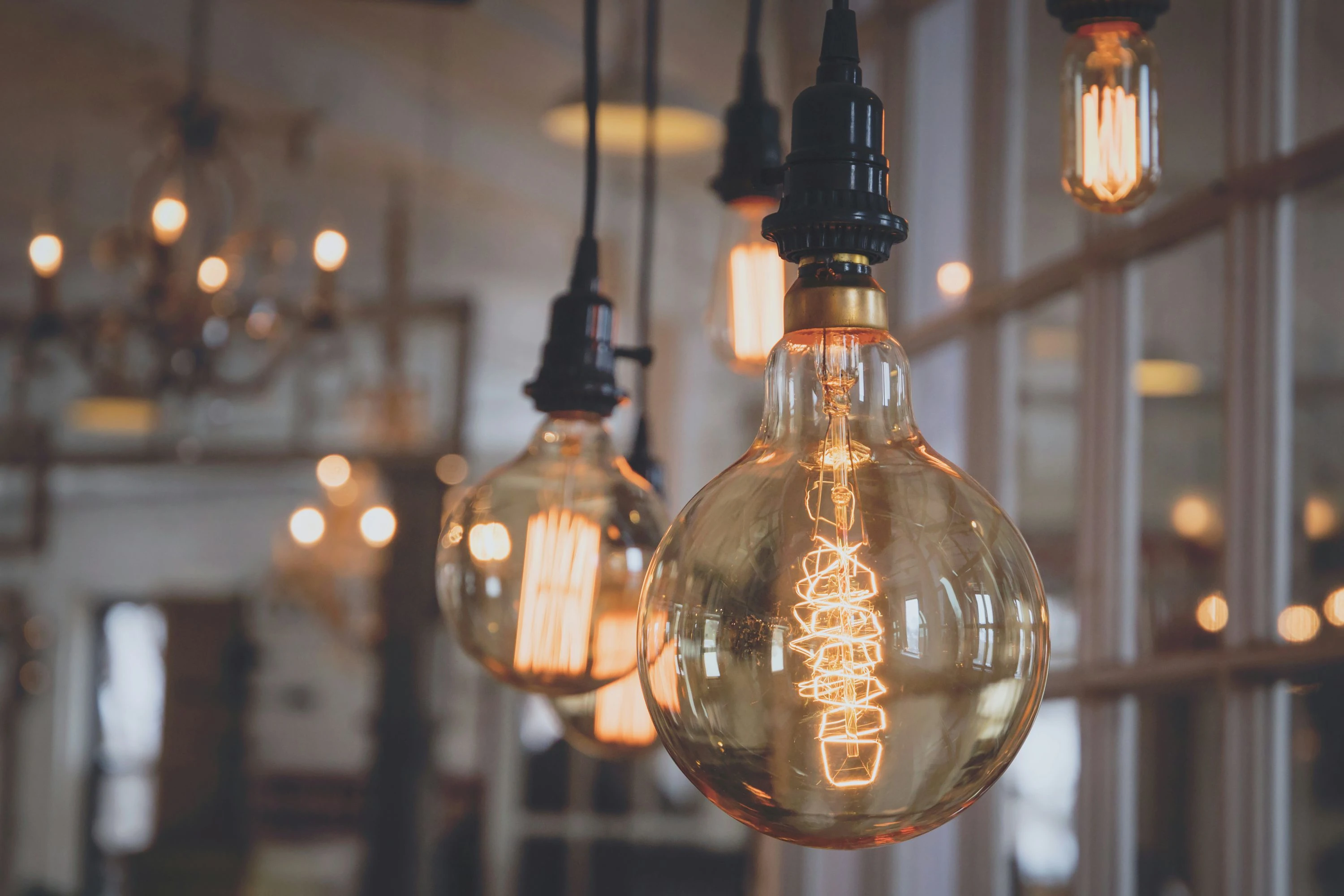
LED filament bulbs combine visible light-emitting filaments with lower energy consumption compared to older incandescent models. Available in pear, sphere, flame, globe, cylinder, or Edison shapes, they are particularly well-suited for designer pendant lights where the bulb remains visible. A 2,700 K color temperature with amber or tinted glass creates a warm atmosphere.
Smart light bulbs—available in E27, E14, B22d, and GU10 sizes, among others—allow you to control brightness, light color, and scheduling from a smartphone, tablet, or voice assistant. Wi-Fi, Bluetooth, and Bluetooth mesh protocols ensure compatibility with leading smart home systems. Depending on the level of protection required against outages or intrusions, automated scenarios can also simulate a presence or trigger an alert.
Assessing lifespan and effectiveness
The advertised lifespan of an LED bulb is generally between 15,000 and 25,000 hours, depending on the model, compared to a few hundred to a few thousand hours for a standard halogen bulb. However, it is important to keep in mind that these lifespans are calculated by extrapolating from component tests, and that some models may begin to fail before the stated lifespan expires.
To choose between two light bulbs with similar light output, divide the lumens by the watts to get the lumens-per-watt efficiency: the model with the better efficiency provides the same amount of light while consuming less power, which generates less heat and better protects the internal components. At the same brightness, an LED consumes about one-tenth as much energy as an incandescent bulb, one-seventh as much as a halogen bulb, and half as much as a compact fluorescent bulb.

Frequently asked questions
The domeashop store offers you a list of questions and answers corresponding to the most frequently asked questions related to the theme and products discussed in this article. If you can't find the answer you're looking for, contact us and our specialists will be happy to help.
A 20-square-meter living room requires a total of 2,000 to 4,000 lumens to achieve an illuminance of 100 to 200 lux, in accordance with recommendations for a living room. This light is distributed among the central light fixture, the wall sconces, and the accent spotlights. A single ceiling light with an output of 1,000 to 1,500 lm provides general lighting; each additional spot light consumes between 5 and 7 watts to provide targeted lighting.
For a bedroom or living room, a color temperature of 2,700 K is the standard: it produces a soft, warm light, similar to the ambiance of old incandescent bulbs, which is conducive to relaxation. Temperatures between 1,800 and 2,400 K are suitable for very intimate decorative lighting. Best suited for rooms used for rest. On the other hand, light colors above 4,000 K are best suited for activity areas such as the kitchen or office, where brighter light promotes concentration.
No: Only light bulbs labeled "dimmable" on their packaging are compatible with a dimmer. If this information is not provided, the bulb may flicker, hum, or fail prematurely. The dimmer itself must be designed for LED technology, as older models intended for halogen bulbs are not always suitable. In low-voltage applications, the transformer must also be compatible with the LED load to ensure stable operation.
Manufacturers generally specify lifespans of 15,000 to 25,000 hours, calculated by extrapolating from component tests. To compare two models objectively, divide their luminous flux in lumens by their power consumption in watts: the best lumens-per-watt efficiency indicates which bulb provides the same amount of light while consuming less power, generating less heat, and better preserving its internal components. Less heat directly translates to a longer service life.