
- There are no more items in your cart
- Shipping
- Total €0.00
How can I protect my home from lightning?

Lightning is one of nature's most impressive and potentially dangerous phenomena. Every year in France, several thousand lightning strikes cause considerable material damage and fire, and endanger the lives of occupants. With the intensification of storm phenomena linked to climate change, protection against lightning is becoming a major concern for any homeowner wishing to secure their property. In this comprehensive article, we'll explore all the solutions available to effectively protect your home against lightning-related risks, from external protection devices to internal systems, including what to do in the event of a storm.
Contents
- Understanding the phenomenon of lightning and its dangers
- What is lightning?
- Risks to your home
- The lightning conductor: fundamental external protection
- Operating principle
- The different types of lightning conductor
- Installation and standards
- Cost and maintenance
- Surge protectors: protecting your electrical installations
- What is a lightning arrester?
- Electrical panel installation
- Surge protectors for fine protection
- Protection of other circuits
- Preventive actions and behaviors to adopt
- Before the stormy season
- During the storm
- After the storm
- Home insurance and lightning
- Basic warranties
- Exclusions to be aware of
- In the event of a claim
- Complementary solutions and innovations
- Storm detectors
- Home automation protection systems
- Building materials and techniques
- Smart meters and protection
- Assessing your protection needs
- Risk factors
- Carry out a risk analysis
- Overall budget and profitability
- The cost of different types of protection
- Return on investment
- Possible financial assistance
- Conclusion
Understanding the phenomenon of lightning and its dangers
Before discussing protection solutions, it's essential to understand what lightning is and why it represents a serious threat to your home.
What is lightning?
Lightning is an electrostatic discharge that occurs between a thundercloud and the ground, or between two clouds. This discharge can reach an intensity of 20,000 to 200,000 amperes and a temperature of 30,000 degrees Celsius, five times hotter than the surface of the sun. The colossal energy released during a lightning strike explains why this phenomenon can cause considerable damage.
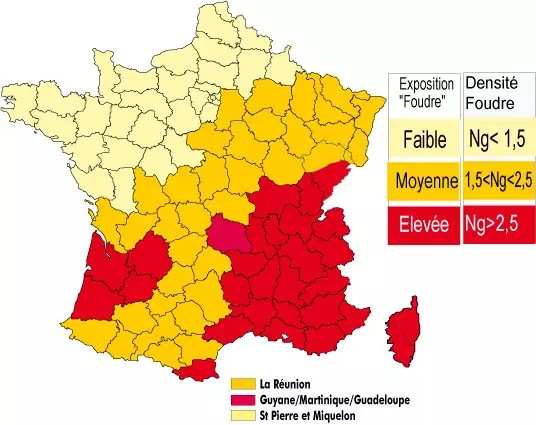
In France, there are around a million lightning strikes on the ground every year, with an average density of 1 to 3 strikes per square kilometer per year. Some regions are more exposed than others, notably the South-West, the Pyrenees, the Alps and the Massif Central.
Risks to your home
Lightning poses several types of danger to a house:
Direct risks arise when lightning strikes the building directly. The impact can cause a fire, destroy the framework, cause concrete elements to explode by vaporizing the water they contain, or cause major structural damage. Tiles can be pulverized, chimneys destroyed, and electrical circuits completely fried.
Power surges are the most common hazard. Even if lightning doesn't strike your home directly, it can fall several hundred meters away and cause a sudden rise in voltage on the power grid. These surges can instantly destroy all your electrical and electronic equipment: computers, televisions, household appliances, home automation systems, boilers, etc. The cost of damage can quickly add up to several thousand euros.
Indirect risks also include fire caused by sparks, electric shock to people touching conductive parts, and damage caused by shock waves.
The lightning conductor: fundamental external protection
A lightning conductor remains the most effective solution for protecting a home against the direct impact of lightning. Invented by Benjamin Franklin in the 18th century, this device has evolved considerably and can now be adapted to all types of building.
Operating principle
The lightning conductor acts as a preferred catching point for lightning. Installed at the highest point of the building, it attracts the electrical discharge and conducts it to the ground via a down conductor system and an earth connection, preventing it from passing through the structure of the house.
Contrary to popular belief, lightning rods don't stop lightning from striking, but they do provide a preferential path for the energy to escape safely to the ground. It protects a cone-shaped volume whose ground radius depends on its height and the desired level of protection.
The different types of lightning conductor
The single rod lightning conductor is the classic model. It consists of a copper or stainless steel spike mounted on a mast. Simple and reliable, it is particularly suitable for residential buildings and protects a limited area.
The Priming Device Lightning Rod (PDA) uses an electronic system that generates an upward tracer earlier than that of a single rod, thus increasing the radius of protection. These models can protect an area with a radius of up to 120 meters, depending on their level of performance. They are particularly suitable for larger properties, or when you want to protect several buildings with a single installation.
The mesh cage lightning conductor, also known as the Faraday cage, involves surrounding the building with a network of interconnected conductors. This highly efficient but more expensive solution is mainly used for industrial and commercial buildings, but can also be considered for high-value homes.
Installation and standards
The installation of a lightning conductor must comply with standard NF C 17-102, which defines the design, installation and maintenance rules for lightning protection systems. This installation comprises three essential elements:
The collection device (tip or cage) must be positioned at the highest point of the building, taking into account any protruding elements such as chimneys or antennas. The height of the mast is calculated according to the level of protection required and the surface area to be protected.
Down-conductors carry the lightning current from the collector to the earthing point. They must follow the most direct path possible to the ground, be firmly attached to the structure and remain at a distance from the building's conductive elements. For a house, two diametrically opposed downspouts are usually installed.
The earth connection is the final and absolutely crucial element of the system. It must have a resistance of less than 10 ohms to effectively dissipate lightning energy. Several techniques are available: ground loop, earth stakes, or trench with buried bare cable. The nature of the soil has a major influence on the effectiveness of the earthing system.
Cost and maintenance
The cost of installing a lightning conductor for a single-family home generally varies between 1,500 and 5,000 euros, depending on the type chosen, the configuration of the building and the complexity of the installation. A single-rod lightning conductor is more affordable than one with a priming device.
Maintenance is relatively light but essential. An annual visual check ensures the integrity of connections and the absence of corrosion. A complete inspection by a professional is recommended every two to four years, including measurement of the earth resistance. After each lightning strike, a thorough inspection is required to ensure that the system has not been damaged.
Surge protectors: protecting your electrical installations
While lightning rods protect the very structure of a building, surge protectors are essential for protecting your electrical and electronic equipment from power surges.
What is a lightning arrester?
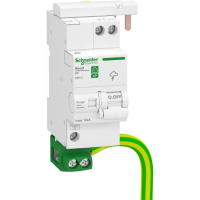
A lightning arrester is an electrical device that detects surges in the circuit and eliminates them by diverting excess energy to earth. It acts in nanoseconds, before the surge reaches and damages the connected devices.
The difference with a surge protector is mainly a question of capacity: lightning arresters installed at the switchboard can handle very high surges (up to 100,000 amperes), while plug-in surge protectors are designed for more moderate surges and provide additional protection.
Electrical panel installation
Since 2015, the installation of a lightning arrester at the main electrical panel has been mandatory in certain French departments particularly exposed to lightning, and strongly recommended everywhere else according to standard NF C 15-100.
Type 1 or 2 lightning arresters are placed at the head of the electrical installation, just after the main circuit breaker. It protects all circuits in the home against atmospheric surges. Installation must be carried out by a qualified electrician, as it requires work on the electrical panel.
The choice of surge arrester depends on several criteria:
The presence or absence of a lightning conductor influences the choice. In conjunction with a lightning conductor, a type 1 arrester is mandatory, as it must withstand direct lightning currents. Without a lightning conductor, a type 2 is generally sufficient.
The grounding system of your installation (TT, TN or IT) also determines the appropriate model. In France, the TT system is the most common for single-family homes.
The number of poles must correspond to your installation: single-phase (1 pole + neutral) or three-phase (3 poles + neutral).
Surge protectors for fine protection
In addition to general protection at the switchboard, it's a good idea to install surge protectors to specifically protect high-value, sensitive equipment. These devices plug directly into an electrical outlet and offer additional protection against residual surges.
IT equipment (computers, servers, NAS) is particularly vulnerable and deserves dedicated protection. A quality surge protector for a complete office costs between 50 and 150 euros, a derisory investment compared to the price of the protected equipment.
A home-cinema system, with its modern TV sets, amplifiers, games consoles and decoders, often represents several thousand euros' worth of equipment. A suitable surge suppressor with sufficient sockets and protection for coaxial and HDMI connections is essential.
Connected equipment and home automation are multiplying in our homes: internet boxes, smart thermostats, alarm systems, cameras, voice assistants. All these devices benefit from surge protection, ideally a model that also integrates protection for the telephone line or fiber optic cable.
Protection of other circuits
Surge protection doesn't just apply to the 230V electrical network. Other circuits must also be protected:
Telephone and Internet lines, whether ADSL, fiber optic or cable, are entry points for power surges. Specific surge protectors are available for these connections, and are installed between the external input and your box.
If installed on a roof, a terrestrial TV antenna can be directly struck by lightning or induced power surges. A coaxial surge protector protects the TV and equipment connected to the antenna cable.
Photovoltaic solar panels, located on the roof, are particularly exposed. Dedicated surge protectors for photovoltaic systems protect both the panels and the inverter, an expensive component of the system.
Preventive actions and behaviors to adopt
Beyond the technical equipment, adopting the right reflexes before and during a storm plays an active part in protecting your home and its occupants.
Before the stormy season
Upstream preparation considerably reduces risks. Start by having your electrical installation checked by a professional, especially if it is several years old. Make sure that the grounding is effective and that all circuits are protected by functional earth leakage circuit breakers.
Identify hazardous trees on your property. Trees that are dead, diseased or too close to the house must be felled or pruned. A tree struck by lightning can fall on your home or spread a fire.
Check the condition of your roof and gutters. A roof in good condition reduces the risk of water infiltration in the event of a violent storm or lightning strike. Unobstructed gutters efficiently drain water and prevent water damage.
Prepare an accessible emergency kit including flashlights with fresh batteries, a battery-powered radio, a charged cell phone, water and non-perishable food. In the event of a power cut due to lightning, you'll be equipped.
During the storm
At the first signs of thunderstorms (distant lightning, thunder, rising wind), take these preventive measures:
Unplug all sensitive electrical equipment not protected by an effective surge protector. Don't just switch them off, physically remove the plugs. This applies particularly to computers, televisions, hi-fi equipment and expensive household appliances.
Close all shutters and windows. In the event of a nearby lightning strike, the glass can explode under the effect of the shock wave. Shutters offer additional protection.
Do not use electrical appliances connected to the mains during a thunderstorm. Do not use a corded phone plugged into a wall socket. Cell phones are safe.
Keep away from windows, chimneys and metal pipes. Lightning can propagate through conductive parts of the house. Stay in the center of the room if possible.
Don't take a bath or shower during a thunderstorm. Metal pipes can conduct current in the event of a lightning strike on or near the house.
If you're outside, get inside immediately. If you're caught outside, far from any shelter, crouch down with your legs together, feet together, avoiding contact with the ground through your hands. Don't lie down. Stay away from isolated trees, high points and bodies of water.
After the storm
Once the storm has passed, before reconnecting your appliances, visually check that no damage is visible on your electrical installation. If you notice any burn marks, a smell of burnt plastic or any other suspicious sign, do not reconnect anything and call in an electrician.
Test your surge protectors. Some models feature an indicator light to show their operating status. After a violent storm, check these indicators. If an arrester is damaged after absorbing a strong overvoltage, it must be replaced immediately.
Inspect your roof, trees and home exterior for damage. Look for broken tiles, fallen branches and burn marks. If in doubt about a lightning strike, call in a professional for a full inspection.
Home insurance and lightning
Understanding how your home insurance works in relation to lightning damage is essential if you are to be properly compensated should the need arise.
Basic warranties
Coverage against lightning damage is generally included in comprehensive home insurance policies. It covers direct damage to your building: partial or total destruction, fire caused by lightning, water damage resulting from lightning damage to the roof.
Electrical damage is often covered by a specific warranty. Check your policy carefully: some insurance policies limit coverage for electrical damage, or require you to take out an additional option. This warranty covers the replacement of electrical and electronic equipment destroyed by a power surge.
Exclusions to be aware of
Even with good coverage, certain exclusions are common. Damage caused by lightning to outdoor installations (electric gates, garden lighting, swimming pools) is not always covered, or is covered with limited compensation ceilings.
Solar panels and specialized equipment may require an extended warranty. Computer data lost as a result of a power surge is generally not covered, hence the importance of regular backups.
The obsolescence of your equipment is taken into account when calculating compensation. A 10-year-old appliance will not be reimbursed at new value, unless you have taken out replacement value cover.
In the event of a claim
If your home has been struck by lightning, it's important to take prompt action. Contact your insurer within five working days of discovering the loss, which is the standard legal deadline. In practice, let them know as soon as possible.
Document all damage with detailed photographs prior to any emergency repair. Keep damaged devices or their remains for expert examination. Draw up a precise list of all destroyed equipment, with purchase date if possible and invoices.
Don't throw away or repair equipment before the insurance surveyor arrives, except in the case of immediate danger or to carry out emergency repairs to prevent further damage.
Gather all the invoices proving the value of your goods: purchase invoices, warranty certificates, previous photos of your interior showing the equipment. This will facilitate compensation.
Complementary solutions and innovations
In addition to conventional protection systems, new solutions are emerging to enhance lightning protection.
Storm detectors
Thunderstorm detectors are devices that analyze atmospheric electromagnetic disturbances to predict the approach of a thunderstorm. Some consumer models, available from 50 to 200 euros, can detect thunderstorm activity up to 40 kilometers away and alert you before the storm arrives in your area.
These devices are particularly useful for outdoor activities, but also to give you time to disconnect your sensitive equipment beforehand. Some connected models send alerts to your smartphone.
Home automation protection systems
Modern home automation increasingly incorporates automatic storm protection functions. Systems can automatically cut power to non-essential circuits when a storm is detected, then restore them once the danger has passed.
These installations, coupled with personal weather stations and storm detectors, offer automated protection without human intervention. The investment is more substantial (several hundred to several thousand euros) but brings total peace of mind.
Building materials and techniques
In highly exposed areas, certain construction techniques offer enhanced protection. The use of conductive roofing materials (steel, zinc) connected to earth can form a natural Faraday cage.
Steel-framed houses naturally benefit from better protection if the structure is properly earthed. Reinforced concrete, with its interconnected, earthed reinforcement, also creates a protective Faraday cage effect.
Smart meters and protection
The arrival of Linky smart meters has raised the question of their sensitivity to lightning strikes. These meters have built-in overvoltage protection, but are nonetheless a potential point of entry. A high-quality lightning arrester at the switchboard remains the best protection, including for the meter itself.
Assessing your protection needs
Not all buildings require the same level of protection. Several factors determine your real needs.
Risk factors
Geographical exposure is the first criterion. Consult the lightning density maps for your region, available from Météorage or from your local prefecture. South-western, Mediterranean and mountainous regions are at greater risk.
The location of the building has a strong influence on the risk. A detached house on high ground or open land is much more exposed than a house on a housing estate surrounded by other buildings. The proximity of bell towers, water towers or tall trees can play a protective or aggravating role, depending on the configuration.
The height and protruding features of your home are important factors. A house with a high chimney, a rake antenna on the roof or a domestic wind turbine presents more potential points of impact.
The presence of sensitive or expensive equipment justifies reinforced protection. If your home houses a professional office with a computer server, a home recording studio, a complete home automation system or works of art, the investment in optimal protection is proportionate to the value of the assets to be protected.
Carry out a risk analysis
For complex situations or high-value buildings, it may be advisable to call on the services of a specialist lightning protection consultancy. These professionals carry out a standardized risk analysis (in accordance with IEC 62305-2) which precisely assesses the level of risk in your home and recommends appropriate solutions.
This study, which generally costs between 500 and 2,000 euros depending on its complexity, will help you avoid either under-sizing your protection and exposing yourself to major damage, or over-investing in unnecessary protection.
Overall budget and profitability
Protecting your home against lightning is an investment whose cost and profitability need to be assessed.
The cost of different types of protection
For a lightning arrester at the electrical panel, allow between 100 and 300 euros for the equipment, depending on the model, plus another 100 to 200 euros for installation by an electrician. The total investment is therefore between 200 and 500 euros, mandatory in some areas and strongly recommended everywhere.
Quality surge protectors to protect your sensitive equipment cost between 30 and 150 euros each. For optimum protection of the whole house, you'll need 3 to 5 surge protectors, i.e. a budget of 150 to 500 euros.
Installing a lightning conductor represents the biggest investment: 1,500 to 3,000 euros for a single-rod model, 3,000 to 5,000 euros for a lightning conductor with a priming device. This protection is not systematically necessary, but becomes essential for homes with high exposure.
Return on investment
Compared to the potential cost of a lightning strike, the investment in protection quickly pays for itself. A lightning strike without adequate protection can cause damage worth tens of thousands of euros: destruction of household appliances and electronics for 5,000 to 20,000 euros, structural damage, fire, business interruption if you work remotely.
Even taking insurance deductibles and coverage limits into account, your out-of-pocket expenses after a claim far exceed the cost of preventive protection.
In addition, some insurers offer premium reductions, generally between 5% and 10%, for homes fitted with lightning protection that complies with the relevant standards. Over time, these savings contribute to the return on investment.
Possible financial assistance
Although there are no specific national subsidies for the installation of lightning protection systems, some local authorities in highly exposed areas do offer subsidies. For more information, contact your local town hall or community of communes.
Lightning protection work can sometimes be integrated into more comprehensive renovation projects benefiting from subsidies such as MaPrimeRénov', if carried out as part of an overall energy renovation program.
If you are a home-based professional, certain protective equipment can be deducted from your business expenses. Consult your accountant for details.
Conclusion
Protecting your home against lightning is no longer an option, it's a necessity, particularly in the current context of intensifying storm phenomena. The combination of external lightning protection for exposed buildings, surge arresters at the switchboard and surge protectors for sensitive equipment is the triptych of effective protection.
In addition to technical equipment, adopting preventive measures before and during storms, knowing your insurance coverage and regularly maintaining your installations will ensure optimum protection of your assets and your family's safety.
The investment in such protection, while significant, remains moderate compared with the potential damage and the costs of reconstruction or replacement. It's a long-term investment that adds value to your property and gives you invaluable peace of mind during stormy seasons.
Don't wait until it's too late: have your level of exposure assessed now, and put in place the protection appropriate to your situation. Your home and possessions deserve this preventive attention.

Product categories
The domeashop store offers product categories related to this item to provide you with more information about the product(s) you are looking for. Don't hesitate to contact us for advice from our specialists.
Frequently asked questions
The domeashop store offers you a list of questions and answers corresponding to the most frequently asked questions related to the theme and products discussed in this article. If you can't find the answer you're looking for, contact us and our specialists will be happy to help.
It's a common misconception. The lightning conductor doesn't attract lightning, it simply provides a preferential catchment point for a discharge that would occur in the area anyway. If lightning is destined to strike within a radius of several dozen meters of your home, the lightning conductor will capture the discharge and safely discharge it to ground level, protecting your home. Without a lightning rod, this same discharge could strike your roof, your chimney or a nearby tree directly, with potentially catastrophic consequences.
Since the NF C 15-100 standard was updated in 2015, the installation of a lightning arrester at the electrical panel is mandatory in departments where the keraunic level (average number of thunderstorm days per year) exceeds 25, as well as for all buildings equipped with a lightning conductor. Even in areas where it is not strictly mandatory, lightning arresters are highly recommended, as surges can occur anywhere. The moderate cost of this protection (200 to 500 euros installed) makes it a highly relevant investment for all homeowners wishing to protect their electrical equipment.
Most comprehensive home insurance policies include lightning cover for direct damage to the building (fire, destruction). However, electrical damage to appliances is often subject to special conditions: compensation ceilings, specific deductibles, exclusion of outdoor equipment or solar panels. It's essential to read your contract carefully and, if necessary, take out an extended warranty for electrical damage. Some insurers also require your electrical installation to comply with current standards to validate the warranty.
Technically, there's nothing to stop you installing a lightning conductor yourself, if you have the necessary skills. However, there are several reasons why this is strongly discouraged. Firstly, an installation that doesn't comply with NF C 17-102 standards will be ineffective and even dangerous. Secondly, in the event of a claim, your insurer may refuse to pay compensation if the installation was not carried out by a certified professional. The installation of a lightning arrester requires work on the main switchboard, and must be carried out by a qualified electrician. Safety and compliance with standards amply justify the use of professionals.
The two types of protection are complementary and not interchangeable. The lightning arrester at the electrical panel is the primary protection: it stops major surges from the mains before they reach your internal circuits. Plug-in surge protectors offer so-called "fine" secondary protection for sensitive equipment, filtering out residual surges that may have passed the main arrester or come from other sources (telephone lines, antenna). For optimum protection, install a surge protector at the switchboard and add quality surge protectors for your most expensive or sensitive equipment.
For lightning conductors, an annual visual inspection is recommended to check the condition of connections, the absence of corrosion and the mechanical integrity of the installation. A full inspection by an approved body must be carried out every two years for buildings open to the public, and every four years for private homes. This check includes measuring the earth resistance, which must remain below 10 ohms. For surge arresters, check their operating lights regularly and have them checked whenever your switchboard is overhauled. After every violent storm or nearby lightning strike, a check is in order, as the protective devices may have been damaged while absorbing the surge.
Unfortunately, the opposite is true. Trees, especially large and isolated ones, are prime targets for lightning strikes. A tree struck by lightning can fall on your house, spread a fire, or transmit part of the lightning current to your home if its roots are close to your foundation. Trees should never be seen as protection. On the contrary, dangerous trees (dead, diseased, leaning towards the house) must be felled or firmly pruned. If you have large trees very close to your home, the installation of a lightning conductor becomes all the more advisable to provide a safer preferential catchment point.
Often, some of the damage caused by a power surge is not immediately apparent. A weakened component may work for a few days before breaking down for good. If you discover that an appliance is no longer working several days after a storm, you can still report it to your insurance company by establishing the link with the climatic event. Document all malfunctions: date of the storm, date the fault was discovered, photos of the device. The more equipment you have affected simultaneously, the more obvious the link with a storm surge. Contact your insurer as soon as possible and explain the situation. The legal reporting period runs from the discovery of the loss, not from the event itself.
A laptop, tablet or smartphone running solely on battery power is effectively protected from mains power surges. However, as soon as it is plugged in to recharge, it becomes vulnerable again. What's more, if your laptop is connected to the Internet via an Ethernet cable plugged into a box that's itself connected to the power grid, there's an entry point for power surges. For optimum protection, disconnect not only the power supply but also all cables (Ethernet, HDMI, USB to powered devices) during thunderstorms. Wi-Fi remains safe. Nevertheless, battery-powered equipment is an excellent backup solution during storms: use your smartphone rather than your landline, and your battery-powered laptop rather than your desktop PC.
New buildings generally benefit from better lightning protection thanks to current electrical standards, which in many cases require lightning arresters, efficient earthing and compliant equipment. Older homes, especially those with electrical installations more than 15 years old, can be vulnerable: no lightning arrester, inadequate earthing, obsolete electrical panel without suitable residual current protection. If you live in an old house, have a complete electrical diagnosis carried out by a professional. Bringing your electrical installation up to standard, including adding a lightning arrester and improving the earthing system, is a worthwhile investment both for lightning protection and for the general safety and value of your property.