
- Home
-
Electrical equipment
-
Sockets and switches
- Bticino
- Legrand
- Hager
- Schneider Electric
- Jung
-
Modelec
-
Collection Confidence
-
Confidence screw collection
- Narrow Confidence facades
- Narrow Confidence facades with screws
- Long, narrow Confidence facades
- Narrow, long Confidence facades with screws
- Narrow, long Confidence cabinet fronts with reading lights
- Narrow, long Confidence cabinet fronts with spotlights
- Simple mechanisms for Confidence facades
- Reinforced mechanisms for Confidence facades
- Reinforced mechanisms for narrow Confidence facades
- Reinforced mechanisms for narrow, long Confidence facades
-
Collection Desir
-
Collection Fascination
-
Collection Hitera
-
Iris Collection
-
Collection Karo
-
Collection M
- Narrow mechanisms
-
Collection Confidence
- Vandal-proof equipment
- Iboco fittings
-
Lighting
-
Interior lighting
-
Wall lights
-
LED strip
-
Downlights
-
Recessed spotlights
-
Surface-mounted spotlights
- Lamps
- Rod-mounted spotlights
- LED panels
-
Suspensions
-
Ceiling lights
-
Track and spotlights track lighting
- Tensioned cable
- Waterproof lighting
- Connected lamps
- Portholes
- Bathroom rulers
- Table lamps
- Panel lighting
- Headboard reading lights
- Light mirror
-
Wall lights
- Outdoor luminaires
- LED bulbs and spotlights
- Special lamps
- Lighting accessories
-
Interior lighting
-
Home security
-
Heating and sanitary
- Heating
-
Individual ventilation
-
Self-adjusting CMV
-
Humidity-sensitive CMV
- Insufflation ventilation
- Double-flow ventilation
- Wall-mounted aerator
- Duct puller
- Ventilation accessories
- Extractors and blowers
- Ventilation grilles
- Flow control
- Roof outlet
- Ventilation box
-
Ventilation duct
- Ventilation sleeve and reducer
- Sound trap
- Ventilation filters
-
Self-adjusting CMV
- Central vacuum
-
Connected home
- Ideas & Advice
-
MenuBack
-
Products
-
-
-
Electrical panel
- Bridging bars, combs
-
Electrical protection
- Differential block
- Earth leakage circuit breakers
-
Earth leakage switches
- 40A ground-fault circuit interrupter
- 63A ground-fault circuit interrupter
- ABB ground fault circuit interrupter
- AC-type ground fault circuit interrupter
- Eaton ground-fault circuit interrupter
- Hager ground-fault circuit interrupter
- Legrand ground fault circuit interrupter
- Schneider residual current circuit breaker
- Siemens ground-fault circuit interrupter
- Type A ground-fault circuit interrupter
- Fuses and fuseholders
- Grounding
- Lightning arresters and surge protectors
- Main circuit breaker
-
Modular circuit breakers
- 10A circuit breakers
- 16A circuit breakers
- 20A circuit breakers
- 32A circuit breakers
- ABB circuit breakers
- Circuit breakers Schneider Electric
- D-curve circuit breakers
- Eaton circuit breakers
- Four-pole circuit breakers
- Hager circuit breakers
- Legrand circuit breakers
- Siemens circuit breakers
- Three-phase circuit breakers
- Molded case circuit breaker
- Energy management
- Modular accessories
- Modular equipment
-
-
-
-
-
Interior lighting
- Bathroom rulers
- Ceiling lights
- Connected lamps
- Downlights
- Headboard reading lights
-
Interior lighting
- Bathroom rulers
- Ceiling lights
- Connected lamps
- Downlights
- Headboard reading lights
- Lamps
- LED panels
- LED strip
- Light mirror
- Panel lighting
- Portholes
-
Recessed spotlights
- Aric
- Arkoslight
- Europole
- Faro Barcelona
- Indigo Lighting - Collingwood
- Ledvance
- Paulmann
- Philips
- SG Lighting
- SLV
- Switch Lite
- Rod-mounted spotlights
- Surface-mounted spotlights
- Suspensions
- Table lamps
- Tensioned cable
- Track and spotlights track lighting
- Wall lights
- Waterproof lighting
-
-
-
Outdoor lighting
- Exterior wall lights
- Bollards and lampposts
- Outdoor recessed
- Mobile luminaires
- Projectors
- Outdoor suspensions
- Outdoor ceiling lights
- Spotlights sign
- Solar luminaires
-
Lights and garlands
- Comet garlands
- Stalactite garlands
- Connectable festoons
- Spotlights and patterns
- Classic garlands
- Curtain lights
- Motifs
- Illuminated fir trees
- Luminous balls and animals
- Guinguette garland
- Garlands Bulbs B22
- Garlands Bulbs E27
- Garlands E14 bulbs
- LED connection cable
- Professional decorations
- Garland accessories
- Outdoor illuminated furniture
- Submersible luminaires
-
-
-
-
-
Smart homes for seniors

Smart home technology can improve the comfort, safety, and independence of older adults living at home, provided that each device is selected based on the occupant's specific risks. Specific measures include fall-prevention lighting, remote assistance, accessible controls, heating, access control, alarms, and privacy protection; public funding is available to cover the cost of this equipment.
Contents
- How does smart lighting help prevent falls?
- Identify High-Risk routes
- Automatically illuminate nighttime travel
- Incorporating lighting into home design
- How can we make Home-Based telecare effective?
- Understanding what triggers an alert
- Check the response and detection limits
- Ensure service continuity
- What smart devices make everyday life easier?
- Control your lights and blinds with ease
- Adjust the heating to fit your habits
- Greet visitors and manage access
- How can you make your home secure without compromising reliability?
- Choose alerts tailored to the risks
- Track activity while respecting privacy
- Protecting data and testing for failures
- What types of financial assistance are available for telecare and home modifications?
- Finance the renovations with MaPrimeAdapt'
- Have home care services assessed under the APA
- Distinguishing the tax credit from other forms of assistance
How does smart lighting help prevent falls?
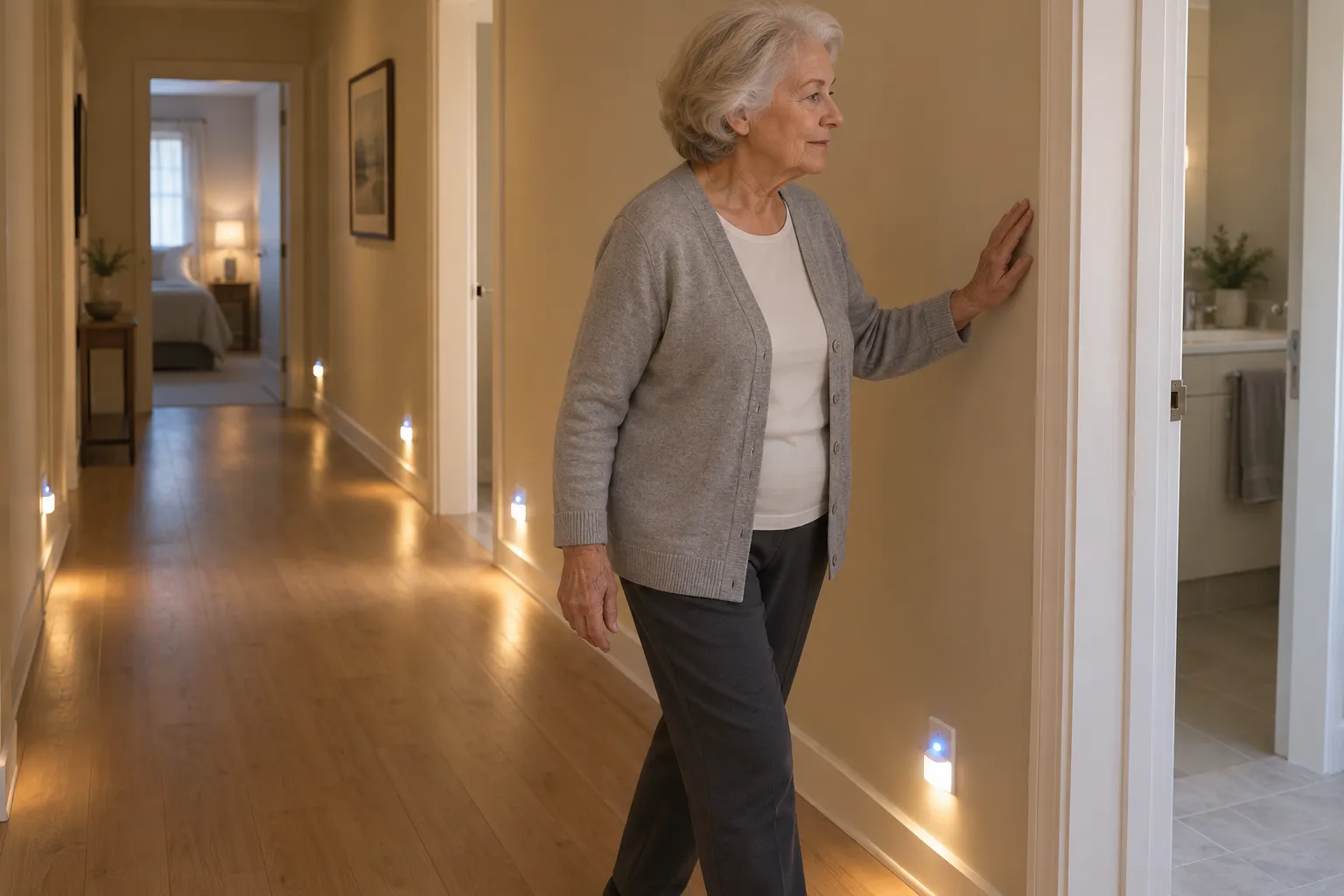
A fall at home remains a major risk that needs to be addressed in older adults. Light has a direct impact on this risk: it makes obstacles, steps, and thresholds visible as a person moves. With home automation, the lights turn on in the right place at the right time, without having to search for a light switch in the dark.
Identify High-Risk routes
The diagnosis begins with the numbers. According to the CNSA (National solidarity fund for Autonomy), 66% of falls among older adults occur at home. One in three people over the age of 65 falls at least once a year. According to the national fall prevention plan cited by the CNSA, these falls result in more than 130,000 hospitalizations each year. They also cause 10,000 deaths a year.
- Insight: The HAS (Haute Autorité de santé) recommends screening for this condition in older adults who experience repeated falls.
- Clutter: furniture, items on the floor, and cables that block everyday pathways.
- Housing layout: stairs, narrow hallways, and the distance between the bedroom and the bathroom.
In practice, motion detectors are placed along the occupant's actual paths, not on a theoretical layout. A piece of furniture can block their detection range, and a cat or dog can cause false alarms. So follow the person's movements for a day before attaching the sensors.
Automatically illuminate nighttime travel
A motion-sensor light turns on as soon as the person gets up. A path of light can then guide her from the bedroom to the bathroom. With a home automation scenario, the system detects movement at night and turns on the hallway lights one after another. It then turns them off after a delay—that is, a preset amount of time.
The "MaPrimeAdapt'" guide from anah (the national housing Agency) lists motion-sensing wall nightlights and light switches that can be reached from bed. Once the system is installed, the lighting duration can still be adjusted: you can extend it if the person's mobility decreases and their movements become slower.
Incorporating lighting into home design
Automatic lighting works more effectively when the walkways are clear and the mats are in place or removed. Adapted housing then combines several design features, room by room, to enhance the resident’s independence:
- Bathroom: accessible shower, shower seat, grab bars, and non-slip flooring.
- Traffic flow: handrails along hallways and stairways.
- Thresholds and steps: addressing level changes and improving visual contrast to make them easier to spot.
- Access to the upper floor: Stairlifts for when stairs become difficult to navigate.
These improvements and the lighting work together to enhance safety. For example, a visual contrast on a stair tread is only useful if the step is lit when someone is walking on it.
How can we make Home-Based telecare effective?
Remote assistance adds a human touch to home technology: someone responds when a problem arises. This service supports home care, but its effectiveness depends on every link in the chain—from the button worn by the person to the procedure followed after an alert is triggered.
Understanding what triggers an alert
The system connects the elderly person to a monitoring center through three components: a trigger, a transmitter installed in the home, and a communication link. The service described on the public portal "For Seniors" is available 24 hours a day, 7 days a week.
There are several ways to activate the system, depending on the layout of the home and the person's habits:
- Wrist button: a bracelet that allows you to call for help yourself in the event of a fall or if you feel unwell.
- Pendant: the same concept, worn around the neck.
- Automatic detection: Sensors detect a fall without any action on the person's part.
- System installed in the room: no accessories to wear on a daily basis.
The system installed in the room is suitable for someone who forgets or refuses to wear a wristband. Conversely, the wearable device follows the person everywhere, including into the garden, if the range allows it.
Check the response and detection limits
As soon as an alert is received, an operator checks the situation. Depending on the severity, he then contacts a family member or emergency services. However, automatic detection may fail to detect a slow, controlled, or low-altitude fall; therefore, the manual call button remains essential, even with sensors.
Before putting the system into service, test four things in the home: the range of the trigger in each room, the audibility of the transmitter, the quality of the connection, and whether the button is actually accessible. For example, someone with osteoarthritis should be able to press this button without difficulty.
Ensure service continuity
It is important to check how a home-monitoring system performs during a power outage. Therefore, you should check the battery life, the list of emergency contacts, the maintenance contract, and the procedure to follow in the event of an alert. Make sure to update this contact list as soon as a family member or friend changes their phone number or moves.
The NF Service: Home telecare certification (a French service quality certification) evaluates, among other things, installation, testing, maintenance, confidentiality, and responsiveness. Its standards specify a remote response time target of 3 minutes or less for certified services. In terms of equipment, the European standards NF EN 50134-1, -2, -3, and -5 govern the system, the triggers, the local unit, and the transmissions. NF EN 50134-7 provides guidelines for installation, response, and risk management.
What smart devices make everyday life easier?
Beyond safety, connected devices reduce the need for tedious tasks: opening the shutters, adjusting a radiator, or walking to the door. These small, time-saving efforts contribute to seniors' well-being and help them maintain their independence, provided that the controls remain easy to use.
Control your lights and blinds with ease
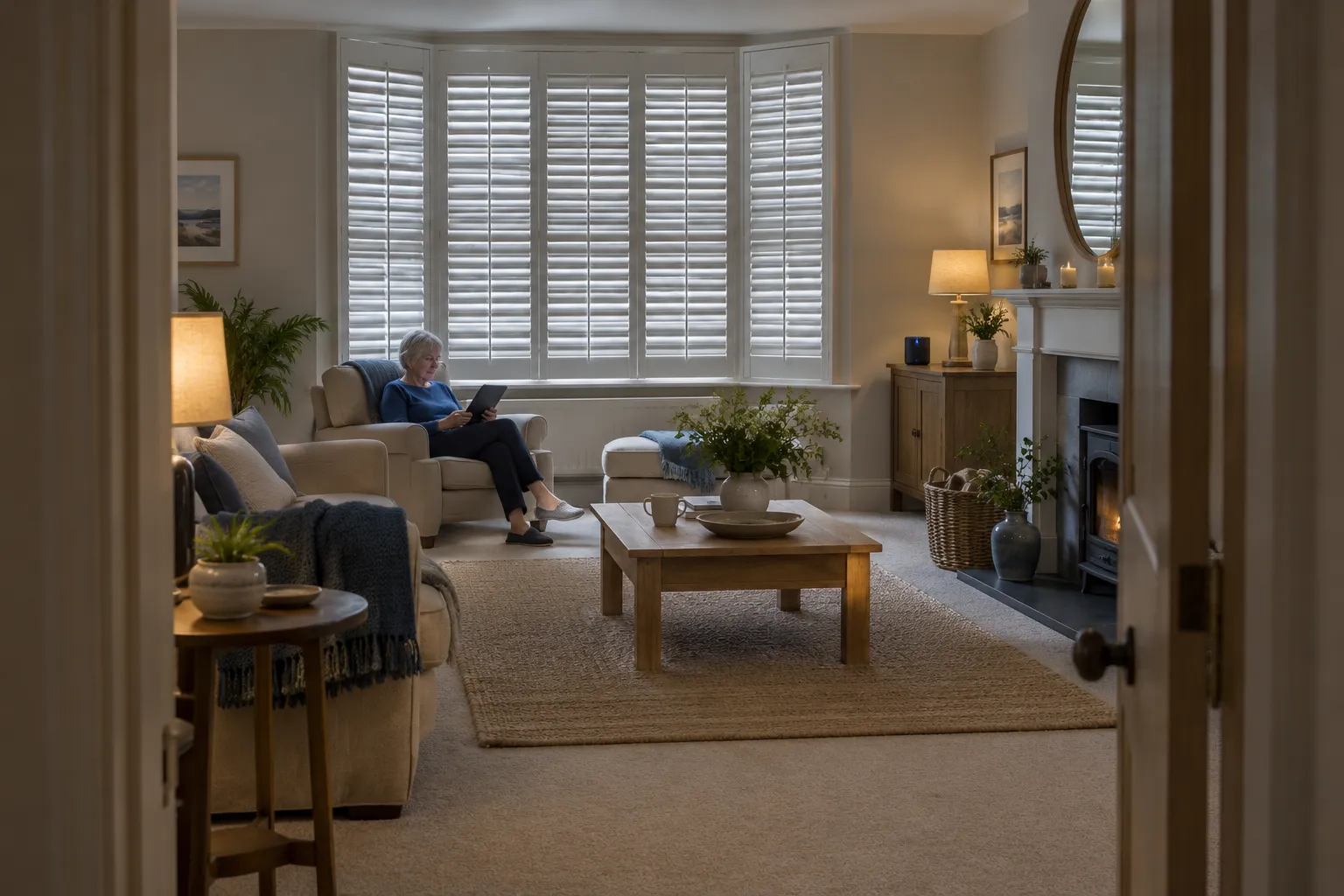
With home automation, you can control the lighting and the shutters without having to walk over to each switch. There are several ways to place an order:
- Mobile apps: Control via a smartphone or tablet.
- Remote control: a familiar object, with no screen or password.
- Voice Assistants: Just one phrase is all it takes to turn on a light.
Motorized shutters prevent people with limited mobility from having to lean out the window, and they can be programmed to close at selected times. In addition, keep physical switches: the phone can get lost, and a code can be forgotten. A training period also helps the person get the hang of the digital controls.
Adjust the heating to fit your habits
A programmable heating system adjusts the temperature room by room and according to the time of day. This ensures a comfortable temperature upon waking up in the bedroom and later in the living room in the afternoon. When staying in the hospital or at a relative's house, scheduling also prevents an empty home from being heated unnecessarily.
Some smart thermostats or radiators detect when someone is in the room or turn off the heat when a window is open. Remote control also helps caregivers: a family member can correct an incorrect setting from their phone without having to go anywhere, which improves everyone's quality of life.
DomeaShop recommends determining the required heat output based on the room: a radiator that's too weak won't heat the room properly, while one that's too powerful will consume too much energy. Next, check for compatibility with the desired app or voice assistant inA selection of programmable smart radiators. Finally, maintain a simple local control mechanism that can be used in the event of an application or network failure.
Greet visitors and manage access
A connected video doorphone displays the visitor in real time on a smartphone and lets you speak with them before opening the door, without having to go to the door. Remote-controlled entry makes it easier for an authorized caregiver or home health aide to enter. This welcoming atmosphere can be found inConnected video doorphones with remote door-opening capabilities.
The difference lies in how access rights are configured: a mistake can block an authorized person or allow an unauthorized person to enter. Have a backup plan in case of a power outage, a dead battery, a lost phone, or a network outage.
How can you make your home secure without compromising reliability?
Alarms, incident detectors, and activity sensors enhance home security. However, they must address the person's actual risks, respect their privacy, and continue to function in the event of a malfunction.
Choose alerts tailored to the risks
A smart alarm system consists of a control panel, motion or door/window sensors, and a siren. Depending on the model and its settings, it sends a remote notification—for example, to a family member who is keeping track of the person. It can also forward the alert to a remote monitoring center.
The number of detectors depends on the size of the home, its entry points, and the rooms that need to be protected. You can compare the compositions inthe line of connected alarms with remote alerts.
Smoke, water leak, and temperature detectors also alert you to a household incident. Effective june 13, 2025, article R142-2 of the building and housing Code (which establishes the rules governing housing) requires at least one standalone smoke alarm per dwelling. According to Service-Public, this detector must bear the CE marking and the reference NF EN 14604.
Track activity while respecting privacy
Motion and door-opening sensors detect a prolonged lack of movement, without the need for an indoor camera. They also let a family member or friend know the status of a device—for example, whether the shutters were opened this morning. Before installing them, work with the person to determine which events trigger an alert, who receives it, and the level of detail provided.
Depending on the level of security required, non-video sensors can monitor certain events in a less intrusive manner than an indoor camera, provided their capabilities are sufficient for the task. If a camera is installed nonetheless, the CNIL (the French data protection authority) specifies that it must not continuously film employees while they are working from home, such as a housekeeper.
Protecting data and testing for failures
Before installation, find out what data is collected: the purpose of the collection, where and for how long it is stored, who receives it, and how it is deleted. This information makes it possible to compare two systems with the same functions.
The CNIL recommends changing default passwords, updating connected devices, and limiting the amount of data collected. Cybercrime.gov.fr (a public assistance program for cyberattacks) also recommends securing your Wi-Fi and, if possible, isolating these connected devices from the rest of your home network.
For a critical alert, check whether the device relies on an Internet router or a single connection. Unplug the box during a test: this will let you know how the system reacts before a real failure occurs.
What types of financial assistance are available for telecare and home modifications?
Three separate programs can help lower the cost: MaPrimeAdapt' for home improvements, the APA for certain services, and the tax credit for in-home services. Everyone has their own circumstances, and the same expense may not necessarily fall under all three categories.
Finance the renovations with MaPrimeAdapt'
Since january 1, 2024, MaPrimeAdapt' has been ANAH's primary grant program for adapting housing to accommodate a loss of independence. Subject to income eligibility, it is available to individuals aged 70 and older, regardless of their GIR classification (a scale that measures dependency on a scale of 1 to 6). It also applies to individuals aged 60 to 69, provided they are classified under the GIR system or have a disability rating of at least 50%. The assistance covers 70% of expenses for very low-income households and 50% for low-income households, up to a limit of €22,000 (excluding tax) in eligible expenses. The work in question includes a walk-in shower, a stairlift, electric roller shutters, or accessibility modifications. According to France Rénov' (the public renovation service), a general home automation system is not covered on that basis alone. The process follows a specific sequence: a project management assistant (a mandatory advisor who supports the project), an assessment, a project proposal with a cost estimate, and then the submission of the application. Work will not begin until the decision is made.
Have home care services assessed under the APA
The personalized home care allowance applies to individuals who are at least 60 years old, reside in France on a stable and regular basis, and have been classified as GIR 1 through 4. After assessing their needs, a telecare service may be included in their care plan. In 2026, according to the CNSA and the DGCS (Directorate general for social Cohesion), the monthly limits under this plan are as follows:
- GIR 1: €2,080.33.
- GIR 2: €1,682.30.
- GIR 3: €1,215.99.
- GIR 4: €811.52.
These amounts are maximum limits: they are neither paid automatically nor earmarked for telecare services. According to the public portal "For seniors," a decision is made no later than two months after a complete application is submitted. So go ahead and submit the request as soon as the need arises.
Distinguishing the tax credit from other forms of assistance
The labor Code classifies telecare and video care as personal services. Benefits that meet the legal requirements may thus entitle the recipient to the corresponding tax credit.
According to Urssaf, this tax credit amounts to 50% of eligible expenses. The general tax Code sets a general spending limit of €12,000, subject to any applicable specific limits. Keep the tax statements sent by the service provider for your tax return.

Frequently asked questions
The domeashop store offers you a list of questions and answers corresponding to the most frequently asked questions related to the theme and products discussed in this article. If you can't find the answer you're looking for, contact us and our specialists will be happy to help.
A stairlift can be installed on an existing staircase to provide access to the upper floor. A ramp or a device that makes it easier to climb stairs addresses a problem with access to housing. According to the ministry of housing, a home that complies with accessibility regulations is not necessarily suited to the specific needs of its occupant.
According to Service-Public, a GIR 5 or 6 does not qualify you for the APA at home: other forms of assistance may be available, particularly from the pension fund. Subject to income requirements, MaPrimeAdapt' remains available to individuals aged 70 and older, regardless of their GIR classification.
No. The eligibility of home improvement projects for MaPrimeAdapt', the inclusion of a telecare service in an APA assistance plan, and its eligibility for a tax credit are governed by three separate mechanisms. Each one is studied separately.
No. Home automation and remote care services complement home care providers and family caregivers. A sensor is also no substitute for home modifications, physical activity, or identifying fall risks.