
- There are no more items in your cart
- Shipping
- Total €0.00
What is a magnetothermal circuit breaker?

In every home, behind the door of your electrical panel, there are silent devices that constantly watch over your safety. Among them, the magneto-thermal circuit breaker plays an absolutely essential role in protecting your electrical installation. Present in virtually all installations complying with current standards, this intelligent device protects your circuits against two major hazards: electrical overloads and short circuits. Whether you're a homeowner, a building professional or simply want to understand your electrical installation, this comprehensive guide explains in detail how a thermal-magnetic circuit breaker works, its characteristics and the criteria for choosing one. You'll find out how this little box can help prevent home fires and protect your electrical equipment on a daily basis.
Contents
- Definition of a thermal-magnetic circuit breaker
- The two protection mechanisms explained in detail
- Thermal protection: your safeguard against overloads
- Magnetic protection: the instant response to short circuits
- The advantages of magnetothermal circuit breakers for your electrical installation
- Essential technical specifications
- Rated current: choosing the right protection
- The trigger curve: adapting sensitivity to use
- The number of poles: adapting to the type of power supply
- Breaking capacity: to cope with violent short circuits
- How to choose the right magnetothermal circuit breaker?
- Installation and maintenance of thermal-magnetic circuit breakers
- The difference between thermal-magnetic circuit breakers and residual-current circuit breakers
- Applicable standards and regulations
- Choosing quality: renowned brands of thermal-magnetic circuit breakers
- Conclusion
Definition of a thermal-magnetic circuit breaker
The magneto-thermal circuit breaker is an electrical protection device that combines two complementary technologies in a single compact device. Also known as divisional circuit breakers in the language of electricians, they represent the modern evolution of the traditional fuse, with a considerable advantage: they can be manually reset after each trip and reused indefinitely, without the need for replacement.
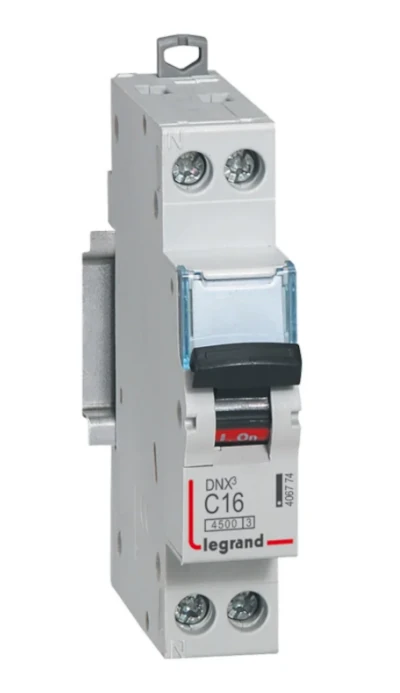
Its name reveals its dual protective nature. The term "magneto" refers to its magnetic protection, which intervenes instantly in the event of violent short-circuits. The term "thermal" refers to its protection against progressive overloads, which heat up electrical conductors to dangerous levels. This dual protection in a single format makes it the central element of modern electrical safety.
This device is installed directly in your electrical panel, usually on a standardized DIN rail. Once in place, it constantly monitors the current flowing through the electrical circuit it protects. As soon as an anomaly is detected, whether a sudden overcurrent or a gradual overload, the circuit-breaker automatically cuts off the power supply in a fraction of a second. This rapid intervention prevents fire hazards, protects your expensive equipment and can even save lives.
The two protection mechanisms explained in detail
Thermal protection: your safeguard against overloads
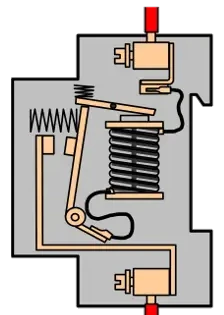
The thermal protection system is based on a simple but ingenious physical principle: the differential expansion of metals under the effect of heat. At the heart of the mechanism is a metal bimetallic strip, composed of two metals with different coefficients of thermal expansion, solidly joined together. These two metals react differently to heating, creating controlled deformation.
When the electric current flows through the bimetal at normal intensity, heating remains moderate and the bimetal retains its original shape. But when an electrical overload occurs, for example when you connect too many devices simultaneously to the same circuit, the current rises, gradually heating up the bimetallic strip. This excessive heat slowly deforms the bimetal blade until it reaches a tipping point. At this precise moment, the mechanical deformation triggers the circuit-opening mechanism, cutting off the power supply before the cables reach a dangerous temperature.
Imagine an installation where you simultaneously connect a radiator, an electric oven and several other appliances to a single line designed for limited power. The current gradually increases, heating up the electrical conductors in your walls. Without the intervention of the thermal-magnetic circuit breaker, this overheating could damage the cable insulation, melt the protective plastic and ultimately cause a fire. Thermal protection intervenes before this critical point is reached, usually within seconds or minutes, depending on the extent of the overload detected.
Magnetic protection: the instant response to short circuits
The magnetic protection mechanism uses a different but equally effective technology: an electromagnet through which the current of the protected circuit flows. Under normal operating conditions, the magnetic field generated by this electromagnet remains relatively weak and has no effect on the release mechanism. Everything changes when a short-circuit occurs.
A short circuit occurs when two conductors with different potentials come into direct contact, with no resistance between them. The current then increases dramatically, sometimes in just a few milliseconds, reaching values several hundred times higher than the circuit's rated current. This exceptional intensity instantly creates an extremely powerful magnetic field in the circuit-breaker's electromagnet. This field suddenly attracts a moving ferrous metal core, which immediately triggers the mechanical opening of the electrical circuit.
This magnetic protection is your life insurance against sudden electrical accidents. Whether it's a bare wire accidentally touching a metal ground, a faulty household appliance causing an internal short circuit, or an unfortunate drilling of an electrical cable hidden in a wall during construction work, the thermal-magnetic circuit breaker reacts in a fraction of a second. It cuts the circuit long before the short-circuit current has time to cause major damage, create a dangerous arc or melt the conductors.
The advantages of magnetothermal circuit breakers for your electrical installation
The integration of these two complementary protections in a single device represents an elegant, economical and particularly effective solution for securing a modern electrical installation. Rather than installing one overload device and one short-circuit device separately, you benefit from complete protection in a compact format that takes up precious little space in your switchboard.
Exceptional reliability is another major advantage of thermal-magnetic circuit breakers. Unlike traditional fuses, which need to be replaced systematically after each intervention, the circuit-breaker is simply reset by tilting its lever upwards. This feature makes it particularly useful in the event of accidental tripping due to a temporary peak in consumption or the simultaneous switching on of several appliances. You no longer need to keep a stock of spare fuses of different ratings, nor wonder which amperage to choose in the midst of an emergency, in the darkness of a power failure.
The remarkable durability of these devices makes them a wise investment for any electrical installation. A quality thermal-magnetic circuit breaker, correctly sized and installed, can operate for several decades without requiring special maintenance or replacement. Its purely electromechanical mechanism, devoid of fragile electronic components, is remarkably resistant to ageing and repeated use. This exceptional longevity explains why the NF C 15-100 standard makes it a central element in the protection of electrical circuits in residential and commercial buildings.
The economic aspect must not be overlooked. Although the initial investment is slightly higher than that of simple fuses, the resettability and long service life of the divisional circuit breaker make it a much more cost-effective solution in the long term. Add to this the peace of mind provided by reliable protection, and you'll understand why these devices have completely supplanted fuses in modern installations.
Essential technical specifications
Rated current: choosing the right protection
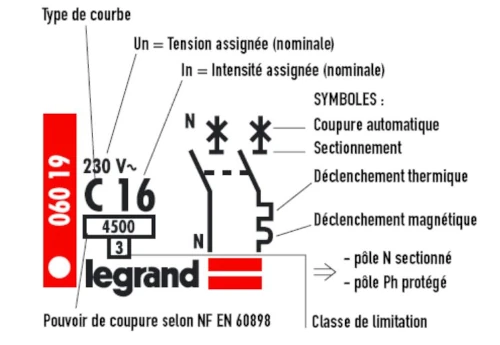
Each thermal-magnetic circuit breaker carries a rating indication expressed in amperes (A), usually visible in large letters on the front panel. This value represents the maximum rated current that the circuit-breaker can withstand continuously without tripping. Commercially available ratings range from 2A for control or signalling circuits to 63A for the most demanding domestic installations, or even higher for industrial applications.
In a conventional home complying with the NF C 15-100 standard, you will typically find a standardized distribution of ratings according to use. Lighting circuits are protected by 10A or 16A circuit breakers, perfectly suited to the modest power consumption of modern luminaires, especially LED bulbs. Standard outlets for common household appliances require 16A circuit breakers, while specialized circuits such as kitchen outlets can go up to 20A to support several appliances simultaneously.
For particularly powerful equipment, calibres increase accordingly. A conventional electric water heater generally requires a 20A circuit breaker, while an electric hob or stove will require a 32A circuit breaker. Heat pumps, air conditioners or charging stations for electric vehicles may require even higher ratings, depending on their power.
The choice of rating is never arbitrary, and is governed by precise electrical safety rules. It must correspond to the cable cross-section of the protected circuit and the maximum power of the devices connected to it. A gauge that is too low will cause frustrating nuisance triggers as soon as you start using your devices normally, forcing you to reset them frequently. On the other hand, an excessively large gauge will not effectively protect your electrical cables, and may allow them to overheat dangerously, to the point of melting the insulation, even before the circuit breaker deigns to trip.
The trigger curve: adapting sensitivity to use
Thermal-magnetic circuit breakers come in a range of trip curves, identified by capital letters engraved on the housing. This curve determines the exact current threshold at which magnetic protection is instantly activated, independently of thermal tripping, which remains the same regardless of the type of curve.
The courbe B instantly trips between three and five times the circuit-breaker's rated current. It is ideally suited to conventional domestic circuits where appliances do not generate high inrush currents on start-up. These circuits mainly include lighting, power outlets for computers, televisions and small appliances. The high sensitivity of this curve ensures optimum protection of people and property.
The courbe C represents the most widespread solution in residential and tertiary electrical installations. It tolerates current peaks of between five and ten times the rated current, thus avoiding nuisance tripping caused by transient inrush currents. Many everyday appliances generate these brief spikes on start-up: refrigerators and freezers, washing machines and dishwashers, vacuum cleaners, certain types of lamps, transformers and electronic power supplies. Curve C offers the best compromise between effective protection and tolerance of normal transients.
The more specialized courbe D, reserved for professional or industrial applications, withstands spikes of up to twenty times the rated current before tripping. This exceptional tolerance is necessary to protect equipment generating very high inrush currents: powerful electric motors, high-power transformers, industrial compressors, machine tools. In residential applications, you may encounter a D curve only for very specific applications such as a deep-well pump or a very heavy electric gate.
The number of poles: adapting to the type of power supply
A thermal-magnetic circuit breaker can be configured with one, two, three or four poles, depending on the type of electrical installation it is to protect. This fundamental characteristic determines how many active conductors the circuit breaker can interrupt simultaneously.
Single-pole circuit-breakers (1-pole + neutral) cut off the phase only, while generally retaining a neutral protection device. Although authorized for certain lighting circuits in the old standards, they are gradually being abandoned in favor of safer solutions.
Two-pole circuit-breakers (2 poles) are the standard in French single-phase domestic installations. They switch off phase and neutral simultaneously, guaranteeing complete isolation of the circuit in the event of a trip. This double-pole disconnection eliminates any risk of residual voltage and facilitates maintenance operations in complete safety. Standard NF C 15-100 now requires two-pole circuit breakers for most circuits, with a few exceptions.
Three-pole (3-pole) and tetra-pole (4-pole, including neutral) circuit-breakers are designed for three-phase installations, common in industry or for powering certain very powerful domestic equipment such as heat pumps, professional air conditioners or three-phase charging stations. The choice between three and four poles depends on whether the neutral conductor also needs to be disconnected.
Breaking capacity: to cope with violent short circuits
The breaking capacity, expressed in kiloamperes (kA), indicates the maximum short-circuit current that the circuit-breaker can interrupt without being destroyed. This crucial technical feature, often overlooked by non-professionals, determines the circuit-breaker's robustness in the face of the most violent electrical faults.
In residential applications, standard breaking capacities are 3 kA, 4.5 kA, 6 kA or 10 kA. For a conventional domestic installation far from the distribution transformer, a breaking capacity of 4.5 kA is generally sufficient. On the other hand, for installations close to a public distribution transformer or in apartment blocks, a breaking capacity of 6 kA or more becomes necessary, as the potential short-circuit current is much higher.
How to choose the right magnetothermal circuit breaker?
Selecting the right thermal-magnetic circuit breaker begins with a precise analysis of the electrical circuit to be protected. This methodical approach guarantees both the safety of the installation and its smooth day-to-day operation.
First, you need to be sure of the cross-sectional area of the cables already installed in your circuit, as this determines the maximum rating of the divisional circuit breaker. This fundamental rule of electrical safety is intangible: a cable with a cross-section of 1.5 mm² can only physically withstand a maximum current of 16A, which requires a circuit breaker with a maximum rating of 10A or 16A. A 2.5 mm² cable can withstand up to 20A under normal installation conditions. For 25A, 4 mm² is imperative, and so on according to the regulatory tables of NF C 15-100.
Next, accurately assess the nature and cumulative power of the devices that will be powered by this circuit. A modern lighting circuit equipped with low-energy LED bulbs will only require a 10A circuit breaker with curve B, which is more than sufficient for several dozen light points. On the other hand, a circuit supplying sockets in a kitchen, where you could simultaneously plug in a kettle, toaster, blender and other small appliances, will imperatively require a 20A circuit breaker with curve C to tolerate the inrush currents of these items of equipment without tripping unexpectedly.
For circuits dedicated to specific equipment such as electric ovens, hobs, water heaters or washing machines, always refer to the wattage indicated by the manufacturer on the appliance nameplate. Convert this power into amperes using the simple formula: Current (A) = Power (W) ÷ Voltage (V). For example, a 3000W oven on 230V will consume around 13A, requiring a 20A circuit breaker to maintain a comfortable safety margin.
Never forget to check that your choice strictly complies with the standards in force in your country. In France, the NF C 15-100 standard imposes extremely precise rules concerning the sizing of protection devices according to the type of circuit and the use of the premises. Scrupulous compliance with these standards is not just an administrative formality devoid of practical sense. It guarantees the actual safety of your electrical installation, avoids problems during regulatory checks before power-up, and protects you in the event of a claim for your home insurance declaration.
Installation and maintenance of thermal-magnetic circuit breakers
The installation of a magneto-thermal circuit breaker in an electrical panel must be carried out by a qualified electrician with the necessary legal authorizations to work on the installations. This requirement is not simply a recommendation of caution, but a legal obligation that engages your civil and criminal liability in the event of an accident.
The physical installation is carried out on a standard DIN rail in the electrical panel, using a simple snap-in system that requires precision and delicacy. The circuit-breaker is positioned on the rail by tilting the top part slightly, then exerting firm downward pressure until the characteristic locking click is heard and felt. Electrical connections must be made with meticulous care, stripping cables to the exact recommended length (usually 10 to 12 mm) and tightening terminal screws to the appropriate torque specified by the manufacturer. Insufficient tightening can lead to contact resistance, resulting in localized overheating and even terminal melting. Excessive tightening can damage the wires or the circuit-breaker housing.
Before carrying out any work on your electrical panel, always switch off the main power supply at the main circuit breaker or the ground fault circuit interrupter (GFCI). This absolutely vital precaution admits of no exceptions, even for a procedure that seems minor to you. After disconnecting the power supply, always check that there is no voltage present using a suitable, approved voltage tester. This double check can literally save your life by detecting a wiring error or unexpected power supply.
Once the thermal-magnetic circuit breaker has been correctly installed and connected, check its mechanical operation by repeatedly moving the lever between the OFF and ON positions. This simple test ensures that the mechanism is not jammed and that the lever swings smoothly from one position to the other. If the model is fitted with a manual release test button, press it to check that the cut-off mechanism is operating correctly.
Maintenance of a thermal-magnetic circuit breaker is fortunately minimal, but it should never be totally neglected. Visually inspect the condition of the enclosure during your periodic electrical panel checks, looking for any suspicious signs: brownish discoloration or blackening indicating overheating, plastic deformation, cracks, or burn marks. Test the mechanical operation of the lever several times a year, ideally at the time of the time change, to ensure that it is not blocked by dirt or oxidation.
If you notice frequent and repeated tripping for no apparent reason, don't try to solve the problem by installing a larger gauge. This dangerous easy solution amounts to suppressing the alarm system rather than extinguishing the fire. Search methodically for the real source of the problem: effective overload due to too many appliances on the same circuit, insulation fault in the wall wiring, faulty household appliances creating current leaks, or premature ageing of the circuit breaker itself which has become too sensitive.
The difference between thermal-magnetic circuit breakers and residual-current circuit breakers
An extremely common confusion, even among experienced DIYers, concerns the distinction between magneto-thermal circuit breakers and residual-current circuit breakers. These two types of device coexist in your switchboard and both contribute to electrical safety, but they protect against radically different dangers and operate on totally different physical principles.
The thermal-magnetic circuit breaker, as detailed throughout this article, protects your electrical installation against overcurrents: progressive electrical overloads that dangerously heat up cables, and violent short-circuits that can cause destructive electric arcs. Its primary mission is to preserve the physical integrity of your electrical conductors and prevent electrical fires, the main cause of damage in the home.
The earth leakage circuit breaker (ELCB), on the other hand, fulfils a completely different and complementary function: it protects people against electrocution by detecting current leaks to earth. Its operating principle is based on a permanent comparison between the current entering a circuit (through the phase) and that leaving it (through the neutral). In a healthy, fault-free circuit, these two currents are exactly the same. But if a faulty device leaks current to earth, or if a person accidentally touches a live conductor, the differential instantly detects this imbalance, however small (typically 30 milliamps in residential applications), and breaks the circuit in less than a tenth of a second. This exceptional responsiveness limits the duration of the electric shock and can save a life.
In a modern electrical installation that strictly complies with standard NF C 15-100, these two types of protection must coexist and complement each other harmoniously according to a precise hierarchical architecture. Differential circuit-breakers are placed at the head of an installation or at the head of a group of circuits (in this case, they're called differential switches), ensuring personal protection for several circuits simultaneously. Downstream of each residual current device, divisional thermal-magnetic circuit breakers protect each circuit individually against overcurrents.
There are also sophisticated devices that combine these two functions in a single compact housing: magnetothermal differential circuit breakers. These more comprehensive devices, necessarily more expensive, offer total protection against the three main risks (overload, short-circuit and electrocution) in a single format. However, their use remains less widespread in conventional residential applications, where the traditional architecture with overhead differentials and divisional circuit breakers per circuit remains the norm, thanks to its excellent cost/efficiency ratio and maintenance flexibility.
Applicable standards and regulations
The NF C 15-100 standard is the absolute reference in France for all low-voltage electrical installations in residential buildings, business premises and establishments open to the public. This evolving standard, regularly updated to incorporate feedback and technological developments, imposes very precise rules on the use of magnetothermal circuit breakers.
According to this standard, each circuit must be individually protected by an overcurrent protection device adapted to the cross-section of the conductors and the use of the circuit. Maximum authorized ratings are strictly defined: 16A maximum for a socket circuit with 1.5 mm² cable, 20A for 2.5 mm², 32A for 6 mm², and so on. These values are non-negotiable, and compliance with them is a condition of installation conformity.
The standard also specifies the minimum number of dedicated circuits in a home: at least four dedicated circuits (washing machine, oven or hob, independent freezer, and one free circuit), each protected by its own appropriately rated thermal-magnetic circuit breaker. In the kitchen, a minimum of six outlets divided into three specific circuits is required, given the high concentration of appliances in this room.
Scrupulous compliance with the NF C 15-100 standard is not just an administrative constraint. It is a prerequisite for obtaining the Consuel certificate of conformity, which is mandatory for all new or completely renovated electrical installations before they are energized. It also guarantees your protection in the event of a claim: a home insurance policy may refuse coverage if an electrical fire occurs on a substandard installation.
Choosing quality: renowned brands of thermal-magnetic circuit breakers
Not all circuit breakers are created equal. Manufacturing quality, reliability over time and actual performance in the face of electrical faults vary considerably from one manufacturer to another. For such a critical device in your electrical installation, choosing recognized and certified brands is a wise investment in terms of safety and longevity.
Leading brands such as Schneider Electric, Legrand, Hager, ABB and Siemens have built their reputations on decades of innovation and reliability. Their thermal-magnetic circuit breakers benefit from rigorous certifications (CE marking, NF conformity) and are designed to last several decades under normal conditions of use. These manufacturers invest heavily in research and development to constantly improve release accuracy, mechanical durability and resistance to harsh conditions.
Entry-level products or unknown brands may seem attractive because of their lower price, but they often have hidden weaknesses: approximate manufacturing tolerances, inferior materials, premature ageing of thermal bimetals, or inaccuracy in trigger thresholds. For a device that literally protects you and your family against the risks of fire and electrocution, saving a few euros on the initial purchase can be a false economy with potentially dramatic consequences.
Conclusion
The thermal-magnetic circuit breaker is an absolutely essential part of any modern, safe electrical installation that complies with current safety standards. Its remarkable ability to combine two complementary modes of protection - thermal and magnetic - in a compact, reliable and infinitely reusable device makes it the preferred solution for effectively protecting electrical circuits against the two major hazards of progressive overloads and violent short circuits.
An in-depth understanding of how it works will give you a better grasp of the overall safety of your electrical installation, and enable you to make perfectly informed choices when renovating, upgrading or creating new circuits. Whether you're a homeowner looking to intelligently supervise a renovation, a building professional looking for the most suitable equipment for your projects, or simply a curious person wanting to understand the devices that silently protect your daily life, the magneto-thermal circuit breaker richly deserves your attention and respect.
Never forget that the precise choice, correct sizing and professional installation of these electrical safety devices must always comply scrupulously with the standards in force, particularly NF C 15-100 in France, and must be entrusted to qualified, licensed electricians. Your personal safety and that of those around you depend directly on it, and cannot be compromised.
To equip your electrical installation with professional-quality magneto-thermal circuit breakers, rigorously compliant with NF C 15-100 standards and guaranteeing optimum protection, discover our carefully chosen selection on domeashop.com. Our experts will be happy to advise you on the choice of ratings, trip curves and switching capacities for your specific project.

Product categories
The domeashop store offers product categories related to this item to provide you with more information about the product(s) you are looking for. Don't hesitate to contact us for advice from our specialists.
Frequently asked questions
The domeashop store offers you a list of questions and answers corresponding to the most frequently asked questions related to the theme and products discussed in this article. If you can't find the answer you're looking for, contact us and our specialists will be happy to help.
The fuse is a single-use device that melts when subjected to excessive current, requiring complete replacement after each trip. The magneto-thermal circuit breaker, on the other hand, is a resettable device that resets simply by tilting its lever. It also offers dual protection (thermal and magnetic) where fuses only protect against overcurrent. In the long term, the circuit-breaker is more economical, more practical and more precise in its tripping thresholds.
Prices vary considerably according to calibre, number of poles, brand and technical performance. For a standard 16A or 20A double-pole divisional circuit breaker from a recognized brand, expect to pay between 5 and 15 euros. Higher ratings, special curves (D) or circuit-breakers with reinforced breaking capacity (10 kA) can cost between 20 and 40 euros. Premium brands like Schneider Electric or Legrand are slightly more expensive than entry-level brands, but offer superior reliability and durability that more than justify the price difference.
A quality circuit-breaker, correctly sized and installed under normal conditions of use, can operate trouble-free for 20 to 30 years, or even longer. Its lifespan depends mainly on the number of tripping cycles it undergoes: a circuit-breaker that hardly ever trips will age much less than one that is frequently used. Manufacturers generally guarantee several thousand operating cycles. However, if your circuit-breaker regularly trips for no apparent reason, or shows signs of ageing (difficulty resetting, discoloration of the casing), it should be replaced as a precautionary measure.
Frequent tripping always signals a problem that should never be ignored. Possible causes include: an actual overload (too many devices on the same circuit), a faulty device creating current spikes, an insulation fault in the wiring (moisture, rodents, aging), a loose connection creating abnormal resistance, or a circuit breaker undersized for the actual use of the circuit. In rare cases, the circuit-breaker itself may be faulty or have aged prematurely. Never try to "solve" the problem by installing a higher caliber without identifying the real cause, as this will remove your security protection.
Legally speaking, only an electrically qualified person can work on an electrical panel. For an individual, replacing a circuit-breaker means cutting off the main power supply, which sometimes requires the intervention of the electricity distributor. From a technical point of view, the operation is not complex for anyone with electrical knowledge, but it does involve mortal risks in the event of error. What's more, any modification to an electrical installation may require a new Consuel certificate of conformity. For your safety and legal compliance, we strongly recommend that you call in a qualified electrician.
A number of signs may indicate a malfunction: repeated nuisance triggers with no identifiable cause, inability to reset the lever (it drops back immediately), lever remaining in intermediate position and refusing to engage completely, visible traces of overheating on the housing (discoloration, deformation, burnt plastic smell), abnormal difficulty in operating the lever, or on the contrary, lever becoming too soft with no mechanical resistance. If you notice any of these symptoms, have the circuit breaker checked and replaced by a professional without delay.
For the vast majority of domestic installations, curve C is the optimum choice, as it offers the best compromise between effective protection and tolerance to the transient inrush currents of modern appliances. Choose curve B only for LED lighting circuits or electronic devices with no significant inrush current, and only if you never experience nuisance tripping. Curve D is reserved for industrial applications or very specific domestic equipment generating very high starting currents (powerful motors, transformers). When in doubt, the C curve is always a safe bet.
In a typical residential installation, the standardized and most economical architecture is to use 30 mA differential switches at the head of circuit groups, followed by simple thermal-magnetic circuit breakers to protect each circuit individually. This configuration offers an excellent protection/cost ratio and facilitates diagnosis in the event of a trip (you know immediately what type of problem is involved). Thermal-magnetic differential circuit-breakers are more expensive, and are particularly useful for particularly sensitive circuits, or in specific configurations where individual differential protection per circuit is required.
The basic rule is that the cable must always be sized to withstand at least the current rating of the circuit-breaker protecting it. In copper cable under normal installation conditions: 1.5 mm² supports a maximum of 16A (10A or 16A circuit breaker), 2.5 mm² supports 20A (16A or 20A circuit breaker), 4 mm² supports 25A (20A or 25A circuit breaker), 6 mm² supports 32A (25A or 32A circuit breaker), 10 mm² supports 40A (32A or 40A circuit breaker). These values are given for insulated cables in standard flush-mounted installation. Other installation methods may allow higher currents, but in this case you should consult the detailed tables in standard NF C 15-100.
Standard NF C 15-100 authorizes up to 8 16A sockets on a circuit protected by a 16A circuit breaker with 1.5 mm² conductors, or up to 12 sockets on a 2.5 mm² circuit with a 20A circuit breaker. These limits may seem generous, but the standard is based on the statistical principle that you'll never plug all your appliances simultaneously at maximum power into all your sockets. In practice, for comfortable use without risk of tripping, it is advisable not to exceed 5 to 6 sockets per circuit in rooms with high power consumption.
No, the thermal-magnetic circuit breaker does not protect against surges or lightning strikes. Its function is strictly limited to protection against overcurrents (overloads and short-circuits). To protect yourself against power surges, you need to install surge protectors in your switchboard, devices specifically designed to divert dangerous transient power surges to ground. In regions with high storm activity, or in buildings equipped with lightning conductors, the installation of lightning arresters is mandatory in accordance with standard NF C 15-100.
Each circuit-breaker has a number of markings engraved or printed on its casing. The most visible number (e.g. 16, 20, 32) indicates the amperage rating. The letter preceding it (B, C or D) designates the trigger curve. You'll also find the rated voltage (230V or 400V), the number of poles, the breaking capacity in kA (e.g. 4500A or 6000A), the energy limitation class, the conformity standards (CE, NF), and the name of the manufacturer. Some circuit-breakers also display their full commercial reference, so that you can order exactly the same model in the event of replacement.
No, this is strictly forbidden by standard NF C 15-100. Each circuit must be individually protected by its own protective device. This fundamental rule allows you to locate a problem immediately (you know which circuit is faulty), facilitates maintenance (you can cut off a single circuit to intervene), and above all guarantees that the circuit-breaker rating is perfectly matched to the cross-section of the cables on the protected circuit. Trying to "save" circuit breakers by grouping several circuits together would seriously compromise the safety of your installation.
Some top-of-the-range thermal-magnetic circuit-breakers incorporate a test button which allows the mechanism to be triggered manually to check that it is operating correctly. Note that this test button on a thermal-magnetic circuit breaker only checks the mechanical tripping mechanism, unlike the test button on a residual current device, which actually checks for current leakage. Above all, it ensures that the mechanism is not jammed, and that the circuit-breaker can trip when necessary. Ideally, operate this test button once or twice a year to keep the mechanism in good working order.
Slight heating of the circuit-breaker housing is normal when protecting a heavily loaded circuit, as the current flowing through it causes Joule heating. However, this warm-up should be very moderate: the casing should be barely warm to the touch. If the circuit-breaker becomes hot, it's a sign of a serious problem: loose connections creating parasitic resistance, an undersized circuit-breaker for the actual load, or defective internal components. An abnormally hot circuit-breaker needs to be checked by a qualified electrician as a matter of urgency, as this situation can develop into a terminal meltdown or fire.