
- There are no more items in your cart
- Shipping
- Total €0.00
What is a bipolar circuit breaker?

The circuit breaker is an essential part of any modern electrical installation. Whether you're an electrical professional, an experienced do-it-yourselfer or simply a homeowner concerned about the safety of your home, understanding the operation and use of this protective device is essential. In this comprehensive guide, we'll explore in depth everything you need to know about the bipolar circuit breaker.
Contents
- Bipolar circuit breaker definition
- Operating principle of a bipolar circuit breaker
- Basic mechanism
- Simultaneous disconnection of both poles
- Trigger curves
- Differences between unipolar, bipolar and tetrapolar circuit breakers
- Single-pole circuit breaker (1P)
- Single-pole circuit breaker (1P+N)
- Bipolar circuit breaker (2P)
- Three-phase circuit breaker (3P and 3P+N)
- Four-pole circuit breaker (4P)
- Bipolar circuit breaker applications and uses
- In residential installations
- For high-power devices
- In professional environments
- Technical specifications to know
- Rated current (In)
- Rated voltage (Un)
- Breaking capacity (BC)
- Trigger classes
- Installation and commissioning
- Location in the electrical panel
- Electrical connection
- Safety rules
- Post-installation checks
- Advantages of two-pole circuit breakers
- Enhanced safety
- Compliance with standards
- Optimum equipment protection
- How to choose a two-pole circuit breaker
- Determining the required size
- Select the appropriate trigger curve
- Opt for the right brand and quality
- Check certifications
- Maintenance and servicing
- Periodic checks
- Service life and replacement
- Troubleshooting common problems
- Regulations and standards
- NF C 15-100 standard
- Consuel and the certificate of conformity
- Recent regulatory developments
- Conclusion
Bipolar circuit breaker definition
A two-pole circuit breaker, also known as a 2P circuit breaker or two-phase circuit breaker, is an electrical protection device that simultaneously interrupts two active conductors in an electrical circuit. Unlike the single-pole circuit-breaker, which protects only one pole, the double-pole circuit-breaker operates on two poles at once, usually phase and neutral, offering enhanced protection for most electrical configurations.
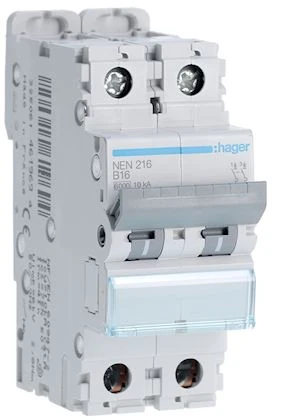
This type of circuit breaker is designed to protect electrical circuits against two major hazards: overloads and short circuits. When an anomaly is detected, the two-pole circuit breaker automatically cuts the power supply to both conductors, guaranteeing optimum safety for people and equipment.
The term "bipolar" refers to the fact that this circuit breaker has two protected poles, i.e. two contacts that open and close simultaneously. This characteristic fundamentally distinguishes it from other types of circuit-breaker and defines its specific applications in residential and professional electrical installations.
Operating principle of a bipolar circuit breaker
Basic mechanism
The operation of a double-pole circuit breaker is based on a sophisticated but reliable electromechanical mechanism. The device incorporates two main detection elements: a thermal trigger and a magnetic trigger. These two systems work in synergy to ensure complete protection of the electrical circuit.
The thermal release consists of a bimetallic strip, i.e. two different metals welded together with different coefficients of expansion. When the current flowing through the circuit-breaker exceeds the rated value for a prolonged period, overheating causes the bimetallic strip to deform. This mechanical deformation activates the tripping mechanism, causing both circuit-breaker poles to open simultaneously.
The magnetic trip unit intervenes in the event of a short-circuit. It consists of a coil and a moving magnetic core. In the event of a sudden rise in current (short-circuit), the magnetic field generated by the coil becomes strong enough to attract the moving core, instantly tripping the circuit-breaker. This mechanism enables an almost instantaneous reaction, usually within milliseconds.
Simultaneous disconnection of both poles
One of the key features of the double-pole circuit breaker is its ability to break both active conductors simultaneously. This synchronized disconnection is guaranteed by a rigid link mechanism between the two moving contacts. When tripping, whether due to overload or short-circuit, both poles open at exactly the same instant.
This simultaneous shutdown offers several considerable safety advantages. It ensures that the protected device is completely isolated from the mains, eliminating any risk of dangerous residual potential. Moreover, this feature is particularly important in installations where phase and neutral must be disconnected together, as is the case for many household appliances or in certain network configurations.
The connection mechanism between the two poles is designed to be extremely reliable and durable. It must withstand thousands of opening and closing cycles while maintaining perfect synchronization. Circuit-breaker manufacturers subject these devices to rigorous testing to guarantee their long-term performance.
Trigger curves
Two-pole circuit breakers are available with different trip curves, designated by the letters B, C, D and Z. These curves define the sensitivity of the magnetic trip unit and determine the current threshold above which the circuit-breaker trips instantaneously.
Curve B is the most sensitive, with magnetic tripping between 3 and 5 times the rated current (In). It is particularly suitable for circuits with long cable runs or for personal protection. Curve C, the most common in domestic installations, triggers between 5 and 10 times In. It is ideally suited to standard applications where moderate inrush currents may occur when certain equipment is started up.
Curve D, on the other hand, tolerates higher current peaks, with tripping between 10 and 20 times In. It is designed for circuits supplying loads with high inrush currents, such as motors or transformers. Finally, the less common Z curve is used to protect sensitive electronic circuits, tripping between 2 and 3 times In.
Differences between unipolar, bipolar and tetrapolar circuit breakers
Single-pole circuit breaker (1P)
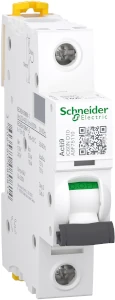
The single-pole circuit breaker protects and disconnects only one active conductor. This type of circuit breaker is used in older domestic installations to replace fuses.
Single-pole circuit breaker (1P+N)
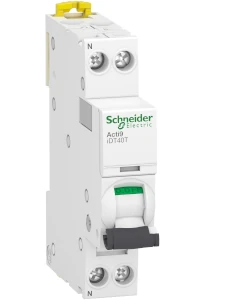
The single-pole circuit-breaker with neutral, or phase-neutral circuit-breaker (Phase + Neutral or 1P+N), protects and interrupts only one active conductor, usually the phase. This type of circuit-breaker is most commonly used in domestic installations to protect lighting circuits and single sockets.
The main advantage of single-pole circuit breakers is their compact size and lower cost. It occupies a single module in the electrical panel, optimizing available space. However, its protection is limited to a single pole, which may be insufficient in certain configurations or for certain types of device requiring complete insulation.
In installations complying with current standards, the single-pole circuit breaker should only be installed on the phase, the neutral remaining protected by other devices at the general electrical panel. This configuration is suitable for conventional single-phase circuits where only the phase requires individual protection.
Bipolar circuit breaker (2P)
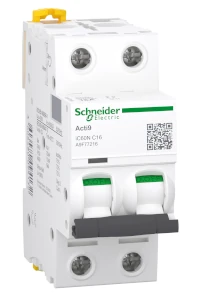
The two-pole circuit-breaker simultaneously interrupts two active conductors. In a conventional single-phase installation, these are phase and neutral. In a two-phase or three-phase installation, two phases may be involved. This type of circuit breaker occupies two modules in the electrical panel and offers enhanced protection compared with the single-pole model.
The use of a double-pole circuit breaker is mandatory in several situations. It is required to protect circuits supplying certain appliances such as electric water heaters, air conditioners, hobs, or any appliance requiring complete power cut-off for safety reasons. It is also essential in bathrooms, where standards require simultaneous phase and neutral disconnection.
The two-pole circuit-breaker also offers the advantage of easy maintenance. By cutting off both phase and neutral, it ensures that the protected device is completely de-energized, eliminating any risk to the operator. This feature is particularly appreciated by electrical maintenance professionals.
Three-phase circuit breaker (3P and 3P+N)
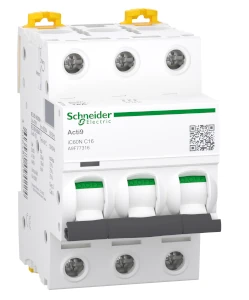
Three-phase circuit breakers come in two main variants: 3P (three-pole) and 3P+N (three-pole + neutral). The 3P circuit-breaker protects and cuts only the three phases, without touching the neutral. It occupies three modules in the electrical panel and is mainly used for three-phase motors and industrial equipment that do not require a neutral connection. This type of circuit-breaker is particularly suitable for balanced loads where the neutral conductor theoretically carries no current. The 3P+N circuit-breaker, on the other hand, protects all three phases and includes a neutral cut-out, although the neutral is generally not protected by thermal and magnetic releases. It occupies four modules like the tetrapolar, but unlike the latter, only the three phases have overload and short-circuit protection. The neutral conductor is simply mechanically disconnected to ensure complete isolation of the circuit. This configuration is common in three-phase installations with neutral, where some equipment requires all three phases plus neutral, such as certain machines combining three-phase motors and single-phase control circuits.
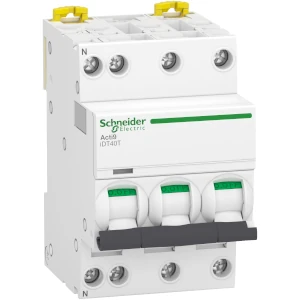
The distinction between 4P (tetrapolar) and 3P+N is important: in a 4P, all four poles are protected and monitored, whereas in a 3P+N, only the three phases are protected, the neutral being simply disconnected without dedicated protection. The choice between these configurations depends on the specific requirements of the installation, the applicable standards and the type of equipment to be protected. In three-phase residential installations, 4P tetrapolar circuit breakers are most frequently used for the main circuit breaker, while individual circuits can use 3P or 3P+N configurations as required.
Four-pole circuit breaker (4P)
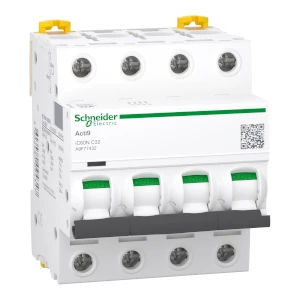
The four-pole circuit-breaker, or three-phase circuit-breaker, simultaneously protects and disconnects four conductors: the three phases and the neutral conductor. It is used exclusively in three-phase installations and occupies four modules in the electrical panel. This type of circuit breaker is essential for protecting three-phase equipment such as certain industrial motors, powerful heat pumps or machine tools.
Tetrapolar circuit breakers operate on the same principles as bipolar circuit breakers, but with added complexity due to the number of poles to be protected. The tripping mechanism must ensure perfectly synchronized disconnection of all four conductors to guarantee optimum safety. Four-pole circuit breakers are generally rated for higher currents than their single- or double-pole counterparts.
In the residential context, four-pole circuit breakers are relatively rare, and are mainly found in large homes with three-phase installations, or in certain older buildings. On the other hand, they are very common in industrial and commercial installations where three-phase power is the norm.
Bipolar circuit breaker applications and uses
In residential installations
The two-pole circuit-breaker has many essential applications in the home. One of its most common uses is to protect electric water heaters. Standard NF C 15-100, which governs electrical installations in France, requires the use of a two-pole circuit breaker for this type of device. The reason is simple: the water heater is a fixed appliance that must be completely isolated from the mains to enable maintenance work to be carried out in complete safety.
Circuits supplying electric or induction hobs also require a two-pole circuit breaker. These devices generally consume a lot of power, and their stationary nature requires extra protection. Similarly, built-in electric ovens, stationary air conditioners and some electric heating systems must be protected by two-pole circuit breakers.
In bathrooms and shower rooms, safety standards are particularly strict because of the presence of water and the increased risk of electrocution. Circuits supplying these rooms often need to be protected by two-pole circuit breakers, especially for sockets located in certain areas of the bathroom. This requirement guarantees complete power cut-off in the event of a fault.
For high-power devices
High-power electrical appliances benefit greatly from the protection offered by a two-pole circuit breaker. Heat pumps, for example, are energy-hungry devices that run continuously, generating high inrush currents when they start up. A correctly sized two-pole circuit breaker not only protects the device against overloads and short circuits, but also ensures that the system can be completely isolated for maintenance operations.
Electric vehicle charging stations are another major application for bipolar circuit breakers. These devices, which are becoming increasingly common in homes, deliver high levels of power over long periods. Protection by two-pole circuit breaker is not only recommended, but often mandatory, depending on the installation and local standards. It ensures optimum safety during long hours of recharging.
Washing machines and dishwashers, although of moderate power, are sometimes protected by two-pole circuit breakers in recent installations. This approach provides an extra level of safety, which is particularly valuable for devices that handle water and often operate unattended. The two-pole circuit-breaker guarantees complete isolation in the event of a fault.
In professional environments
In the tertiary and industrial sectors, two-pole circuit breakers play a crucial role in protecting equipment and ensuring the safety of installations. This type of protection is widely used in modern offices, which are equipped with numerous IT devices and air-conditioning systems. Computer servers, in particular, often require a power supply protected by a double-pole circuit breaker to guarantee complete isolation in the event of intervention.
Shops and restaurants use bipolar circuit breakers to protect their professional kitchen equipment: ovens, fryers, hotplates, cold rooms and other specific appliances. This equipment, which is often high-powered and operates intensively, requires reliable, robust protection. The two-pole circuit-breaker is the perfect answer to these requirements, offering maximum safety.
In workshops and small industries, machine tools, compressors and other electrical equipment are systematically protected by appropriate circuit breakers. Two-pole circuit breakers are the preferred choice for single-phase, medium-power equipment, enabling efficient protection management while optimizing cabinet space.
Technical specifications to know
Rated current (In)
The rating of a two-pole circuit breaker, expressed in amperes (A), represents the maximum current the breaker can withstand in continuous operation without tripping. This is the most important criterion when selecting a circuit breaker. Standard ratings available on the market range from 2A to 63A for residential applications, and up to several hundred amperes for industrial applications.
The choice of rating must take several factors into account: the power of the device or circuit to be protected, the cross-section of the cables used, and the length of the circuit. Too low a rating will lead to nuisance tripping, while too high a rating will not provide effective protection against overloads. Standard NF C 15-100 provides precise tables for determining the appropriate gauge according to conductor cross-section.
For a standard socket-outlet circuit with 2.5 mm² cables, a 20A circuit-breaker is generally recommended. For a 2000W to 3000W electric water heater, a 20A or 25A circuit breaker will be appropriate, depending on the configuration. Cooker hobs often require higher ratings, generally between 32A and 40A depending on their wattage. It is vital to consult the device manufacturer's recommendations to ensure optimum protection.
Rated voltage (Un)
The voltage rating of a two-pole circuit breaker indicates the maximum mains voltage on which the circuit breaker can be installed. For domestic installations in France, the standard voltage is 230V single-phase, and circuit breakers are generally designed to withstand 400V. This safety margin allows the same circuit-breakers to be used in different electrical configurations.
Please note that the rated voltage does not necessarily correspond to the operating voltage. A circuit-breaker rated for 400V can perfectly well be used on a 230V network, but the reverse is never possible. This feature offers considerable flexibility for electricians and makes it possible to standardize equipment in electrical panels.
The rated voltage also influences the circuit-breaker's breaking capacity. This is because it is more difficult to extinguish the arc that forms when the contacts are opened at high voltage. Manufacturers take this parameter into account in the design of their circuit-breakers to guarantee safe, effective breaking under all conditions of use.
Breaking capacity (BC)
The breaking capacity, expressed in kiloamperes (kA), represents the maximum short-circuit current that the circuit-breaker can safely interrupt without being damaged. This is a fundamental characteristic that determines the circuit-breaker's ability to protect the installation in the most critical situations. Standard breaking capacities for residential applications are 3kA, 4.5kA, 6kA and 10kA.
The choice of switching capacity depends mainly on the proximity of the electrical transformer and the configuration of the distribution network. In an urban area, close to a transformer station, short-circuit currents can be very high, requiring a breaking capacity of 6kA or more. Conversely, in a rural area far from the main grid, a breaking capacity of 3kA may be sufficient.
It is always preferable to choose a circuit-breaker with a higher breaking capacity than the calculated minimum requirements. This safety margin enables us to anticipate changes in the power grid and guarantees long-term protection. A 6kA circuit breaker represents an excellent compromise between performance and cost for most modern residential installations.
Trigger classes
The trip classes, defined by the B, C, D and Z curves mentioned above, determine the circuit-breaker's reactivity to overcurrents. This classification is essential for adapting protection to the type of load supplied. Incorrect class selection can lead to either nuisance tripping or insufficient protection.
For standard lighting circuits and sockets, curve C is universally recommended. It offers a good compromise between effective protection and tolerance of normal inrush currents. Circuits supplying heating resistors or water heaters can also use curve C circuit breakers without any particular problem.
Curve B is useful for very long circuits or for reinforced differential protection. It is also used in certain photovoltaic installations or when greater sensitivity is required. Curve D, on the other hand, is reserved for specific applications with high inductive loads, such as pump motors or transformers. Using the wrong curve can compromise the effectiveness of the protection.
Installation and commissioning
Location in the electrical panel
Installing a two-pole circuit breaker in an electrical panel requires rigorous organization and compliance with strict rules. The circuit-breaker must be positioned on a standardized DIN rail, a system that guarantees solid mounting and allows easy assembly and disassembly. Each two-pole circuit breaker takes up two modules (18mm wide units), which must be taken into account when designing the panel.
The distribution of circuits in the electrical panel must follow a clear, functional logic. We recommend grouping circuit breakers by geographical area of the home or by circuit type. For example, you could group all the kitchen circuits together, then those in the bedrooms, then those in the bathroom. This organization greatly facilitates subsequent interventions and troubleshooting.
The electrical panel must offer sufficient space to allow wiring without undue stress on the wires. An overloaded switchboard with compressed wires presents the risk of overheating and complicates servicing. It is therefore prudent to plan for a capacity that exceeds immediate needs; generally speaking, a surplus of 20% to 30% allows us to anticipate future expansions.
Electrical connection
When connecting a two-pole circuit breaker, particular care must be taken to ensure compliance with good electrical practice. Each terminal on the circuit-breaker must be fitted with a single conductor, firmly tightened with a suitable screwdriver. The tightening torque recommended by the manufacturer must be scrupulously observed: insufficient tightening can cause dangerous overheating, while excessive tightening can damage the terminals.
Phase and neutral must be correctly identified and connected to the appropriate terminals. Although the two-pole circuit breaker cuts both poles, it's important to observe the wiring conventions: phase on the left, neutral on the right when looking at the circuit breaker from the front. This standardization facilitates subsequent interventions and reduces the risk of errors when making modifications to the installation.
Horizontal feeder combs are highly recommended for distributing power from the main breaker to the divisional breakers. These combs replace multiple individual wires, providing cleaner, more reliable and safer wiring. They also considerably reduce installation time and minimize the risk of poor contact.
Safety rules
Any work on a switchboard must be preceded by disconnection of the main power supply. It is absolutely forbidden to work under voltage, even for a simple circuit-breaker replacement. Switching off the main or subscriber circuit breaker is mandatory, and the use of a VAT (Voltage Absence Verifier) is highly recommended to confirm that the installation is de-energized.
The installation of two-pole circuit breakers must comply with NF C 15-100, the French standard governing the design and installation of low-voltage electrical installations. This standard imposes minimum cable cross-sections according to circuit-breaker rating, safety distances and circuit identification rules. Failure to comply with this standard may result in refusal of conformity by Consuel during commissioning.
If you're not an electrician, we strongly advise you to call in a professional electrician to install or replace circuit breakers. Electricity presents real and potentially fatal dangers. A professional not only has the necessary technical skills, but also the professional liability insurance to protect against any subsequent problems.
Post-installation checks
Once the two-pole circuit-breaker has been installed, a number of checks must be carried out before it is switched on. First, visually check all connections for tightness, ensure that wires are not excessively long and stripped, and check that conductors do not touch other metal parts of the panel. Unconnected ends must be properly insulated.
Electrical continuity must be tested using a multimeter. In the open position (circuit-breaker tripped), there must be no continuity between upstream and downstream. In the closed position, continuity must be perfect with virtually no resistance. This test ensures that the circuit-breaker contacts are working properly and that the disconnection mechanism is operational.
After power-up, check that the circuit-breaker terminals have not overheated after a few hours of operation. Localized heating may indicate incorrect tightening or a faulty connection. It is also advisable to test the circuit-breaker's operation by simulating a load close to its nominal rating, to ensure that it does not trip unexpectedly.
Advantages of two-pole circuit breakers
Enhanced safety
The main advantage of the two-pole circuit breaker is the increased level of safety it provides. By simultaneously cutting off phase and neutral, it guarantees total isolation of the protected device from the electrical network. This feature is particularly crucial in situations where a fault on the neutral conductor could maintain a dangerous potential even after the phase alone has been disconnected.
In certain network configurations, particularly where the neutral is distributed and may be live with respect to earth, the double-pole circuit breaker offers protection that a single-pole circuit breaker cannot. This situation may arise in the event of a major imbalance on the three-phase network, or in the presence of faults on the energy distributor's installation. The two-pole circuit-breaker provides effective protection against these exceptional situations.
For maintenance operations, the double-pole circuit-breaker offers an additional guarantee to the operator. By cutting off both active conductors, it eliminates any risk of residual voltage, even in the event of atypical wiring or accidental inversion of phase and neutral. This safety feature is particularly appreciated by professionals, who can work with confidence on equipment protected by this type of circuit-breaker.
Compliance with standards
The use of bipolar circuit breakers in the situations prescribed by standard NF C 15-100 is mandatory to obtain the certificate of conformity issued by Consuel. This certificate is required for the initial commissioning of a new or completely renovated electrical installation, as well as for any increase in subscribed power. Failure to comply with this obligation may result in refusal of connection by the energy distributor.
Insurance companies attach particular importance to the compliance of electrical installations. In the event of an electrical claim, a substandard installation may result in a reduction or even cancellation of compensation. Installing two-pole circuit breakers where required is an integral part of this compliance, and contributes to the validity of insurance coverage.
As part of the sale of a property, the mandatory electrical diagnosis (DEO) verifies the presence and correct sizing of protective devices. The absence of bipolar circuit breakers in the required locations is an anomaly that will be noted in the report. Although this does not prevent the sale, these anomalies can be used by the buyer to negotiate the price or demand compliance work.
Optimum equipment protection
In addition to personal safety, the two-pole circuit breaker provides optimum protection for electrical equipment. Modern devices, especially those with power electronics, are sensitive to electrical faults. Incomplete disconnection or an undetected fault can cause irreversible damage to electronic circuits. The two-pole circuit-breaker, by guaranteeing a clean and complete cut-off, minimizes these risks.
Heating appliances, especially electric water heaters, benefit greatly from bipolar protection. This equipment often operates for several hours a day, and is subject to considerable thermal stress. An insulation fault or overload can quickly lead to a dangerous situation. The two-pole circuit breaker detects and interrupts these faults before they damage the device or create a fire hazard.
For expensive equipment such as heat pumps, air-conditioning systems or electric vehicle charging stations, the investment in a quality bipolar circuit breaker represents modest insurance compared to the cost of replacing the device. The reliability and durability of this equipment are directly influenced by the quality of its electrical protection.
How to choose a two-pole circuit breaker
Determining the required size
Choosing the size of a double-pole circuit breaker is a crucial step, requiring precise analysis of several parameters. The first factor to take into account is the power of the appliance or the total power of the appliances to be supplied by the protected circuit. To convert power in watts (W) to current in amperes (A), we use the formula: I = P / U, where P is power in watts and U is voltage in volts (230V for a domestic installation in France).
For example, for a 3000W water heater: I = 3000 / 230 ˜ 13A. We therefore choose a circuit-breaker of the next higher rating, either 16A or 20A, depending on the manufacturer's recommendations and cable cross-section. It's important to include a safety margin, as devices may consume slightly more than their rated power, particularly during start-up phases.
The second decisive criterion is cable cross-section. Standard NF C 15-100 establishes a strict correspondence between the cross-section of conductors and the maximum rating of the circuit-breaker protecting them. For 1.5mm² cables, the maximum rating is 16A. For 2.5mm², we can go up to 20A or 25A, depending on the application. For 6mm², the rating can be up to 32A. These limits ensure that the cables will not heat up dangerously, even under maximum load.
Select the appropriate trigger curve
The choice of trigger curve must be adapted to the type of device to be protected. For the majority of standard household applications (sockets, lighting, standard household appliances), curve C is the optimal choice. It offers the best protection while tolerating the moderate inrush currents that occur when many electrical appliances are switched on.
For circuits supplying equipment generating high inrush currents, such as certain pumps, motors or transformers, a D curve may be required. However, this choice must be made with care, as an overly tolerant curve delays tripping in the event of a short-circuit. Please consult the technical specifications of the device to determine the amplitude and duration of the starting currents.
When in doubt, the C curve is a safe and versatile choice. If unwanted tripping occurs with a C curve, it is always possible to switch to a D curve at a later date. The reverse (moving from a D curve to a C curve) is never necessary, and would rather suggest an initial error in sizing.
Opt for the right brand and quality
The bipolar circuit breaker market offers a wide range of products, from premium brands to entry-level products. Established brands such as Schneider Electric, Legrand, Hager, ABB and Siemens offer proven reliability and excellent durability. Their circuit-breakers are rigorously tested and independently certified to ensure compliance with current standards.
These reference brands also offer complete ranges with a wide availability of calibers and features. This facilitates future maintenance and replacement of components. Their technical manuals are detailed, and their after-sales services are generally responsive to questions or problems. The extra investment in a recognized brand is justified by the peace of mind and longevity of the installation.
Entry-level products may seem attractive because of their lower price, but they often have limitations. Service life may be reduced, the number of operating cycles supported is generally lower, and contact quality may deteriorate more rapidly. For an electrical installation that is intended to last several decades, prioritizing quality over initial cost is a prudent approach that makes economic sense in the long term.
Check certifications
Two-pole circuit breakers marketed in Europe must comply with several standards and bear the corresponding markings. CE marking is compulsory and certifies that the product complies with applicable European directives. IEC 60898 (or EN 60898 for the European version) specifies the requirements for domestic circuit breakers. Some circuit-breakers may also comply with NF C 61-410, a French version of the international standard.
In addition to standards, some independent bodies issue additional certifications guaranteeing superior performance. The NF mark, issued by AFNOR in France, certifies that the product meets not only mandatory standards, but also additional quality criteria. NF-certified products have undergone more stringent testing and generally offer greater reliability.
At the time of purchase, it is advisable to physically check the presence of these markings on the circuit-breaker itself. Counterfeit products or products of dubious quality may display non-authentic markings. Purchasing from reputable distributors and checking the consistency of packaging, documentation and the product itself will help avoid unpleasant surprises.
Maintenance and servicing
Periodic checks
Preventive maintenance of a double-pole circuit-breaker helps to ensure that it remains in good working order over the long term. We recommend carrying out a manual release test at least once a year. This simple procedure involves opening and closing the circuit-breaker to check that the mechanism operates freely and that the contacts make properly. This test detects any blockages or abnormal resistance.
Visual inspection of the electrical panel and circuit breakers should be carried out regularly, ideally every six months. This inspection looks for signs of overheating (housing discoloration, black streaks, burning smell), traces of moisture, loose connections or damaged cables. Any abnormal signs should be taken seriously and thoroughly investigated by a professional.
Tightening connections is an important maintenance operation, but should be carried out with care. The terminals may loosen slightly over time due to the heating and cooling cycles of the electrical panel. An annual tightening check, carried out with the power off and using a torque screwdriver if possible, will prevent overheating due to poor contacts.
Service life and replacement
The theoretical service life of a quality bipolar circuit breaker is generally in excess of 20 years under normal conditions of use. However, this duration can be significantly reduced in harsh environments (high temperature, humidity, corrosive atmosphere) or in the event of frequent use. A circuit-breaker that trips regularly wears out faster than one that stays closed all the time.
Circuit breakers have a number of operating cycles guaranteed by the manufacturer, generally between 10,000 and 20,000 cycles for domestic models. A cycle corresponds to an opening followed by a closing. In normal residential use, this number of cycles is almost never reached. On the other hand, in an industrial plant with frequent start-ups, this limit may become relevant.
Certain signs indicate that a circuit breaker needs to be replaced: difficulty resetting after tripping, repeated nuisance tripping with no identifiable cause, signs of overheating or arcing, cracked or damaged housing, abnormal rigidity of the operating lever. When faced with any of these symptoms, preventive replacement of the circuit-breaker is the wisest solution to avoid failure at the critical moment.
Troubleshooting common problems
Untimely tripping of a two-pole circuit breaker is the most common problem encountered. There can be many causes: real overload (too many devices on the circuit), a problem with a connected device, overheating of the circuit-breaker itself due to poor contact, or a faulty circuit-breaker. The troubleshooting methodology consists of isolating the cause by progressive elimination.
To identify an overload, you need to calculate the total power of the devices likely to operate simultaneously on the circuit and check that it remains below the circuit-breaker capacity. If the overload is confirmed, either reduce the simultaneous use of the appliances, or divide the circuit into several separate circuits, each protected by its own circuit breaker. This last solution requires the intervention of a qualified electrician.
To test whether a specific device is responsible for the trips, you can proceed by successive disconnections. We reset the circuit-breaker with all the disconnected devices, then reconnect them one by one, observing the behavior of the circuit-breaker. The triggering device must be checked by a professional, or replaced if faulty. If the trip occurs without any devices connected, the circuit-breaker itself is probably faulty.
Regulations and standards
NF C 15-100 standard
The NF C 15-100 standard is the essential reference for all low-voltage electrical installations in France. This standard, which is regularly updated to incorporate technological developments and feedback from experience, defines the safety requirements applicable to new and fully renovated installations. In particular, it specifies when the use of a double-pole circuit breaker is mandatory.
According to this standard, two-pole circuit breakers are mandatory to protect circuits supplying electric water heaters, regardless of their volume. The purpose of this requirement is to ensure complete insulation of the appliance to facilitate maintenance work and eliminate any electrical risk when replacing the resistor or thermostat. The cable cross-section and circuit-breaker rating are also precisely defined according to the water heater's power rating.
For socket-outlet circuits in bathrooms, the standard imposes strict rules based on defined safety volumes around water points. In some cases, the use of double-pole circuit breakers is mandatory, particularly for circuits located in volumes 1 and 2. These requirements are designed to minimize the risk of electrocution in these particularly sensitive environments, where water and electricity coexist.
Consuel and the certificate of conformity
Consuel (Comité National pour la Sécurité des Usagers de l'Électricité - National Committee for the Safety of Electricity Users) is the body responsible for checking the conformity of electrical installations before they are energized by the energy distributor. The certificate of conformity issued by Consuel is mandatory for all new installations, for complete renovations, and for increases in subscribed power above certain thresholds.
The Consuel inspection checks the presence and correct sizing of protection devices, including two-pole circuit breakers. The inspector ensures that these circuit breakers are installed where required by the standard, that they are correctly sized, and that they correspond to the characteristics of the installation. Failure to comply will result in an unfavorable opinion and the impossibility of energizing the installation.
It is important to note that the Consuel certificate is not an absolute guarantee of the quality of the installation, but rather a verification of compliance with minimum safety requirements. A Consuel-compliant installation may still have room for improvement in terms of safety or functionality. It does, however, meet the regulatory requirements for legal operation.
Recent regulatory developments
Electrical installation regulations are regularly updated to keep pace with technological advances and improve safety. Recent amendments to the NF C 15-100 standard have strengthened requirements for differential protection, circuit security, and the integration of new technologies such as electric vehicle charging stations and photovoltaic installations.
As far as double-pole circuit breakers are concerned, the changes mainly concern the extension of their mandatory use to new types of equipment. Charging stations for electric vehicles, for example, need to be protected by appropriate devices, generally including a two-pole circuit-breaker combined with specific residual current protection. The aim of these regulations is to ensure safety during long load periods and to protect against insulation faults.
Installations in new housing are also subject to stricter requirements. The minimum number of protected circuits, cable cross-sections and circuit-breaker ratings are more precisely defined. This standardization facilitates installation and guarantees a uniform level of safety throughout the country. Professionals need to keep abreast of these developments to keep their skills up to date.
Conclusion
The two-pole circuit breaker is a fundamental component of any modern electrical installation, providing robust, reliable protection against overloads and short circuits. Its ability to switch off two active conductors simultaneously makes it an essential safety device for a wide range of applications, from water heaters to air-conditioning systems and bathroom circuits.
Understanding the operation, technical characteristics and installation rules of two-pole circuit breakers enables you to make informed choices when designing or renovating an electrical installation. Compliance with standards, in particular NF C 15-100, and the choice of quality products guarantee not only regulatory compliance, but above all the long-term safety of people and property.
Whether you're an electrical professional or a homeowner concerned about the safety of your home, investing in the right quality two-pole circuit breakers is a valuable insurance policy. These devices, although discreet in their electrical panel, play a crucial role in preventing electrical accidents and protecting your equipment.
Remember that any work on an electrical installation must be carried out in strict compliance with safety regulations, and that when in doubt, calling in a qualified professional electrician is always the best decision. Your safety and that of your family depend on it.
For all your needs in bipolar circuit breakers and quality electrical equipment, don't hesitate to visit our domeashop.com store, where you'll find a rigorous selection of certified, standards-compliant products, accompanied by expert advice to guide you in your choices.

Product categories
The domeashop store offers product categories related to this item to provide you with more information about the product(s) you are looking for. Don't hesitate to contact us for advice from our specialists.
Frequently asked questions
The domeashop store offers you a list of questions and answers corresponding to the most frequently asked questions related to the theme and products discussed in this article. If you can't find the answer you're looking for, contact us and our specialists will be happy to help.
A two-pole circuit-breaker protects against overloads and short-circuits by simultaneously disconnecting the phase and neutral conductors. It detects overcurrents in conductors. A two-pole differential switch, on the other hand, protects against insulation faults and current leakage to earth, detecting current differences between phase and neutral. They complement each other: the residual current device protects people against electrocution, while the circuit-breaker protects equipment and cables. In a complete installation, there's usually an earth leakage switch upstream protecting several circuits, each of which is then protected by its own double-pole or single-pole circuit breaker.
Yes, technically it's always possible to replace a single-pole circuit breaker with a double-pole one, but the reverse is not true. The two-pole circuit breaker offers superior protection by breaking both phase and neutral. However, it's important to bear in mind the size of the circuit-breaker: a double-pole circuit-breaker takes up two modules, compared with a single-pole circuit-breaker. This means you need the right amount of space in the electrical panel. In addition, the cost of a bipolar circuit breaker is higher. This replacement is appropriate to increase the safety of a sensitive circuit or to comply with current standards, but it is not always compulsory if the existing installation meets the standards in force at the time of installation.
For a 200-liter electric water heater, power is generally between 2000W and 3000W. Applying the formula I = P / U (with U = 230V), we obtain a current between 8.7A and 13A. The NF C 15-100 standard recommends a 20A circuit breaker to protect this type of device, combined with cables with a minimum cross-section of 2.5mm². This rating provides a sufficient safety margin to take account of voltage variations and slight temporary overconsumption. It is important to check the water heater manufacturer's recommendations, which may impose a specific rating. In all cases, the circuit-breaker rating must be consistent with the cross-section of the cables used to ensure effective protection.
There are several reasons why a two-pole circuit breaker may trip unexpectedly. The most frequent cause is a real overload: too many appliances operating simultaneously on the circuit, exceeding the circuit-breaker's capacity. Calculate the total power of the devices to verify this hypothesis. An insulation fault in a connected device can also cause tripping, especially if the device is old or damaged. Disconnect the devices one by one to identify the culprit. Poor contact in the circuit-breaker terminals can lead to localized overheating, triggering the thermal bimetallic strip. Finally, the circuit-breaker itself may be defective, especially if it is old or has undergone numerous tripping cycles. In the latter case, it must be replaced.
Yes, it is highly recommended and generally mandatory to use a two-pole circuit breaker to protect an air-conditioning system. These devices are high-power fixed equipment requiring complete insulation for maintenance. The power of a residential air conditioner generally varies between 1500W and 3500W, depending on the model. The circuit-breaker rating must be adapted to this power: a 16A or 20A circuit-breaker is suitable for most domestic air-conditioning systems. Reversible air conditioners, which also operate in heating mode, generate high inrush currents when the compressor starts up. A double-pole circuit-breaker with curve C or D provides effective protection against these phenomena, while guaranteeing complete disconnection for safe maintenance and repair work.
The price of a two-pole circuit breaker varies considerably according to brand, rating and technical features. For a standard household circuit-breaker from a recognized brand (Legrand, Schneider Electric, Hager), you should expect to pay between €8 and €25 for the most common ratings (10A to 32A). Models with higher ratings (40A to 63A) or special features (high breaking capacity, compact version) can cost from €30 to €50. Two-pole differential circuit breakers, which combine overload and differential protection, are more expensive, with prices starting at around €40. Entry-level products or lesser-known brands can be found for as little as €5, but their reliability and lifespan are generally inferior. Investment in a quality product is recommended in view of its expected lifespan (20 years or more) and the importance of the protection provided.
Installing a two-pole circuit breaker in an existing electrical panel is technically feasible for an experienced DIYer with basic electrical knowledge. However, to carry out this operation, it is essential to disconnect the power supply and scrupulously comply with safety regulations. You also need to master the sizing rules (cable size, cross-section, tripping curve) to guarantee effective protection. If you're not sure of your skills, we strongly recommend that you call in a professional electrician. This recommendation becomes an obligation for new installations or complete renovations, which require a Consuel certificate. A qualified professional has not only the technical know-how, but also the professional liability insurance to protect you in the event of a problem. The cost of an electrician's intervention (generally between €80 and €150 for this operation) is modest compared to the risks involved.
The theoretical service life of a quality bipolar circuit breaker is generally in excess of 20 to 30 years under normal conditions of use. This longevity depends on several factors: manufacturing quality, environmental conditions (temperature, humidity, presence of dust), and frequency of use. A circuit-breaker that never or very rarely trips will keep its performance intact for decades. On the other hand, a circuit-breaker subjected to frequent tripping will wear out more quickly, particularly in the electrical contacts which are subject to arcing each time they are opened under load. Manufacturers specify a guaranteed number of operating cycles, typically between 10,000 and 20,000 cycles for domestic models. Certain signs indicate that replacement is necessary: difficulty resetting, nuisance tripping with no identifiable cause, traces of overheating, damaged housing. As part of a complete electrical renovation, we recommend replacing all circuit breakers, even if they still appear to be functional, to benefit from the latest technological advances and guarantee uniform protection.
No, a two-pole circuit breaker does not provide direct protection against electrocution. Its main function is to protect circuits against overloads and short circuits. The protection of people against direct and indirect contact with live parts is ensured by differential devices (differential switches or differential circuit breakers). These devices detect current leakage to earth, characteristic of an insulation fault or contact between a person and a live element. In a compliant installation, the two-pole circuit-breaker and the residual current device complement each other and work together to ensure overall safety. The two-pole circuit-breaker intervenes upstream to prevent dangerous overheating and short-circuits that could cause fires, while the residual current circuit-breaker specifically protects people against electric shocks. There are also two-pole differential circuit-breakers that combine both functions in a single device, offering complete protection.
Several methods are available for testing the correct operation of a double-pole circuit-breaker. The simplest manual test consists of opening and closing the circuit-breaker by operating its control lever. The mechanism must operate freely, with no hard points or abnormal resistance. The characteristic "click" should be crisp and clear. With the power off, you can use a multimeter in continuity mode to check that, in the open position, there's no connection between upstream and downstream, and that, in the closed position, there's perfect continuity on both poles. For a more thorough test under load, you can deliberately create an overload by connecting several powerful devices to the protected circuit until the nominal rating is exceeded. After a few minutes, the circuit-breaker should trip thermally. Caution: this test must be carried out in a controlled manner, and you must ensure that the cables can withstand this temporary overload. If the circuit-breaker doesn't trip as expected, it's probably faulty and needs to be replaced. If in doubt, call in a qualified electrician with professional measuring equipment.